Austere thread of chant beneath the church vaults
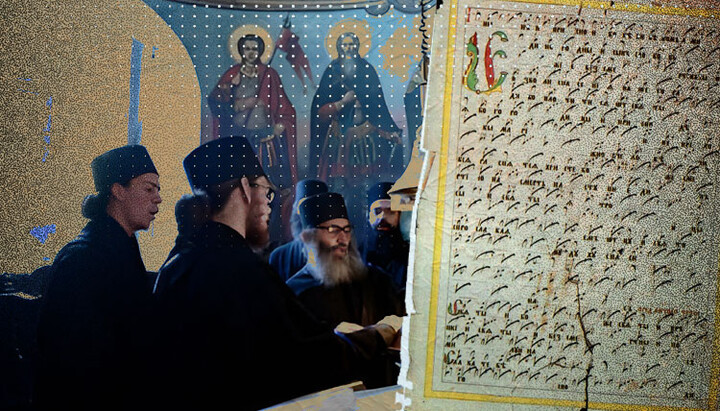
Znamenny Chant. Photo: UOJ
If you hear Znamenny chant for the first time – not on a recording, but live, in a small church where it is sung without microphones – the first reaction is almost always the same: something feels unfamiliar. There is no familiar support of polyphony, no warm bass foundation that catches you and carries you along. There is a single line. It moves steadily, almost without ornament, and makes no attempt to charm you. It simply bears the word.
Hooks instead of notes: a script that does not know how to lie
Znamenny chant has a distinctive system of notation, and that explains much about its nature. We are used to staff notation, which fixes the precise pitch of each sound, its duration, its place within the meter. Znamenny notation – hooks and signs – is built differently. It records not the sound itself, but movement: where the melody is going, how it turns, by what inward gesture it carries the word. A “hook” meant “the firm guarding of the mind from evil,” while a “little serpent” signified “the avoidance of earthly glory and the vanity of this world.”
This is not merely a mnemonic device. It is an entire system in which the sign of notation and the sign of a spiritual state are one and the same.
Vladimir Martynov, who devoted much of his scholarly life to Znamenny chant, argues that it is called Znamenny not only because it is written in signs, but because it itself is “a melodic sign indicating the presence of silent inner prayer.”
Why monophony is not poverty
It is precisely here that what at first seems like strange asceticism begins to open up. Znamenny chant is monophonic – for seven centuries in our Church, people sang in one voice, and this was a principled choice, not a technical limitation.
In that monophony, voices do not compete, do not display their timbres, do not split into parts. They move together, like people walking while looking in one direction.
St. Basil the Great wrote in his Homilies on the Psalms: “A psalm is the tranquility of souls, the giver of peace; it calms the tumultuous and agitated thoughts; it softens the irritability of the soul.” And then comes something that applies to Znamenny chant almost literally: “Psalmody bestows on us one of the greatest blessings – love – having devised communal singing as a bond of unity and bringing people together into one harmonious choir.” One harmonious choir – that is monophony. Not dreary, not poor, but something that arises when different voices cease pulling in different directions and begin to breathe together.
What happened in the seventeenth century
In the mid-seventeenth century, when the schism and Nikon’s reforms upended the fabric of Russian church life, church singing began to change along with the liturgical books. Partes polyphony entered the churches – Western in origin, concert-like in its inner logic. It knows how to astonish, envelop, and command attention. It can be deeply powerful and expressive. Znamenny chant did not disappear, however: in the Old Believer tradition it was preserved almost untouched, and in certain monasteries and churches it still lives today.
But in that very rupture lies something worth returning to. After listening with participants at one of his lectures to fragments of Znamenny chant, Martynov concluded that Znamenny chant “is not unused because it is imperfect, but because man cannot endure the ardor contained within it.” We have simply become spiritually weaker.
Singing as obedience
For us, accustomed to singing that embellishes prayer, Znamenny chant offers something else. It does not want to be liked – not because it does not care, but because that is not its task.
When a choir sings Znamenny chant, it is not performing a musical composition. It is reading prayer aloud.
Here the rhythm is not subject to meter, but follows the stress, the semantic breathing of the text. That is why this chant is almost impossible to hear superficially: it does not allow you to slip into that pleasant state of emotional impression which we sometimes mistake for prayer.
Read also
Facade of bones and facade of light
Antoni Gaudí spent forty-three years building a church in Barcelona, knowing that this construction was for the ages.
Trial of a dead pope
Once in Rome, the body of a deceased pope was seated on the throne and put on trial. The accusation relied on a church canon that had once saved his see.
Monastery built in defiance of king
When Orthodox believers in Minsk were left with just one church, townspeople decided to build another – and even a royal decree did not stop them.
Young Mother and Sleeping Christ
Michelangelo carved a Virgin Mary who looks younger than her Son – and signed his name in marble for the only time in his life. Neither of these peculiarities was accidental.
Orthodox books from a Uniate printing press
In the 18th century, Uniate monks at Pochaiv printed books used in prayer by Orthodox Christians and Old Believers alike.
The story of the honey brotherhood
The Mogilev Brotherhood began with members pooling money to brew honey drinks for feast days – and eventually grew to have its own printing press.