The desert where Mary of Egypt vanished
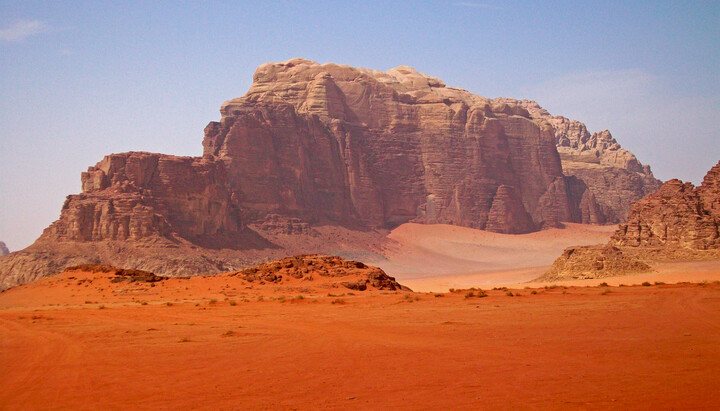
The Jordanian desert – the place of Saint Mary of Egypt’s feat. Photo: Wikipedia
Beyond the Jordan, another world begins. On the western bank, at Wadi al-Kharrar, the land is still alive: there is water, vegetation, and traces of human presence. But step eastward – and within two hundred meters the ground beneath your feet turns to white limestone, with not a single tree in sight. It was here that a woman once arrived carrying three loaves of bread – and never left this place again for forty-seven years.
Her name was Saint Mary of Egypt. Before her conversion, she had spent seventeen years in debauchery in Alexandria – and, by her own account, she took no payment for her sin, simply because she loved it. In Jerusalem, at the doors of the church where the Precious Cross of the Lord was kept, an invisible force barred her from entering three times. She prayed before the icon of the Most Holy Theotokos in the narthex – and a voice told her to go beyond the Jordan. She crossed the river at the very ford where the Lord Himself had once received Baptism, and entered the desert. This happened in the fifth century. From that day on, nothing was known of the ascetic for almost half a century.
A place not meant for life
The Transjordan plateau is not a desert of dunes and scattered oases. It is a stony limestone tableland, cut through by dry riverbeds – wadis that fill with water only after rare rains. In hollows between the rocks, a little moisture gathers after a storm – the only source of water here. At any other time, there is no water at all. As for food, there are only bitter roots and the occasional thorny plant clinging to cracks in the stone.
Mary entered this wilderness with three loaves. Within weeks, the bread had hardened into rusks, then crumbled into dust. After that, she could feed herself only on whatever grew beneath her feet.
By day, the stone surface heats up to forty-five or even fifty degrees Celsius. By night, that same plateau cools to four or five degrees, and in winter there are frosts. A body exhausted by the daytime blaze begins to shiver from cold before dawn. And so it was for thousands of days without relief.
Cloth does not survive in such conditions for more than two or three years – the sun and the wind devour it quickly, until it literally falls apart.
Mary’s clothing decayed and vanished. For decades, she remained completely naked.
This plateau is inhabited by yellow scorpions – tiny, nearly transparent creatures, yet among the most venomous in the world. The desert viper lives here too, burying itself in the ground where it is almost impossible to see. To sleep on the earth in these places is to risk, every single night, a bite that can kill within hours. Mary slept on that ground for forty-seven years.
What Zosimas saw after twenty days on the road
Abba Zosimas, from the monastery that stood near Wadi al-Kharrar, would go out into the Transjordan desert every Great Lent according to the monastery’s rule: the brethren scattered into the wilderness and returned by Pascha. On one such journey, after walking for twenty days, he saw a figure ahead of him. At first he thought it was a phantom. He crossed himself. Only then did he realize it was a human being.
Saint Sophronius of Jerusalem, who recorded this testimony in the seventh century, described what Zosimas saw as follows: “It was naked, black in body as though scorched by the burning heat of the sun; the hair on its head was white like wool, and not long, falling no lower than the neck.”
Human skin darkens and toughens under the naked sun after years of exposure – this is explained by dermatology, not only by hagiography. Hair is bleached white by the blaze.
Zosimas saw what nearly half a century beneath the open sky does to the human body. But he saw something else as well – that very body, which under such conditions should never have remained alive.
A human being without regular food or water, without clothing or shelter, in such a climate, should not survive even a few months. Medicine knows of cases in which the will to live held the body together longer than biology would allow – Viktor Frankl documented this in those who survived the concentration camps. But Saint Mary lived in the desert not for months, but for almost half a century. The Church calls this the providence of God – and there is no other explanation.
When Zosimas finally caught up with her – she had first run from him, ashamed of her nakedness – he threw her his cloak. Then she told the elder the whole story of her life. Zosimas listened in silence. And then he wept.
Seventeen years against the memory of her former life
Of the forty-seven years in the desert, the hardest were the first seventeen. Mary was not struggling with the climate or with hunger – she was struggling with memory. Alexandrian wine, meat, faces from her former life – all of it came back in the absolute silence of the wilderness with shocking force and relentless persistence.
Saint John Cassian the Roman, who in the fifth century systematized the spiritual experience of the Egyptian desert fathers, described this very law of the soul: when there is nothing outside to occupy the mind, former passions begin to sound with full force – because there is nothing left to drown them out. Cassian considered victory over them without a spiritual guide almost impossible. Mary had no such guide at all.
When the assault of thoughts became unbearable, the Life says, she would fall to the ground and pray. And then the image of the Most Holy Theotokos would appear before her – She Who had judged her.
After seventeen years of struggle, the thoughts withdrew. The remaining thirty years she lived in that peace which no one near her could see or measure – because there was no one near her. Until Zosimas came.
The weakness of Mary of Egypt was total and absolute – physical and spiritual at once. And the power that kept her in that desert was equally absolute.
Six centuries before her, Joshua had passed along that same bank with the people of Israel. Four centuries before her, the Lord had received Baptism there. The place at Wadi al-Kharrar had witnessed many crossings. Most travelers crossed over – and returned. But she did not return. The desert beyond the Jordan became the place of Saint Mary’s final passage into eternity, where neither cold nor blazing heat could hinder her from beholding the face of the Lord she had come to love.
Read also
Facade of bones and facade of light
Antoni Gaudí spent forty-three years building a church in Barcelona, knowing that this construction was for the ages.
Trial of a dead pope
Once in Rome, the body of a deceased pope was seated on the throne and put on trial. The accusation relied on a church canon that had once saved his see.
Monastery built in defiance of king
When Orthodox believers in Minsk were left with just one church, townspeople decided to build another – and even a royal decree did not stop them.
Young Mother and Sleeping Christ
Michelangelo carved a Virgin Mary who looks younger than her Son – and signed his name in marble for the only time in his life. Neither of these peculiarities was accidental.
Orthodox books from a Uniate printing press
In the 18th century, Uniate monks at Pochaiv printed books used in prayer by Orthodox Christians and Old Believers alike.
The story of the honey brotherhood
The Mogilev Brotherhood began with members pooling money to brew honey drinks for feast days – and eventually grew to have its own printing press.