UOC bishops initiate correspondence discussion around Filaret's personality
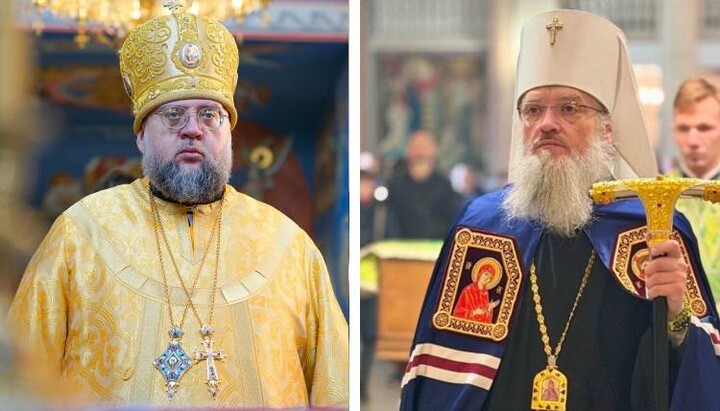
Archbishop Sylvester and Metropolitan Luke. Collage: UOJ
The death of Filaret Denysenko on March 20, 2026, provoked controversy within the Ukrainian Orthodox Church. The occasion was reflections by Archbishop Sylvester (Stoychev) of Bilohorodka, which he published on his social media page.
In his text, His Grace Sylvester, among other things, noted that in 1990–1991 Filaret "sensed that what is called a 'tectonic shift' had occurred and that the world would never be the same as before."
Metropolitan Luke (Kovalenko) of Zaporizhzhia perceived these words as an attempt to "legitimize the schism". In his opinion, "the high assessment of Denisenko's 'volitional qualities'" and his ability to "sense tectonic shifts" sounds like an apology for the sin of pride, a justification of personality cult against conciliar reason." The Metropolitan believes that "if Filaret's path is recognized as 'prophetic,' then the Council in Kharkiv in 1992 that deposed him is declared an error, and its participants are opponents of 'historical progress.' This leads to an absurd conclusion: the Church must repent before the schism for preserving canonical order."
Archbishop Sylvester did not leave the criticism unanswered. In his new publication he thoroughly analyzed Metropolitan Luke's arguments: "Anyone who wishes can reread my text and be convinced that in it I say nothing about the gift of 'prophecy' nor about the erroneousness of the Kharkiv Council's decisions."
According to His Grace Sylvester, the Zaporizhzhia hierarch uses a peculiar polemical method: "One gets the impression that Metropolitan Luke does not understand how the prophetic gift differs from natural intuition. He calmly substituted one concept for another and on this basis accused me of condemning the Kharkiv Council. In general, I am amazed by Metropolitan Luke's ability to first see in the text what is not there, and then on this basis boldly accuse me."
The sharpest passage was His Grace Sylvester's comment about Metropolitan Luke's "selectivity." The Bilohorodka hierarch stressed that the Council of the UOC – with the participation of bishops, clergy, monastics and laypeople – took place on May 27, 2022, at the Feofania Monastery in Kyiv, and its decisions are binding for all members of the Church. At the same time, the Archbishop noted, "Today we constantly hear outright insults directed at this Council, at its participants, at the decisions they have made, and even regarding the resumption of the holy chrism making."
Concluding his text, Archbishop Sylvester stated that he considers "discussions within the Church a normal and quite healthy phenomenon, which is a mandatory condition so that the conciliar mind of the Church is not replaced by personality cult, as His Grace Luke fears."
Earlier, the UOJ wrote that Zelensky commented on Filaret's death.
Read also
Khust Eparchy honors memory of St. Job of Uholka
A Liturgy is served in Mala Uholka, a birthplace of St. Job of Uholka, on the saint's feast day.
UOC parish in Cologne donates ultrasound machine to Kharkiv region hospital
In Cologne, UOC believers raised funds for an ultrasound machine for the Kehychivka district hospital in the Kharkiv region.
Shevchuk tells Pope Leo of Ukraine's preparations for "another harsh winter"
The head of the UGCC expressed "special gratitude" to the Pope for his phone calls with Putin and Zelensky.
Berlin hierarch comments on Phanar document published by UOJ-USA
Metropolitan Mark called the information about the 2018 "Unification Council" alarming if confirmed, and expressed hope that Patriarch Bartholomew will reconsider his position.
UOC marks Synaxis of All Saints of Volyn Land at Lutsk cathedral
Metropolitan Serhiy of Ternopil and Kremenets led the Liturgy on the feast day of the Lutsk cathedral of All Saints of the Volyn Land.
SBU detains OCU cleric who organized draft evader's escape for money
In Transcarpathia, law enforcement officers detained a clergyman of the OCU who arranged for a draft evader to be smuggled into Slovakia for $15,000.