The week of open gates: why the church walls seem to fall away at Pascha
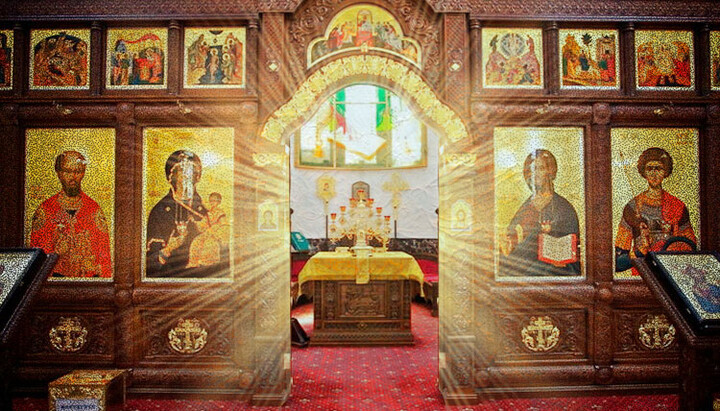
Open Royal Doors. Photo: UOJ
You step into the church these days – and something feels different at once. We grow used to everything, even to the very atmosphere of the храм. Over the long fast, the eye learns to rest against a wall. For weeks we stood before closed doors and a heavy curtain, and it seemed right. We needed that distance to become aware of our fallen state. The altar was hidden; we prayed without seeing what took place within.
And then – Bright Monday. The eye, out of habit, searches for support in the closed panels, but instead it simply falls through into emptiness. Where a wall once stood, there is now an unfamiliar, almost startling openness. You see the Holy Table. You see the priest covering the Chalice or bending low over the open Gospel. Everything that, all year long, was guarded from casual sight is suddenly laid bare. At once you understand: something in the world has changed. God no longer hides from us.
From a light barrier to a high wall
These tall icon-covered walls did not appear in our churches all at once. In the early centuries, everything was far simpler. The Christians of the first communities prayed before a low partition – the templon. It was more like a delicate lattice, through which every movement of the clergy could be seen. The community breathed together with the altar. The mystery of the Eucharist was shared.
The walls grew slowly, layer by layer. Century after century, new rows of icons were added, until by the fourteenth century the iconostasis had become a solid barrier. Behind it, almost everything disappeared.
In the memory of the Church there remains an understanding: we deserved this architecture. We found it too hard to endure holiness as a nearness that burns the soul.
We hid from the blinding presence of God behind gold and wood. Distance became our refuge – a way not to be blinded before our time. We ourselves built these walls, sensing that we were not yet capable of living in the vision of an open heaven.
In the Temple of Jerusalem, a vast and unimaginably heavy veil once hung. A dense curtain, beyond which only the high priest could pass, and only once a year. It was necessary, lest people simply perish before the greatness of the grace concealed there. And then, when Christ died, that curtain was torn. By itself. From top to bottom. As though an unseen hand had seized it and ripped it apart. That moment overturned everything. The old order – in which God was separated from humanity by rules and walls – came to an end. The way was opened. And now the doors that stand wide open all week are simply a reminder of that torn veil. There is no more division.
Seven days without boundaries
The Typikon during these seven days is strict and astonishingly beautiful: the doors are not closed. At all. They remain open even when not a single soul is in the church. The outer doors may be locked, but the inner gates stand open. No one looks into the altar in an empty church, no one sees the Holy Table – and yet the boundary between the divine and the human has already been removed.
In these days even the priest’s voice reaches the people without obstruction. We grow used to this spaciousness in just a few days, and by midweek it begins to feel as though it had always been so. The eye learns the depth, begins to notice the folds of the altar coverings, the dust motes dancing in the rays of light from the altar windows. We begin to breathe freely, deeply.
You pass by, you see the Chalice – and you understand: you are at home; you are no longer a stranger standing at the threshold of a great mystery. We are allowed to see everything.
This openness changes something within us. Suddenly it becomes clear: the Kingdom of Heaven is the Father’s house, where the doors have been torn from their hinges. And all that gilded carving of the iconostasis, which usually seems so imposing and permanent, during this week appears merely as a window frame for meeting God. We learn not to fear this closeness, to look into the face of Mystery without the old dread.
Bread at the threshold of the altar
Right before the open gates, all week long, stands the artos – the great Paschal bread. During Bright Week it reminds us of Christ’s presence among His disciples. It will be distributed to the faithful only on Bright Saturday, when the doors are finally closed. But for now it stands there, in the most visible place – precisely where our gaze used to stumble against the closed panels of the doors.
It is like someone who has come out to meet his guests and stopped in the doorway. Standing there, waiting, not going anywhere.
The presence of the artos here makes the openness of the altar almost tangible. God has come out to meet us, Himself reducing the distance to its very limit. We stand beside this bread and understand: eternity is now within arm’s reach.
By the end of the week, we become different. This growing accustomed to an open heaven does not pass without a trace. We begin to notice that the people around us, too, have somehow drawn closer, become more understandable. When there is no wall between you and the altar, the walls between you and your neighbor in the church also begin to crack. We all stand in one light, in one space, before one Chalice. And this unity in Christ is the most honest reality one can experience in these days.
When the Doors close again
On Saturday evening, the panels of the gates will slowly begin to come together. It is always a slightly sorrowful moment, as though a window we have only just learned to look through is being shut. Yet even in this closing there is truth. We still live in ordinary time. We are still on the way to Heaven. This brief contact with it was a divine foretaste. But we need time to learn how to live in such blinding light.
We will return to our daily routines, to the bustle, to our familiar concerns. The iconostasis will close again, and once more we will pray without seeing the altar. Yet within us there will remain forever this feeling: the wall is no more.
Closed doors in ordinary days are a confession of our own weakness. We need the reminder that we must still grow into the fullness of joy – that the path to the Kingdom requires effort and a long inner labor.
But we have already seen what lies beyond those doors. There is only light.
And now, even when the wooden panels meet again, we will know: it is only a temporary barrier. The veil has been torn forever. The Savior, in the form of the Bread of Life, stands at the threshold of the altar – and calls us to Himself.
Read also
Honest atheism vs. spiritual hypocrisy
The 70th anniversary of Albert Camus’s Nobel Prize recalls an uncompromising challenge to Christianity. An honest unbeliever brings theology back to the mystery of the Cross.
The valley of trouble and the gateway of hope
One soldier buried an expensive cloak and some gold beneath his tent. Because of this, all Israel lost a battle. Why did one man’s sin bring disaster upon an entire nation?
From love spells to bishop's throne
Antioch’s most powerful sorcerer sent demons against a devout young Christian woman three times – and failed every time. In the end, a demon himself revealed the truth that led to his conversion.
The Weeping Queen of Blachernae
On the night of the Feast of the Protection, only two people witnessed the miracle in the Church of Blachernae. Everyone else prayed and saw nothing. Yet they, too, received grace.
Deadly spiral of human hatred
The tragedy of Lebanon's civil war lays bare how dehumanization and fear can turn human beings into monsters.
Woe to expectant mothers – or to those of little faith?
God commanded one prophet not to have children, yet told his people in exile to bear sons and daughters. What does this apparent contradiction tell us today?