Logic of Love: how Myrrhbearers outpaced Apostles
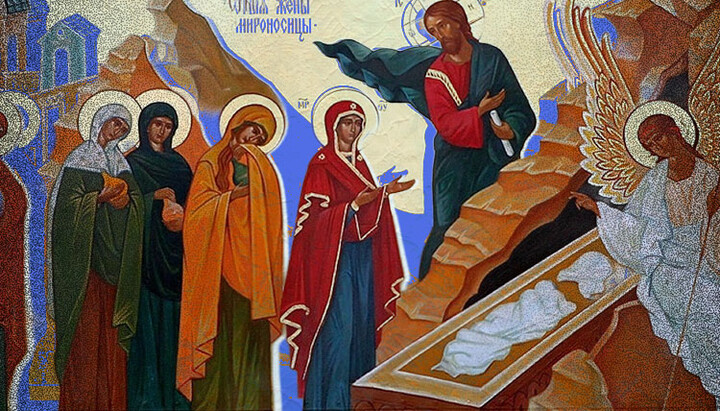
Holy Myrrh-bearing Women at the tomb of Christ. Photo: UOJ
There are questions in Church history that each new generation raises for itself. "What must I do to inherit the Kingdom of Heaven?", people have asked, and will probably ask themselves until the end of time, following the Gospel youth. There are also questions that arise in a given era, quite relevant at the time, but once they receive an answer, people lose interest in them.
Take, for example, the celebration of March 8. How many spears were broken, how many disputes! Today this is almost no longer relevant: the Sunday of the Myrrh-Bearing Women, faithful disciples of Christ, has put everything in its place. For us it has already become ordinary and familiar: church tradition calls us to dedicate the second Sunday after Pascha to the Myrrh-bearing Women. And this is just, though, in my opinion, partially: the very events of the Gospel narrative about the Resurrection are already a hymn to the triumph of feminine feelings over masculine logic.
Against common sense
If we type "feminine logic" in an internet search bar, we will get a huge portion of hate. From harmless caricatures and videos to vulgar jokes. Let's leave this to the conscience of the authors. I don't want to figure out whether this is composed out of a sense of revenge by offended men whose family life didn't quite work out, or by women wittily ready to laugh at themselves. This is unimportant. What's important for us is whether this has significance in relation to the chronology of Gospel events.
Let us imagine ourselves, if not as participants, then at least as observers of those events.
Night. More precisely, early morning of the first day of the week. The horizon to the east of Jerusalem is just beginning to be colored gray, the last stars are fading. In this gray twilight, barely distinguishable, stepping silently, several feminine figures are walking. They are heading toward the city gates, which the city guard is about to open at dawn: soon the first travelers and caravans will begin streaming into the city, for Passover is Passover, but trade goes on. The city lives its own life, and in this rhythm little has changed to this day.
And here is where the dialogue known from the Gospel takes place. The women reason among themselves: "Who will roll away the stone from the tomb for us?" About this stone, the evangelist Mark clarifies: "for it was very large." But it's not just about the stone. Modern man, calling his interlocutor to logical thinking, often uses the idiomatic appeal to "turn on your head." So, if the Myrrh-Bearing Women had then "turned on their heads," they would, in all likelihood, not have gone anywhere at all.
Judge for yourselves. The Apostle and Evangelist John the Theologian, describing Christ's burial, though performed in haste, draws our attention to an important detail: Nicodemus, the secret disciple, brought spices, a mixture of myrrh and aloes, with which they anointed the body of the deceased in those times. And, wrapping Him in a shroud, they laid Him in a new tomb. That's it. The ritual, though in haste, was observed. Is there any point in repeating it again?
Sanhedrin, custody, and love
Furthermore. Of the problems the women were to face, the stone was the least. There was also the guard, which had received clear instructions precisely about such zealots. And there was also the custody – a seal on this stone. To touch it without sanction from the high priest or members of the Sanhedrin is like tearing the seal from the door of a room under the control of investigative authorities. You wouldn't escape troubles and investigations afterward.
But they go. They quietly reason. They fear. But they go anyway. Yes, the Body is already in the tomb. Nothing can be changed. Yes, everything has already been done. But it was done WITHOUT THEM! And no one allowed them to mourn their beloved Teacher!
And here no logic works. Except the logic of love.
And Christ reveals Himself to them. To those who were always "in the background." Who prepared, washed dusty clothes, set the table and washed dishes but loved quietly and sincerely. And what was masculine logic doing at this time? Probably sleeping. An uneasy sleep "for fear of the Jews." The men had calculated and understood everything: they too would not be left in peace. They had to decide what to do next.
Apostles for the apostles
And then there was a knock at the door. Not careful and quiet, but such that was ready to tear the door off its hinges, a knock from which everything froze inside. But this was not the Roman or temple guard.
This was a woman. Mary. She whose love and devotion proved in God's eyes more important than logic. She who brought the Good News to the disciples, becoming for a moment an apostle for the apostles themselves.
And what about now? Nothing changes. According to the word of Saint Macarius the Great, "...both now Job is the same, and God is the same, and the devil is the same." Times of "Hosanna" are replaced by cries of "Crucify!" The present time is no exception. As a century ago, when yesterday's students of church parish schools tore crosses from temples and burned bonfires of icons, today those who were baptized in temples restored by their fathers' hands are ready to divide believers into the "right" and "wrong."
But even today in times of trials they continue to go to churches. Often under the contemptuous glances of their neighbors. Somewhere under shelling and the wail of sirens. But they go. They fear, but they go. They are today's disciples of Christ, whose lives don't make it into news chronicles. Those who today, as many years ago, contrary to logic and "common sense" continue to keep faithfulness to God.
Why? It's all simple: "Love... bears all things, never fails" (1 Cor. 13:7–8). Happy feast day, our dear sisters! Strength to you and fortitude of spirit from the Risen Christ the Life-Giver!
Read also
Honest atheism vs. spiritual hypocrisy
The 70th anniversary of Albert Camus’s Nobel Prize recalls an uncompromising challenge to Christianity. An honest unbeliever brings theology back to the mystery of the Cross.
The valley of trouble and the gateway of hope
One soldier buried an expensive cloak and some gold beneath his tent. Because of this, all Israel lost a battle. Why did one man’s sin bring disaster upon an entire nation?
From love spells to bishop's throne
Antioch’s most powerful sorcerer sent demons against a devout young Christian woman three times – and failed every time. In the end, a demon himself revealed the truth that led to his conversion.
The Weeping Queen of Blachernae
On the night of the Feast of the Protection, only two people witnessed the miracle in the Church of Blachernae. Everyone else prayed and saw nothing. Yet they, too, received grace.
Deadly spiral of human hatred
The tragedy of Lebanon's civil war lays bare how dehumanization and fear can turn human beings into monsters.
Woe to expectant mothers – or to those of little faith?
God commanded one prophet not to have children, yet told his people in exile to bear sons and daughters. What does this apparent contradiction tell us today?