The God Who walked into suffering and pain
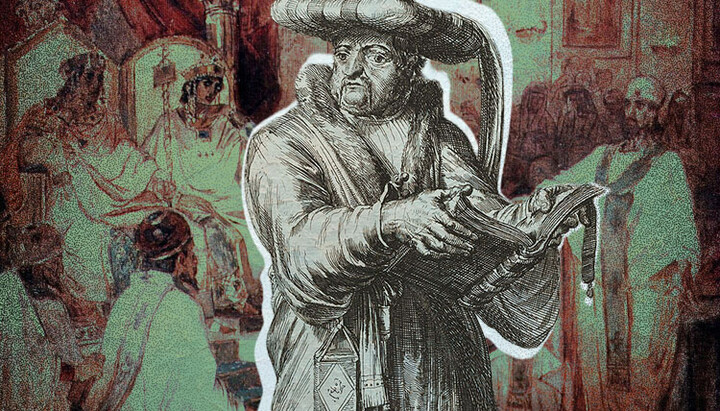
Archimandrite Eutyches – ideologist of Monophysitism. Photo: UOJ
At the end of a punishing day, when your legs throb and your vision dims with exhaustion, the idea of an all-powerful Creator can feel distant, almost alien. A gulf opens between the fragile human body – aching, breathless, finite – and a being beyond time, untouched by limitation. In fifth-century Constantinople, that very tension spilled into the streets, igniting a conflict that drew in both Church and empire with full force.
At the center stood Archimandrite Eutyches, a powerful monk of Constantinople, revered at court and respected as an ascetic beyond reproach. His reasoning was driven by a single concern – to shield the dignity of the divine from any contact with human weakness. He proposed that, after the Incarnation, Christ’s human nature was wholly absorbed into the divine, like a drop of honey dissolving without a trace in the vastness of the ocean.
To the mind of the age, this seemed almost self-evident.
Ancient philosophy insisted that the Absolute must remain untouched, impassible. To imagine the Creator of the universe growing hungry, sweating along the dusty roads of Palestine, or weeping in helplessness – this felt like a violation of cosmic order. Eutyches’ teaching, later called Monophysitism, offered a safer vision: God passes through human history, yet remains invulnerable.
But the dispute did not remain confined to quiet study halls. In 449, the Monophysite party gained a temporary victory at what would later be called the “Robber Council” of Ephesus, forcing their position through political pressure and even violence. Yet the Church’s conscience recognized in this teaching a threat to the very heart of Christianity.
One of the decisive blows against Eutyches’ ideas came from the Bishop of Rome, Leo I, whose famous Tome did not dwell in abstractions but returned to the stubborn, concrete reality of the Gospel. Leo the Great carefully laid out the evidence – not theories, but events – revealing the unconfused presence of two natures in Christ.
The Gospel against the heresy
The New Testament leaves no room for the notion of “dissolution.”
The infant cries from the cold in Bethlehem – this is the physiology of a human being. The Magi fall to their knees before Him – this is the recognition of God. In a storm on the Sea of Galilee, the exhausted traveler falls asleep in the stern of the boat, worn down by preaching and the press of crowds. Yet when He is awakened, He rebukes the wind – and the storm obeys.
The divine does not replace human weakness. It acts within it.
The decisive moment in this struggle unfolds in the Garden of Gethsemane. If Christ’s humanity had truly been swallowed up by divinity, as Eutyches claimed, then the agony before His arrest becomes mere theater – a performance staged by the Absolute for the benefit of future generations.
But the Gospel of Luke refuses such a reading: “And being in agony, He prayed more earnestly; and His sweat became like drops of blood falling to the ground” (Luke 22:44).
Modern medicine recognizes in this description a condition known as hematidrosis – a rare phenomenon in which extreme stress causes capillaries to rupture, mingling blood with sweat. We cannot diagnose the first century from a distance. Yet the image itself speaks unmistakably: this is not staged fear. This is the extremity of human anguish, the edge of death.
That night, the anesthesia of divine omnipotence did not intervene.
Only what is assumed can be healed
The Church’s resistance to Monophysitism was not stubbornness – it was necessity. Decades earlier, St. Gregory the Theologian had formulated a principle that would become foundational at the Council of Chalcedon: “What is not assumed is not healed; but what is united with God is saved.”
If God did not take upon Himself the capacity for fear, then human fear remains unredeemed. If He did not pass through real suffering, then the frailty of the body is left untouched by healing.
The Apostle Paul expresses this with striking clarity: “For we do not have a High Priest who is unable to sympathize with our weaknesses, but One who in every respect has been tempted as we are, yet without sin” (Hebrews 4:15).
“Tempted” here does not mean distant observation. It means passage through the full weight of human experience.
After the Resurrection, when Christ appears to the Apostle Thomas, the One who has conquered death still bears wounds. The marks of nails remain. The pierced side is not erased. Divinity does not erase human suffering – it carries it into eternity.
The Council of Chalcedon in 451 sealed this truth, condemning the teaching of Eutyches and affirming the doctrine of two natures. It was not merely a definition – it was a declaration: suffering has entered the very biography of God.
And for the person sitting in silence after a long and exhausting day, this means something disarmingly concrete. The One toward whom their thoughts turn is not distant. He knows what pain is.
God Himself walked on blistered feet over rough stones, and in the darkness of that final night, He asked that the cup might pass from Him – and in doing so, He confirmed the reality of every moment He lived.
Read also
Trial of a dead pope
Once in Rome, the body of a deceased pope was seated on the throne and put on trial. The accusation relied on a church canon that had once saved his see.
Monastery built in defiance of king
When Orthodox believers in Minsk were left with just one church, townspeople decided to build another – and even a royal decree did not stop them.
Young Mother and Sleeping Christ
Michelangelo carved a Virgin Mary who looks younger than her Son – and signed his name in marble for the only time in his life. Neither of these peculiarities was accidental.
Orthodox books from a Uniate printing press
In the 18th century, Uniate monks at Pochaiv printed books used in prayer by Orthodox Christians and Old Believers alike.
The story of the honey brotherhood
The Mogilev Brotherhood began with members pooling money to brew honey drinks for feast days – and eventually grew to have its own printing press.
Golgotha in the midst of a pogrom
In the autumn of 1938, the Jewish artist Marc Chagall painted the crucified Christ. Synagogues burn and refugees flee around the cross, while the Crucified One Himself is wrapped in a prayer shawl.