What is the essence of Christian spiritual feat?
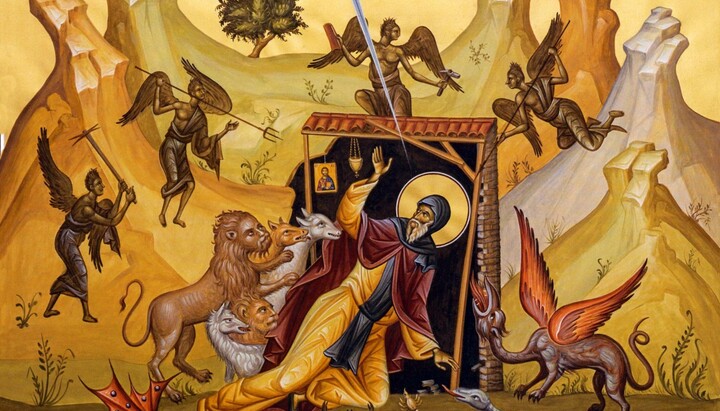
Saint Anthony the Great fighting against demons. Photo: pravlife
The word "feat" in modern language is often understood too narrowly – as something heroic, associated with risk to life. But in Orthodoxy this concept is much broader and deeper.
It must be said immediately that the word "feat" comes from the verb "to move," and from here also comes "to struggle." That is, a feat is not simply a one-time heroic act, but a constant movement of the soul toward God, compelling oneself to good. The Lord Himself said: "The kingdom of heaven suffers violence, and the violent take it by force." This effort, this compelling of oneself is the foundation of every feat.
The Holy Fathers distinguish several types of feats, and it is worth speaking about them in detail.
First, this is the feat of martyrdom. This is the highest and most obvious feat, when a person is ready to give his very life for faithfulness to Christ. In the first centuries of Christianity this was an everyday reality, and therefore the Church itself stands on the blood of martyrs. But even in our time martyrs have not disappeared. The twentieth century gave our Church an enormous host of new martyrs who suffered during the years of persecution. And today in different countries of the world Christians continue to suffer for their faith.
Second, this is the feat of confession. Confessors are those who openly witnessed about Christ before persecutors, endured sufferings, prisons, exiles, but were not killed. In essence, this is the same martyrdom, only not unto death. And in our time such a feat is also possible when a person, for example, at work or in society openly speaks about his faith, even knowing that this will bring him troubles.
Third, this is the feat of monasticism or monastic life. The venerable are those who became like Christ through renunciation of the world, through life in fasting, prayer, obedience. Monasticism is also called "bloodless martyrdom," because a monk daily dies to the world, to his own will, and to his passions. This is a special path to which not all are called, but which is very important for the entire Church.
Fourth, there is the feat of foolishness for Christ's sake. This is a very rare path, when a person intentionally takes upon himself the appearance of madness in order to hide his virtues from human praise and to denounce the vices of society. Such were the blessed Basil and Xenia, Andrew the Fool, and many others. This is a path not for imitation but rather for reverent wonder, because it requires special divine election.
Fifth, this is the hierarchical feat – the feat of bishops and pastors who bear the burden of responsibility for their flock, preach, defend the faith from heresies, care for the salvation of many souls. Saint Nicholas of Myra, John Chrysostom, Gregory the Theologian – these are examples of this feat.
Sixth, there is the feat of righteousness in the world. This is the feat of those who did not go to a monastery, did not receive a martyr's crown, but in ordinary worldly life managed to preserve purity of soul, faithfulness to God, and love for neighbors. The righteous Joachim and Anna, the righteous John of Kronstadt – all of them show that holiness is possible both in family, and in service, and in ordinary everyday concerns.
But these are, so to speak, the great types of feats that are noted in church tradition. And if we speak about the daily life of a Christian, then it too should all be a feat even if small and unnoticed.
What are these feats? This is, first of all, the feat of prayer when a person forces himself to pray, especially when he doesn't want to, when it's cold in his heart, when he's lazy.
This is the feat of fasting not only in relation to food, but also in relation to tongue, eyes, thoughts. This is the feat of patience when we endure offenses, illnesses, and sorrows, without murmuring against God.
This is the feat of obedience to God's will, to a spiritual father, to parents, in that which is not contrary to faith. This is the feat of mercy when we share with those in need, visit the sick, and comfort the sorrowful.
Saint Ambrose of Optina said that the entire life of a Christian is a struggle, and whoever does not struggle is not saved. And in this struggle what is important is constancy, faithfulness, and readiness to rise after falls and go again.
And one more thing. A feat by itself does not save. One can fast much, pray much, labor much and at the same time perish if there is no humility and love at the foundation. The Holy Fathers warned about this many times. A feat is only a means, an instrument by which a person purifies his heart. And the goal is the acquisition of the grace of the Holy Spirit, and union with God. Therefore every feat must have humility at its foundation, because if it is not there, then the feat will turn into pharisaism.
Finally, one should not assign oneself some great feats. The Holy Fathers strictly warn about the danger of self-willed asceticism, especially without blessing and without discernment. Better is small doing with discernment than great without discernment. The Lord looks not at the magnitude of the feat but at the heart.
Read also
Love is stronger than death
The loss of a loved one leaves a deep wound, but the Christian faith emphasizes the eternal nature of love. A conversation about the spiritual bond between spouses beyond the threshold of earthly life.
The true compass of the Christian life
St. Anthony the Great called discernment the highest virtue. The experience of the Desert Fathers shows that the path to spiritual sobriety lies through humility, seeking counsel, and overcoming the passions.
What is the essence of Christian spiritual feat?
Archpriest Vasily Kucher reflects on modern asceticism.
How can one find their purpose in life?
Archpriest Vasiliy Kucher addresses the question of life’s purpose and God-given calling.
“Let God arise”: Why do we speak of a past event as though it were future?
Archpriest Vasyl Kucher explains the linguistic and theological features of the well-known prayer.
How to cope with the loss of a spiritual father?
The departure of a spiritual guide is an enormous trial. Archpriest Vadym Gladky on how to cope with the loss of a spiritual father and why this event is a step toward spiritual maturity.