Israel’s Yad Vashem head added to Myrotvorets for criticizing OUN-M leader
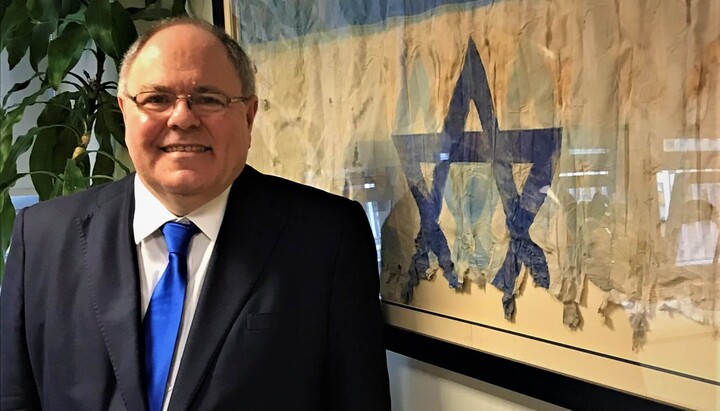
Dani Dayan. Photo: itongadol
Dani Dayan, chairman of the directorate of Israel’s state Holocaust memorial complex Yad Vashem, has been added to the database of the Ukrainian extremist website Myrotvorets. The site’s authors accuse him of “deliberate, systematic actions aimed at inciting interethnic and interstate hostility between Israel and Ukraine,” as well as “humanitarian aggression against Ukraine” and “information provocations.”
The reason for his inclusion in the database was the reaction of Yad Vashem and Israel’s Foreign Ministry to the state ceremony for the reburial of the remains of Andriy Melnyk, leader of the Organization of Ukrainian Nationalists (Melnyk faction), held on May 25, 2026, in Kyiv Region in the presence of Ukraine’s top leadership. In his speech, President Zelensky called Melnyk a “hero.” A litiya before the burial was served by OCU spokesman Ivan (Yevstratiy) Zoria, along with UGCC clerics.
“Honoring the leader of a movement that supported and collaborated with Nazi Germany during the persecution and murder of millions of Jews undermines the moral foundations necessary for preserving the memory of the Holocaust. Yad Vashem is deeply concerned by such state commemorative events, carried out at the expense of historical truth and the memory of the victims of the Holocaust,” Yad Vashem said in its response.
Israel’s Foreign Ministry also issued an official statement expressing regret over the decision to hold a state ceremony and calling Melnyk a Nazi collaborator: “There is no place for ignoring historical truth and the memory of the victims murdered by the Nazis and their collaborators.”
In response to criticism from Jerusalem, current OUN head Bohdan Chervak called the Israeli Foreign Ministry’s statement an “outright provocation” and accused the ministry of “playing along with Russian propaganda.” According to him, Israel’s statements “have nothing to do with historical truth.”
“The Myrotvorets Center asks law enforcement agencies to regard this publication on the website as a statement about this citizen’s deliberate acts against Ukraine’s national security, peace, the security of humanity and the international legal order, as well as other offenses,” the publication says.
Myrotvorets is a Ukrainian website created in 2014 to identify and publish the personal data of individuals allegedly threatening Ukraine’s national security. It publishes personal information, including addresses and phone numbers. Journalists, artists, politicians, and public figures from various countries have appeared in the Myrotvorets databases. Notably, Ukrainian rabbis and Jewish organizations inside Ukraine have not commented on the reburial of the OUN-M leader.
Earlier, the UOJ reported that the remains of OUN-M leader Melnyk were brought to the UGCC cathedral in Kyiv.
Read also
Upper Lavra court hearing postponed
The next court hearing in the Upper Lavra case has been scheduled for November 3.
UOC priest blesses ambulances at Kamianske medical center
A UOC priest in Kamianske blessed ambulances for a medical facility and wished its doctors God's help in their work.
Dumenko to German ambassador: Law targeting UOC also applies to other groups
Epifaniy Dumenko sought to defend Ukraine’s law restricting religious organizations during a meeting with the German ambassador.
Activists bused to court hearings in UOC cases, media say
A minibus has been spotted transporting protesters to and from courthouses where UOC cases are being heard.
Firefighters save historic UOC church from fire in Zakarpattia
A fire broke out at a UOC church in the Tiachiv district, damaging the altar and church furnishings.
Volyn Eparchy faithful collect six tons of aid for Sviatohirsk Lavra
Believers in Volyn collected food and warm clothing for people displaced by the war who have found shelter at Sviatohirsk Lavra.