How the UOC Council in Feofania was turned into a “lawless gathering”
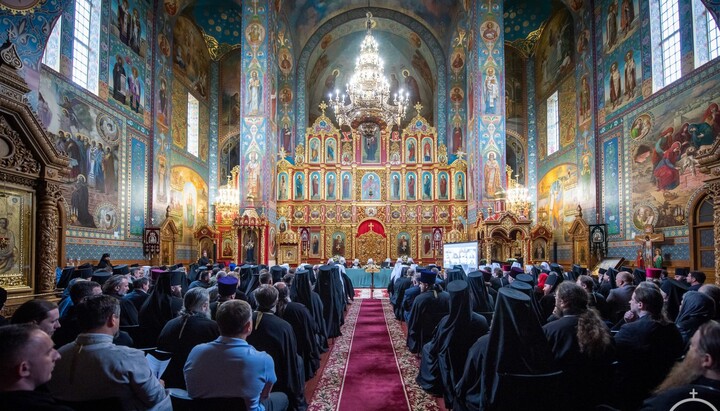
Council in Feofania. Photo: UOC
The anniversary of the UOC Council in Feofania was marked on May 27, and, as expected, it triggered another wave of criticism from a number of ROC clerics and several Telegram channels. One of the most common accusations is that the Council was convened in violation of the Church’s Statute. Critics claim that delegates should have been elected separately, whereas the gathering in Feofania was originally called as an ordinary meeting that supposedly had no authority to make conciliar decisions. From this comes the familiar conclusion: if the Statute was violated, then there was no Council at all, its resolutions are worthless, and what took place in Feofania was nothing more than a “lawless gathering.”
But is that really true?
A closer look at the facts tells a very different story.
The Statute of the UOC does not prescribe a specific procedure for electing delegates to a Council. It merely states that a Council is convened by the Primate, while the procedure itself is determined by the Holy Synod. Thus, when the meeting of bishops, clergy, and laity discussing current Church affairs concluded on May 27, 2022, Metropolitan Onuphry proposed that a Council be held immediately, on that very day.
“When His Beatitude put the matter to a vote and all the bishops and all the participants approved it, they thereby testified that those present became delegates of the Council of the UOC.”
The next step was equally important. In accordance with the UOC Statute (Section II, Paragraph 4), the Holy Synod met and approved that decision. In other words, everything that took place on May 27, 2022, followed the Statute: the Primate convened the Council, the Synod approved the procedure for selecting delegates, the Council of Bishops approved the agenda for the Local Council, and finally the Council itself was held.
Could things have been done differently?
Of course.
In peacetime, the meeting could have been dissolved, the Synod convened a month or two later, and delegates summoned again at a later date specifically for a Council. But everyone remembers what those days were like. These were the first months of the war. Church seizures were already spreading across the country. A full-scale media campaign against the Church was gathering momentum. Under such circumstances, many delegates might simply have been unable to travel to Kyiv a second time.
This is precisely why, as Metropolitan Viktor emphasizes, “in many dioceses, delegates to the assembly were selected as though they were expected to participate in a Council afterward.” Even where this was not formally the case, it is obvious that separate “conciliar elections” would almost certainly have produced the very same delegates. The simple reason is that the number of active clergy and committed laypeople in most dioceses is limited, and the same people who shoulder Church responsibilities today would have been entrusted with them then.
Which brings us to an uncomfortable conclusion.
The barrage of insults directed at the Council – claims that it was a “gathering,” “filth,” “foam,” or some other illegitimate assembly – has little to do with canonical law or factual analysis. Such rhetoric is driven not by evidence but by emotion.
And this raises an entirely legitimate question.
What is the purpose of all this?
Will endless accusations and inflammatory labels make the UOC stronger? Will they help the Church remain united under pressure from the state and the OCU? Will they strengthen the faithful at a time when the Church faces some of the greatest challenges in its modern history?
Or is the goal something altogether different?
The answer seems self-evident.
But let each reader answer that question for themselves.
Read also
Who destroyed and restored Kyiv Lavra? MinCulture's video reveals the truth
The Culture Ministry’s propaganda about the Kyiv-Pechersk Lavra has inadvertently revealed the truth.
Ternopil post on Feast of Intercession: Has calendar reformn failed?
A significant number of believers have rejected the new church calendar introduced by the OCU and UGCC with government support.
Shoulder straps or a cassock: who writes the script for UOC "fighters"?
Everything indicates that both Veliar and Pshenychny are ordinary performers of someone else's script. There is only one question – does the scriptwriter wear shoulder straps or a cassock?
Why is it legal to kill a person before birth but not after?
Children are the most privileged members of society. Yet that same society officially permits children to be killed – and on a massive scale.
Honoring the Bolsheviks’ successors at Kyiv Lavra
It was under the Reserve that the relics of the saints were desecrated, Lavra churches were turned into an atheism museum, and toilets were installed in sanctuaries.
"Degenerates" and "stupid animals": anti-UOC activists turn on children
Future historians will wonder how a vast country’s information agenda could have been shaped for so long by people so petty, vicious, and utterly contemptible.