One letter won’t settle the debate over Saint Ilya Muromets
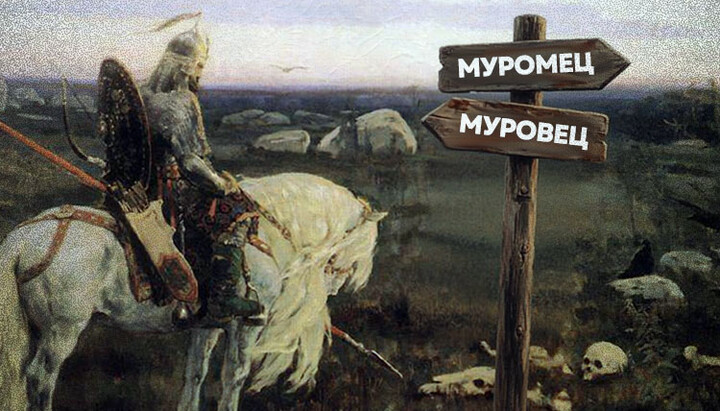
Knight at the Crossroads. Photo: UOJ
The old inscription, “Ilya Muromets” had been replaced with “Illia Murovets” – substituting a single letter. The idea behind the change was straightforward: to detach the saint from the city of Murom and instead connect him to Morovsk city in the Chernihiv region.
With that one administrative gesture, its authors hoped to resolve a centuries-old dispute over the monk’s origins. Supporters of the Chernihiv version hailed it as a restoration of historical justice.
Let us set aside, for the moment, the question of who is right. Instead, let us look at what can actually be said about the man whose relics rest in that niche.
What the 1988 examination revealed
Venerable Ilya is known from more than epic legends alone.
In 1988, his relics were examined by an interdepartmental commission of the Ministry of Health of the Ukrainian SSR. The work lasted nearly three years and involved specialists from the Kyiv Medical Institute – forensic experts, radiologists, and physicians from several disciplines. The results painted an unexpectedly detailed portrait.
The man in the shrine was exceptionally tall for his era, standing about 177 centimeters (5 feet 10 inches) when the average height in Kyivan Rus was little more than 150 centimeters. His skeleton bore evidence of a severe spinal condition suffered in youth – one capable of depriving a person of the ability to walk for years.
There were also healed fractures of the ribs and clavicle, a penetrating wound to the left arm, and a fatal chest wound caused by a sharp weapon, most likely a spear. That wound appears to have ended his life. The evidence suggests that he raised his arm to shield his chest and that the blow pierced straight through his hand.
This is no longer the portrait of a fairy-tale strongman. It is the portrait of a professional warrior who lived a hard and dangerous life and took monastic vows near its end.
What the epic tales describe as “thirty-three years on the stove” appears in the examination report as a debilitating illness that may indeed have confined him to bed for many years. Such a convergence between legend and anatomy is rare in hagiography.
Ilya was glorified among the saints in 1643, together with the other ascetics of the Lavra – long before physicians began analyzing his life and physique.
Witnesses tell different stories
The question of the saint’s origins, however, remains far murkier than either side would like.
The documentary trail is brief and contradictory.
In May 1594, the diplomat Erich Lassota von Steblau, ambassador of the Holy Roman Emperor, passed through Kyiv. In his diary he described the caves and mentioned two different heroes: Ilya Muromets, whose tomb he saw in a chapel of Saint Sophia Cathedral, and a giant nicknamed Chobotok, whom he encountered separately in the caves.
To Lassota, these were two different people.
More than forty years later, in 1638, the Lavra monk Athanasius Kalnofoysky published his Teraturgima, a description of the monastery’s caves and miracles. A meticulous observer, he did not simply accept popular tales about a gigantic warrior. He personally descended into the caves and measured the tomb in an effort to separate legend from fact.
It was Kalnofoysky who merged the two figures into one. He identified the cave-dwelling giant as Ilya, equated him with Chobotok, and estimated the date of his death at around 1188.
According to tradition, the nickname Chobotok (“Little Boot”) originated from an encounter in which the warrior, caught while putting on his footwear, fought off attackers using nothing but a boot.
The forms of his name also shifted from source to source: “Muromets,” “Murovlin,” “from Murom.” Whether these references preserve a memory of Murom or of Morovsk is impossible to determine with certainty.
Historians have debated the issue for generations. Replacing a letter on a museum plaque does not end that debate. It merely elevates one interpretation to official status.
A hand formed in the sign of three fingers
There is another detail preserved in the relics – one that survived controversies far greater than the current dispute.
The saint’s right hand is folded in the three-fingered gesture used for making the sign of the Cross.
Pilgrims have noted this feature for centuries. One visitor to the caves in the sixteenth century recorded seeing the incorrupt body of a large warrior beneath a golden covering, his left hand pierced by a spear and his right hand arranged for the sign of the Cross. Later travelers described the same position.
During disputes with the Old Believers over the proper manner of crossing oneself, this hand was repeatedly cited as tangible evidence. It became an argument more persuasive than many theological treatises.
Curiously, even then the relics were drawn into the polemics of the day. People wanted the deceased monk to validate positions that mattered to the ambitions of the living.
What one letter cannot decide
This is where an important line must be drawn.
Scientific examination can determine a saint’s height, the nature of his wounds, and the cause of his death. Historical sources can tell us that one traveler saw two heroes while another identified them as one.
What neither science nor history can establish is the saint’s national identity.
After all, no one seriously asks which modern state Saint George the Great Martyr belonged to, or under whose jurisdiction Saint Nicholas the Wonderworker was born. They belong to the Church, and national borders have little relevance to that reality.
Venerable Ilya was a warrior and a monk long before countries with their present names existed.
Our lands have witnessed princely feuds, nomadic invasions, hetmans, empires, and atheist commissars armed with their decrees. Each sought to leave a mark and reshape the history of the Lavra according to contemporary needs.
Most of those figures are now little more than a line in a history textbook.
But Venerable Ilya remains where he has always been – resting in his cool niche, his fingers still formed in the three-fingered sign. The inscription beside him has been changed before, and it will probably be changed again.
The measure of his sanctity, however, remains untouched by any nameplate.
Read also
Golgotha in the midst of a pogrom
In the autumn of 1938, the Jewish artist Marc Chagall painted the crucified Christ. Synagogues burn and refugees flee around the cross, while the Crucified One Himself is wrapped in a prayer shawl.
Stories of the Early Church. Level of governance: patriarch
How did several episcopal sees rise above the rest, why did the Church’s administrative map come to mirror that of the empire, and is the patriarchate a sacred form of Church governance?
A Chronicle without an author
We are accustomed to calling The Tale of Bygone Years the work of St. Nestor. Yet another monk left his signature on it, while the chronicle itself passed from one generation of scribes to the next.
How a wedding stopped a war
The young princess of Slutsk was married off to keep two powerful noble families from drowning the city in blood. Soon afterward, a Uniate metropolitan complained that Orthodoxy had been reborn in Slutsk.
Man before the forces of nature
A solitary figure on the shore seems insignificant before the immense power of the sea, yet it is he who stands before the Creator.
The mysteries of Golgotha in the light of archaeology
The veil of centuries obscures what really happened in the fourth century. Archaeology and ancient texts shed light on the true history of one of Christianity’s greatest sacred sites.