What remains of Bulgakov on Andriivskyi Descent?
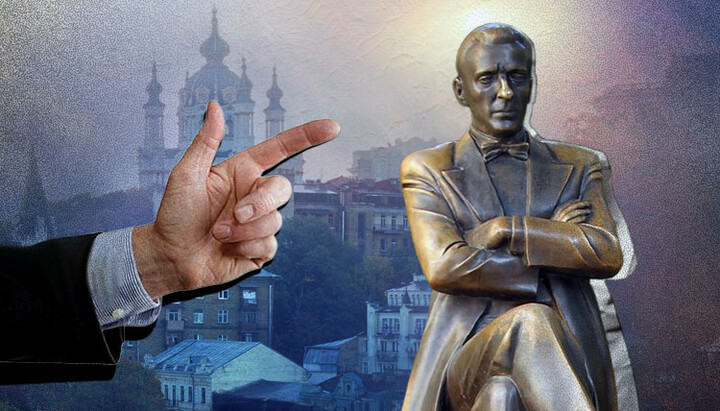
A monument to Mikhail Bulgakov in Kyiv. Photo: UOJ
It's pleasant to walk along Andriivskyi Descent (Saint Andrew's Descent) late in the evening, when the daytime heat subsides and Podil slowly plunges into twilight. Away from the noisy central streets, time feels different altogether. The Descent lives its own secluded life, with its own sounds, its own air mixed with the scent of blooming linden trees and the coolness drifting from the Dnieper.
Recently, the bronze figure of writer Mikhail Bulgakov was dismantled near house number thirteen. All that remains on the granite pedestal are chips left by crowbars and several deep scratches in the stone. This empty patch of ground now involuntarily catches the eye of everyone who passes by. Previously, someone would always linger here, take photographs, place flowers on the bronze knees of the writer, but now passersby simply look at the vacant spot and walk on.
Today it is difficult to surprise us with the demolition of monuments to politicians and cultural figures, just as with street renamings. But here, on the steep Kyiv hillside, the desolation feels particularly acute. Those who gave the order to demolish the monument forget one thing: Bulgakov's personality cannot be completely removed from Kyiv history because he himself largely created the image of the city we know.
The roots of the Kyiv text
In literary studies, there has long existed the concept "Kyiv text". It was once substantiated by scholar Vladimir Toporov, and later thoroughly researched by Kyiv philologist Myron Petrovsky. The essence of this phenomenon is that Kyiv possesses such an expressive appearance that its hills and streets merge into a single living organism. And Mikhail Bulgakov became the principal creator of this image in the literature of the last century. In his books, the City is always written with a capital letter, because it appears to the reader as an eternal city, as a place where earthly history intersects with eternity.
To understand where the writer’s deep perception of his homeland came from, one needs to look into the history of his family and the atmosphere in which he was raised. Mikhail grew up in the family of Afanasy Ivanovich Bulgakov, a professor at the Kyiv Theological Academy. This was the intellectual elite of that time. Inhabitants of the house on Andriivskyi Descent used to hold serious theological disputes, discuss biblical meanings, read ancient texts, and await the end of times, sensing the approaching catastrophes of the new century. The head of the family was known as a high intellectual, a Church historian who professionally translated the most complex Latin works of Saint Augustine and Jerome of Stridon.
The future writer absorbed these ideas from early childhood. Christianity was not a set of formal rituals for him. It became the mirror through which he later looked at the revolution and the collapse of the familiar world.
His main Kyiv novel "The White Guard" opens with an epigraph from the Revelation of John the Theologian about the judgment of the dead. For Mikhail Bulgakov, the Civil War was not merely a change of governments or a struggle between political factions – it was a small apocalypse.. And the Turbin house, with its cream-colored curtains, old books and a lamp, becomes an ark amid universal chaos. The writer transforms an ordinary Kyiv house into a shelter where remnants of humanity are preserved while the rest of the world goes mad.
When medicine is powerless
In the middle of the novel there is a scene that completely breaks the stereotypes of secular literature of that time. Alexei Turbin is dying of typhus. The doctors have already given up, declaring the powerlessness of medicine and directly telling the family that there is no hope, that the agony has begun, and the man has only hours to live. At this moment his sister Elena locks herself in the bedroom, falls to her knees before an ancient icon of the Mother of God and begins to pray.
In this fervent appeal to God, there was a cry from the soul of a person from whom the turning of epochs had taken everything: first the mother, now the brother, and around them the very way of life was collapsing every day. Bulgakov describes this moment without sentimentality, recording every movement of the praying woman’s inner life.
"Mother-Intercessor... Entreat Your Son, entreat the Lord God to send a miracle," Elena appeals. And death retreats. The next morning at the patient's bedside, doctors note with surprise that the temperature is dropping and life is returning to the cooling body. Mikhail Bulgakov, himself a former physician who perfectly understood the nature of typhus, leaves direct testimony of a miracle at the very center of his text. He, having grown up in an academic church environment, knew that there are moments when human strength and knowledge end, giving way to Divine Providence.
Recipe for survival within chaos
Today's Kyiv resident lives in the same blizzard as the heroes of Bulgakov's novel a hundred years ago. The times have coincided with frightening precision. Again there is anxiety outside the windows, again people are trying to save their families and frantically seeking answers to difficult questions. It seems that the world has gone mad, and familiar life is breaking under the weight of circumstances.
The empty pedestal on Andriivskyi Descent remarkably becomes a monument to our era.
This era has learned to quickly destroy the remnants of the past, remove monuments, and change signs, but it is not yet capable of creating texts and meanings of the same compelling power. Attempts to judge the great writer by the laws of contemporary political ideas always look petty. Culture always outgrows the slogans of its time, because it speaks of the eternal, of the fragility of the human soul, and not of party interests. Mikhail Bulgakov left us a reminder of how a person tries to remain human amid catastrophe.
The fresh chips on the granite pedestal now evoke rather a quiet sadness.
The City will remember Bulgakov better anyway than the officials who included the writer's monument in the demolition lists. His intonations, his heroes, and his descriptions of Kyiv streets have long become part of the city's landscape.
The only way to survive this historical blizzard has not changed in a hundred years. One must draw the curtains, protect one's inner world, preserve warmth in the house and pray for those who are dear to us. And the memory of cultural roots will always remain with us.
Read also
Golgotha in the midst of a pogrom
In the autumn of 1938, the Jewish artist Marc Chagall painted the crucified Christ. Synagogues burn and refugees flee around the cross, while the Crucified One Himself is wrapped in a prayer shawl.
Stories of the Early Church. Level of governance: patriarch
How did several episcopal sees rise above the rest, why did the Church’s administrative map come to mirror that of the empire, and is the patriarchate a sacred form of Church governance?
A Chronicle without an author
We are accustomed to calling The Tale of Bygone Years the work of St. Nestor. Yet another monk left his signature on it, while the chronicle itself passed from one generation of scribes to the next.
How a wedding stopped a war
The young princess of Slutsk was married off to keep two powerful noble families from drowning the city in blood. Soon afterward, a Uniate metropolitan complained that Orthodoxy had been reborn in Slutsk.
Man before the forces of nature
A solitary figure on the shore seems insignificant before the immense power of the sea, yet it is he who stands before the Creator.
The mysteries of Golgotha in the light of archaeology
The veil of centuries obscures what really happened in the fourth century. Archaeology and ancient texts shed light on the true history of one of Christianity’s greatest sacred sites.