Does Patriarch Bartholomew consider Ukrainians bearers of the "Russian World"?
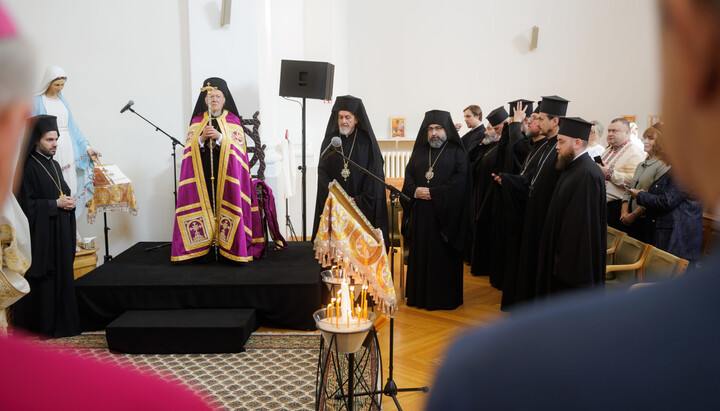
Patriarch Bartholomew in Lithuania. Photo: orthodoxianewsagency
Here are the key points from Patriarch Bartholomew’s “Lithuanian speech”:
• The establishment of a structure of the Constantinople Patriarchate in Lithuania is a “historic duty of the Mother Church.”
• The Exarch of Lithuania possesses a “deep and comprehensive” knowledge of the Russian language and is also “able to celebrate services in Church Slavonic and according to the Slavic Typikon.”
• Constantinople is opening an exarchate in Lithuania for refugees from Ukraine and other Slavic countries who “hope to behold the face of a true spiritual father rather than a distant administrative official.”
• Patriarch Bartholomew sent this particular exarch to Lithuania so that he might speak to Ukrainians “words of consolation and healing in the language of their forefathers.”
• The exarchate is being established “not to divide, but to unite.”
And this is where a number of questions arise.
First, Lithuania already has an Orthodox Church.
In 2022, that Church appealed to the Russian Orthodox Church seeking greater independence, and its current status remains unresolved. Be that as it may, the canonical Church has existed there for centuries, and the sacred canons do not permit the creation of parallel jurisdictions.
Second, if a parallel jurisdiction is nevertheless being established, there should be compelling reasons for doing so.
What reasons does Patriarch Bartholomew point to?
He emphasizes that the exarch is particularly needed for the pastoral care of Ukrainian refugees.
Had the bishop spoken Ukrainian, one might at least understand the reasoning behind such a decision.
But the exarch does not know Ukrainian – he knows only Russian.
Against that backdrop, the Patriarch’s statement that Ukrainians require consolation “in the language of their forefathers” sounds almost offensive.
Does this mean that the forefathers of Ukrainians were Russians and that Ukrainians themselves are carriers of the so-called “Russian World”?
And, ultimately, what is unique about a Russian-speaking exarchate of the Phanar if the clergy of the Lithuanian Orthodox Church already speak both Russian and Church Slavonic fluently?
Third, the statement that Ukrainians “hope to behold the face of a true spiritual father rather than a distant administrative official” is no less puzzling.
Does Patriarch Bartholomew seriously believe that authentic spirituality is possible only within his own jurisdiction?
Fourth, the claim that Constantinople’s exarchate is intended “not for division but for unity” is almost word-for-word identical to what Phanar Exarch Bishop Daniel (Zelinsky) said in Ukraine shortly before the creation of the OCU:
“We have come here not to divide Ukrainian Orthodoxy, but on the contrary, to take further steps toward bringing about the desired unity of the Ukrainian Orthodox Church.”
We know where that “unity” ultimately led.
And for that reason, one cannot help but feel concerned for Lithuania.
Read also
Ternopil post on Feast of Intercession: Has calendar reformn failed?
A significant number of believers have rejected the new church calendar introduced by the OCU and UGCC with government support.
Shoulder straps or a cassock: who writes the script for UOC "fighters"?
Everything indicates that both Veliar and Pshenychny are ordinary performers of someone else's script. There is only one question – does the scriptwriter wear shoulder straps or a cassock?
Why is it legal to kill a person before birth but not after?
Children are the most privileged members of society. Yet that same society officially permits children to be killed – and on a massive scale.
Honoring the Bolsheviks’ successors at Kyiv Lavra
It was under the Reserve that the relics of the saints were desecrated, Lavra churches were turned into an atheism museum, and toilets were installed in sanctuaries.
"Degenerates" and "stupid animals": anti-UOC activists turn on children
Future historians will wonder how a vast country’s information agenda could have been shaped for so long by people so petty, vicious, and utterly contemptible.
Zelensky sees murder of Polish priest but not of Sviatohirsk monk
Why does Zelensky react so emotionally and swiftly to the murder of a Catholic cleric while remaining completely silent about the murder of an Orthodox monk?