How Epifaniy became a successor of the "occupier"
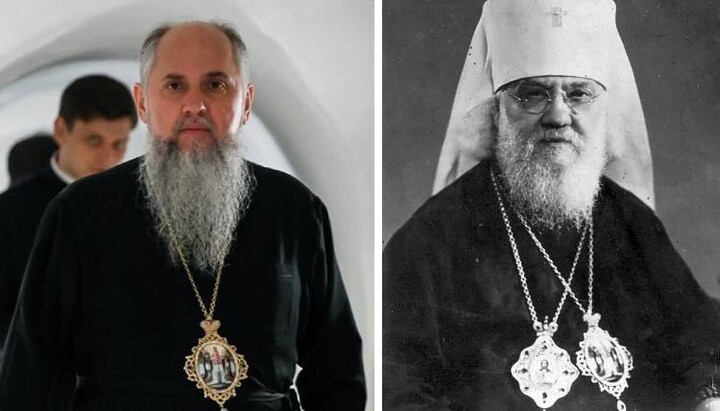
Dumenko declared himself the successor of the ROC exarch. Collage: UOJ
Epifaniy Dumenko continues to sort through the stolen "inheritance" he acquired after Filaret's death. While conducting another "service" at the Lavra, he wore a panagia that belonged to the ROC exarch Metropolitan Ioann (Sokolov).
The OCU spokesman Zoria views this as a symbol of "succession". In other words, Dumenko is supposedly the rightful head of the Lavra because he possesses the panagia of one of the monastery's canonical sacred archimandrites.
That would all be well and good, were it not for one inconsistency. For years, the OCU has advanced the claim that the entire history of Orthodoxy in the Ukrainian lands after 1686, when Constantinople gave the Kyiv Metropolis to Moscow, is a period of “spiritual occupation.”
In early 2023, when the OCU was first allowed into the Lavra, it published a policy statement with a clear thesis: the OCU is the successor to the Kyiv Metropolis of Constantinople, while the UOC represents the “Moscow” period. The authors of the statement even went so far as to divide the saints of the Kyiv Caves Lavra into categories: of the 120 venerable fathers, 100 were declared “right”, that is, of the “Constantinople” period, while the remaining 20 were labeled products of the “occupation.”
Now let's return to the personality of the exarch whose panagia Dumenko wore. He was born in the Moscow region and lived and served in various dioceses across Russia until he was nearly seventy years old. After being assigned to Kyiv in 1944, he was, according to the Russian Orthodox Church, “the only bishop of Patriarchal allegiance in all of Ukraine.” According to Wikipedia, Soviet authorities used the Exarch to oversee the subordination of Orthodox ecclesiastical life in Ukraine to the Moscow Patriarchate. The Metropolitan also played a coordinating role in the liquidation of the Uniate Church and its absorption into the Russian Orthodox Church.
In other words, in the OCU's view, Bishop Ioann was the living embodiment of that very "spiritual occupation" of Ukraine and the Kyiv-Pechersk Lavra that they so heroically fight against today.
And today they present Epifaniy as the successor of such an "occupier." Don't ask how this is possible. It seems the answer is simple: Serhii Dumenko found a beautiful panagia among Filaret's belongings, and they retroactively invented a concept to fit it.
Yesterday it was occupation, today it is succession. Yesterday an enemy, today a predecessor. There is no logic here, nor was one intended.
Zoria assumes that OCU supporters will not notice these contradictions. And, as experience suggests, that assumption is correct.
Read also
Ternopil post on Feast of Intercession: Has calendar reformn failed?
A significant number of believers have rejected the new church calendar introduced by the OCU and UGCC with government support.
Shoulder straps or a cassock: who writes the script for UOC "fighters"?
Everything indicates that both Veliar and Pshenychny are ordinary performers of someone else's script. There is only one question – does the scriptwriter wear shoulder straps or a cassock?
Why is it legal to kill a person before birth but not after?
Children are the most privileged members of society. Yet that same society officially permits children to be killed – and on a massive scale.
Honoring the Bolsheviks’ successors at Kyiv Lavra
It was under the Reserve that the relics of the saints were desecrated, Lavra churches were turned into an atheism museum, and toilets were installed in sanctuaries.
"Degenerates" and "stupid animals": anti-UOC activists turn on children
Future historians will wonder how a vast country’s information agenda could have been shaped for so long by people so petty, vicious, and utterly contemptible.
Zelensky sees murder of Polish priest but not of Sviatohirsk monk
Why does Zelensky react so emotionally and swiftly to the murder of a Catholic cleric while remaining completely silent about the murder of an Orthodox monk?