Strike on the Lavra: what will the consequences be?
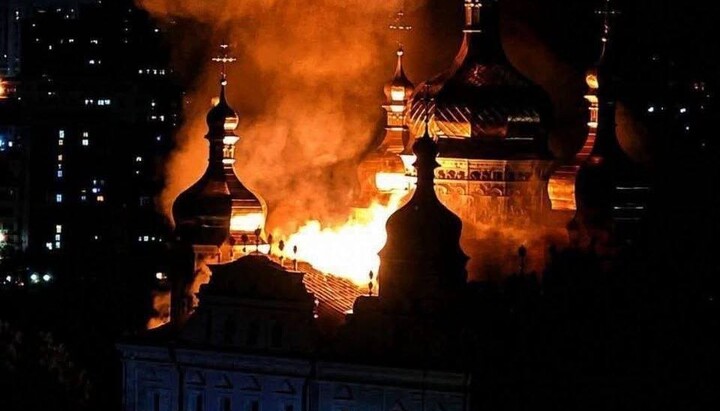
Strike on the Lavra's Dormition Cathedral. Photo: open sources
On June 15, during a nighttime Russian attack on Kyiv, an event took place that caused enormous international resonance: the Dormition Cathedral of the Kyiv-Pechersk Lavra, one of the chief shrines of Orthodoxy, was damaged in a strike.
Many statements have already followed from various individuals and organizations. In Russia and Ukraine, people are arguing over who is directly to blame for this tragedy. Russians insist that the church was allegedly hit by a malfunctioning Ukrainian air-defense missile, while the Ukrainian authorities say it was a deliberate strike by a Geran UAV. Accordingly, commentators have predictably split into two camps and are furiously accusing one another.
Religious leaders are arguing as well. The Patriarch’s vicar, Archbishop Savva (Tutunov), believes that the strike on the Lavra is the fault of “a people who voluntarily renounced the Russian name and the Orthodox faith.” He says the fire on the roof of the Dormition Cathedral is the same fire that burned in the Odesa Trade Unions House, and that it “will burn Ukraine out as retribution for cruelty, indifference, cowardice, and betrayal.”
The authorities and “patriots” of Ukraine, who for years called the Lavra “a stronghold of the Russian world,” have suddenly remembered that it is a Christian shrine. The UCCRO members see the strike on the Lavra as a reason to demand that Western partners intensify sanctions pressure on Russia. The country’s leadership is demanding the same, having already shown images of the burning cathedral to Trump and Rubio.
Everyone is using this event as an opportunity to advance a narrative useful to themselves. And very many people who call themselves Christians are demanding “retribution.” One “Orthodox” Telegram channel in Ukraine went so far as to urge the authorities to destroy the “military” Resurrection Cathedral in Moscow.
And no one is saying that a strike on the Lavra, the portion of the Mother of God, is a level of absurdity beyond all limits – that after destroying hundreds of Orthodox churches, the war has now reached the very heart of our Orthodoxy.
What comes next? A missile into the caves? The destruction of the relics of the Venerable Fathers? What has to happen before everyone, without exception, says: “Enough”?
Both in Ukraine and in Russia, people see the end of the war in a “just peace.” But everyone has their own version of this “justice,” because it is built on political calculations.
In the Gospel, however, there is no “just peace.”
There is simply peace.
Without any conditions.
Read also
Who destroyed and restored Kyiv Lavra? MinCulture's video reveals the truth
The Culture Ministry’s propaganda about the Kyiv-Pechersk Lavra has inadvertently revealed the truth.
Ternopil post on Feast of Intercession: Has calendar reformn failed?
A significant number of believers have rejected the new church calendar introduced by the OCU and UGCC with government support.
Shoulder straps or a cassock: who writes the script for UOC "fighters"?
Everything indicates that both Veliar and Pshenychny are ordinary performers of someone else's script. There is only one question – does the scriptwriter wear shoulder straps or a cassock?
Why is it legal to kill a person before birth but not after?
Children are the most privileged members of society. Yet that same society officially permits children to be killed – and on a massive scale.
Honoring the Bolsheviks’ successors at Kyiv Lavra
It was under the Reserve that the relics of the saints were desecrated, Lavra churches were turned into an atheism museum, and toilets were installed in sanctuaries.
"Degenerates" and "stupid animals": anti-UOC activists turn on children
Future historians will wonder how a vast country’s information agenda could have been shaped for so long by people so petty, vicious, and utterly contemptible.