Archaeologists unearth bell tower of ancient rock monastery in Ukraine
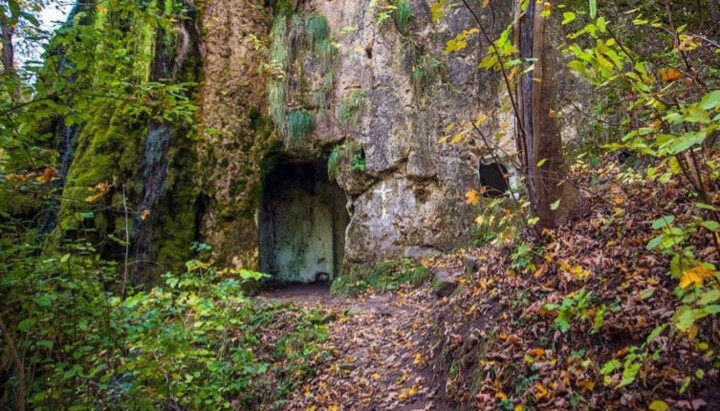
The rock monastery in Maliivtsi near the waterfall. Photo: KhM-INSIDE
In the village of Maliivtsi, Khmelnytskyi region, an archaeological expedition led by Pavlo Nechytailo presented the results of excavations on the grounds of an ancient rock monastery, KhM-INSIDE reports.
Researchers uncovered the massive foundation of a bell tower that was wiped off the face of the earth during Soviet repressions against the Church. The finds allow the monastery to be dated to the 12th–13th centuries, confirming the deep historical roots of Orthodoxy in the region.
The walls of the discovered bell tower were built using an ancient technique: the outer part was laid with hewn stone, while the core was filled with a mixture of small rock fragments. In its strength, the structure resembled a defensive tower. “The goal of our expedition is to uncover the remains of the bell tower destroyed by the Bolsheviks in the 1930s, together with the church,” Pavlo Nechytailo said.
At a depth of about one meter, the excavation team found fragments of Old Rus’ pottery, 18th-century coins, and burials dating back to the pre-Mongol period. One of the most valuable finds was a fragment of textile interwoven with metal thread, which may have been part of a church vestment.
Maliivtsi Museum Director Anastasiia Donets noted that the cultural layer also contained fragments of frescoes that had been knocked off the church walls and used as construction debris during 19th-century rebuilding work.
As the UOJ reported, the foundation of the 12th-century Resurrection Church was discovered in Grodno.
Read also
Catholic media outraged by forcible conscription of Uniate cleric
The Vatican’s Apostolic Nunciature has demanded the return of a forcibly mobilized Greek Catholic cleric.
Rivne court fines man for criticizing parish's "transfer" to OCU
A resident of the Rivne region was convicted over Facebook posts criticizing the “transfer” of a religious community in the village of Butove to the OCU.
Novynskyi: I quoted the Gospel to Zelensky on first day of war
The former Ukrainian MP said he advised Davyd Arakhamia to begin negotiations with Russia in the first days of the full-scale war and later spoke with Volodymyr Zelensky.
Sumy Eparchy venerates miraculous Korsun-Shpylivka Theotokos Icon
Celebrations honoring the Mother of God’s icon known as the “Restorer of Sight” were held at Sumy Cathedral and concluded with a car procession around the city.
Receding Dniester in Khmelnytskyi region exposes foundation of flooded church
The foundation of St. John the Theologian Church, submerged during the construction of a hydroelectric power plant, has resurfaced for the first time in 45 years.
Medieval сhurch сrumbles as Culture Ministry сites missing agreement
The 14th–15th-century St. Nicholas Church in Chesnyky, Ivano-Frankivsk Region, is falling into disrepair.