The death that leveled the classes
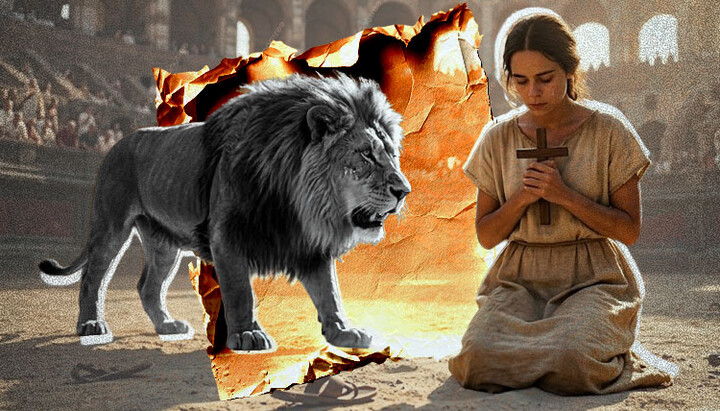
The courage of Christian women. Photo: UOJ
Let us begin with the dry letter of the law in order to fully appreciate the magnitude of what happened. Over every Roman household stood the all-powerful pater familias, and his authority over all members of the family was known as patria potestas. Included within it was the dreadful ius vitae necisque – the absolute right of life and death. A father could simply refuse to acknowledge a newborn child and coldly cast it out to certain death. More than that, his authority over his grown son or daughter extended all the way to the right of execution.
Likewise, a free woman remained throughout her life under the strict guardianship of a man – first her father and then her lawful husband.
The ancient jurist Gaius, attempting to justify this system and explain why an adult woman supposedly required a lifelong guardian, arrogantly appealed to the “weakness of the sex” (infirmitas sexus) and an innate “frivolity of mind” (levitas animi) – only to admit openly in the same breath that such arguments were more socially convenient than genuinely true.
Of course, a woman managed her everyday affairs herself. But whenever something truly significant was involved – property, legal transactions, or court proceedings – the signature of a guardian was required. Before the cold face of the state apparatus, an experienced and wise matron remained little different from a child, incapable of determining her own destiny.
A slave, meanwhile, was not considered even a naïve child. In official writings he was cynically described as an instrumentum vocale – a “speaking tool,” a living object that happened, by some absurd accident, to possess the ability to talk. And a thing, by definition, cannot have convictions or principles. You do not put a tool on trial for treason. You break it, throw it away, and replace it with another.
Let us remember this grim arrangement. At the summit of the social pyramid sits the father, armed with the unquestioned right to execute anyone beneath him. Below him stands the voiceless woman, humiliatingly assigned to a guardian for life. And beneath her is the slave, officially reduced to the status of agricultural equipment.
Defiance in a Carthaginian prison
Let us travel to sweltering Carthage in the spring of AD 203. In a dark and damp prison sits a young woman named Vibia Perpetua. She is only twenty-two years old, the mother of a tiny infant, and the beloved daughter of a wealthy and influential pagan.
Perpetua left behind a moving account of her final days on earth. It is one of the earliest surviving continuous texts written by a woman’s own hand. Through it, the authentic voice of the accused herself reaches us across the centuries.
One day her father comes to her cell. He is not the grotesque tyrant of modern historical caricature. He is an old man who genuinely loves his daughter, utterly devastated by grief. Falling to his knees in tears, he kisses her hands, invokes his venerable age and his infant grandson, and desperately begs her to renounce her new faith.
Under Roman law, he has the right not merely to plead but to command – and, overcome with anguish, he does exactly that. It is here, in the half-light of a Carthaginian prison, that the pivotal moment occurs, the reason this martyrdom account remains so extraordinary.
Perpetua gently points to a clay vessel standing nearby on the floor – a simple jug for drinking water – and quietly asks her father whether it can be called by any name other than what it truly is.
Through his tears, the bewildered old man answers: no.
Then, looking directly into his eyes, she replies firmly: “Neither can I call myself anything other than what I truly am. I am a Christian.”
In these seemingly simple words lies a legal revolution of immense proportions – a revolution that shattered the ancient system of subordination forever.
The battered young woman does not scream, does not collapse into hysteria, and does not engage in philosophical arguments about pagan gods. Instead, with astonishing calm and dignity, she tells her father that she alone can choose in whom she will believe.
She claims the great name “Christian” for herself, independently of her father’s wishes, independently of guardianship, independently of parental authority. Soon afterward, before a public tribunal, the procurator Hilarianus will repeat the same demand – simply offer a token sacrifice to the idols for the emperor’s well-being. Meanwhile, her weeping father will attempt to drag her from the platform, begging her to spare the family from disgrace.
Yet Perpetua’s answer never changes: “I am a Christian.”
The perpetual child of Roman law suddenly speaks as a free and fully responsible person, ready to bear the consequences of her choice.
The silent victory of a frail slave girl
Now let us travel to Lyons in Roman Gaul. The year is 177 – more than a quarter of a century before the terrible events in Carthage. Among the many Christians arrested by the authorities was a destitute slave girl named Blandina, astonishingly frail and sickly by nature. She was precisely that powerless, downtrodden “speaking tool,” deprived even of the right to her own body. Her noble mistress, who was also among the Christians, genuinely feared – and not without reason – that the exhausted Blandina simply lacked the physical strength to survive torture.
What happened next is known to us from a chilling letter of the Gallic churches, miraculously preserved by the historian Eusebius of Caesarea. Professional Roman executioners subjected the fragile girl to savage torture from early morning until late at night, mercilessly taking turns at their bloody work.
And then something extraordinary happened.
The torturers themselves were the first to collapse from exhaustion.
Openly admitting defeat, these hardened men could not comprehend, with superstitious horror, how the battered young woman was still breathing.
The pitiful “object” standing on that blood-soaked arena proved stronger, more whole, and more resilient than all the others around her.
The hidden trap of the imperial court
We must understand what people were actually being executed for.
Rome was remarkably tolerant in matters of religion. It peacefully accommodated dozens of exotic cults and foreign deities within its vast pantheon.
The issue was not faith in Christ as such.
The problem was the refusal to perform an act of civic loyalty: to cast a pinch of incense before the emperor’s statue, to offer the customary oath by his genius. It was a routine test of allegiance to the imperial order. Any refusal to perform this seemingly trivial ritual was interpreted by officials as a direct and insolent challenge to the state itself.
And here lay the brilliant trap that mighty Rome unknowingly set for itself.
To condemn someone according to the full rigor of the law for such ideological defiance, the authorities first had to recognize that person as a genuine moral agent – someone capable of conscious choice and responsible action.
By publicly trying the patrician Perpetua and the slave Blandina for disloyalty to the regime, the proud empire was forced, however reluctantly, to acknowledge in both women precisely what its legal system had denied them for centuries: the fundamental capacity to possess convictions of their own and to answer for those convictions before the highest authority on earth.
Rome dragged these fragile women onto the blood-stained sands of the amphitheater in order to display their supposed insignificance before a roaring crowd.
Instead, contrary to its own principles, it transformed them into fully conscious defendants – independent subjects of law, capable of moral responsibility.
On the burning sands of Carthage, walking shoulder to shoulder beside the noble Perpetua, was her faithful servant Felicitas, who had miraculously given birth in the horrific conditions of prison only two days before her public execution. According to the moving testimony of eyewitnesses, the condemned women exchanged the kiss of peace before their deaths, bidding farewell to the world together.
The amphitheater itself had originally been designed as a giant model of social hierarchy. Below, in the arena, were dirt, sweat, and the blood of the doomed. Above, seated on marble tiers according to rank and privilege, were the respectable spectators.
Yet here, in that very arena, a wealthy mistress and a penniless slave stood embracing one another as equal and free sisters, sharing a common destiny.
The stone pyramid of social inequality that imperial Rome had spent centuries constructing crumbled into dust.
True freedom beyond fear
Yet we should resist the temptation to turn this difficult story into a triumphant anthem.
The confessors of Lyons who survived the persecutions strictly forbade the enthusiastic faithful from calling them by the glorious title of “martyrs.” Through tears they insisted that there is only one true Martyr in the universe – Christ Himself – while they were merely weak and insignificant people who had done their duty.
These remarkable Christians sincerely prayed for their merciless executioners. They did not exalt themselves above those unfortunate believers who had broken under unbearable pain and renounced Christ.
But within them there was something far greater at work – something that changed the very foundations of civilization itself.
Rome possessed absolute power over human bodies. According to its law, it could execute, imprison, send people to the mines, or sell them on the slave market.
Yet the moment an exhausted and battered defendant looked into the face of the executioner and uttered the words, “I am a Christian,” something profoundly unsettling became apparent to the empire.
Beyond the limits of Rome’s seemingly boundless authority there existed another realm – a sovereign territory of the human spirit.
And neither a father, nor the legions, nor an all-powerful procurator could cross its borders.
Read also
Golgotha in the Midst of a Pogrom
In the autumn of 1938, the Jewish artist Marc Chagall painted the crucified Christ. Synagogues burn and refugees flee around the cross, while the Crucified One Himself is wrapped in a prayer shawl.
Stories of the Early Church. Level of governance: patriarch
How did several episcopal sees rise above the rest, why did the Church’s administrative map come to mirror that of the empire, and is the patriarchate a sacred form of Church governance?
A Chronicle without an author
We are accustomed to calling The Tale of Bygone Years the work of St. Nestor. Yet another monk left his signature on it, while the chronicle itself passed from one generation of scribes to the next.
How a wedding stopped a war
The young princess of Slutsk was married off to keep two powerful noble families from drowning the city in blood. Soon afterward, a Uniate metropolitan complained that Orthodoxy had been reborn in Slutsk.
Man before the forces of nature
A solitary figure on the shore seems insignificant before the immense power of the sea, yet it is he who stands before the Creator.
The mysteries of Golgotha in the light of archaeology
The veil of centuries obscures what really happened in the fourth century. Archaeology and ancient texts shed light on the true history of one of Christianity’s greatest sacred sites.