The certificate that saved lives under the Gestapo’s nose
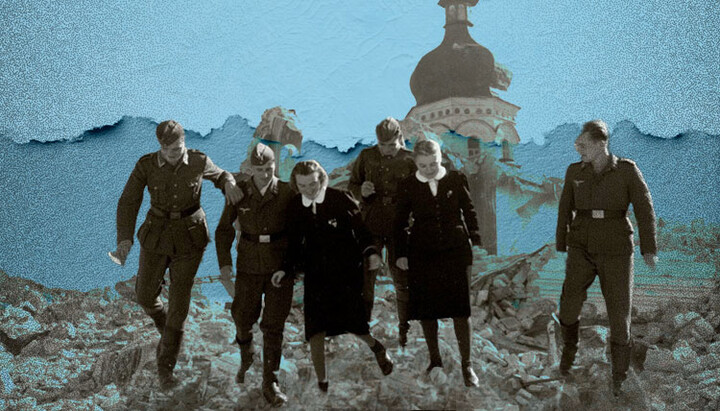
Military Kyiv. Photo: UOJ
Old church forms have survived to this day – baptismal certificates once kept by Professor Oleksandr Glagolev. A Kyiv priest and renowned scholar of Hebrew antiquity, he famously testified in defense of Mendel Beilis during the Beilis trial. After his death, the blank certificates passed to his son, Father Oleksii, rector of the Holy Protection Church in Podil. In haste, names were entered onto those forms for people whom a single sheet of paper could transform into baptized Christians – Orthodox believers whom the occupiers would no longer send before a firing squad.
Execution for sheltering the persecuted
Kyiv emptied with frightening speed during the occupation. Of nearly half a million inhabitants before the war, only about 170,000 remained by the time the city was liberated. Some had been deported to Germany. Others disappeared into Babyn Yar. Hunger claimed many of the rest.
The famine was artificial. Food deliveries were intended primarily for the Germans, while everyone else survived on the meager leftovers sold in markets. Those desperate enough could try to travel to nearby villages in search of provisions, though wartime conditions made even that perilous. Bread was baked from millet mixed with chestnut flour and lupin. The loaves resembled bitter bricks that initially poisoned people before hunger forced them to adapt. A silver cross or a father's watch could be exchanged for a handful of gray flour wrapped in a scrap of newspaper.
The churches reopened under German occupation should not be mistaken for an act of goodwill.
A secret directive issued by the Reich Main Security Office explicitly forbade the German authorities from supporting church life, organizing services, or allowing mass baptisms. Permitting churches to reopen was nothing more than a calculated attempt to secure the population's loyalty. At the same time, anyone caught sheltering a Jew faced execution – not only the person providing refuge, but everyone who had helped.
The occupation lasted 778 long days. Throughout that time, this Kyiv parish survived against overwhelming odds. What the Soviet authorities would later describe as collaboration with the enemy meant something entirely different in Podil – risking one's own life every single day to save a condemned neighbor.
A passport with someone else's photograph
In early October 1941, a Jewish woman, Izabella Mirkina, and her ten-year-old daughter were brought to the Glagolev family. There was nowhere to hide them, yet remaining in the city meant certain death.
Mother Tatiana made a remarkable decision. She handed Izabella her own passport.
Not long before, the Glagolevs' apartment had been flooded, damaging the official seal inside the document. That flaw became their opportunity. They carefully removed Tatiana's photograph and replaced it with Izabella's.
Father Oleksii later recorded what that act of courage nearly cost his wife:
"My wife almost paid with her life for this desperate deed. When Gestapo officers came from apartment to apartment carrying out requisitions, they demanded to see her passport. When she could not produce it, they declared that they would take her to the Gestapo as a suspicious person."
In the autumn of 1943, Father Oleksii himself was brutally beaten after German soldiers mistook him for a Jew. His life was saved only because several nuns intervened on behalf of the priest.
A certificate of church choir service
The story of this courageous parish did not end there.
To save young people from being deported to forced labor in Germany, Father Oleksii Glagolev issued church employment certificates almost without pause. One person became a choir singer. Another was listed as a sexton. Someone else became a church caretaker. Official employment at an operating church provided exemption from deportation.
Under the guise of church workers, both Russians and Jews found shelter in parish houses. Among those rescued in this way was the family of a Red Army lieutenant colonel – his wife and their six children.
In time, every position within the parish was filled by people who needed protection. Mother Tatiana herself served as the registrar for the parish houses, maintaining the household registers through which identities could be safeguarded. The property manager was family friend Oleksandr Horbovskyi.
Long before the occupation ended, this parish had ceased to be a place of outward splendor. There was no gold shining on its domes. Its legal existence depended entirely on the occupiers, who could revoke permission for the church to remain open at any moment.
Yet stripped of privilege, impoverished, and deprived of every earthly protection, the parish fulfilled the very purpose for which the Church exists. It gathered together a world that had been torn apart and stripped of its humanity – one fragment at a time, one person at a time, saving one precious life after another.
Read also
Golgotha in the midst of a pogrom
In the autumn of 1938, the Jewish artist Marc Chagall painted the crucified Christ. Synagogues burn and refugees flee around the cross, while the Crucified One Himself is wrapped in a prayer shawl.
Stories of the Early Church. Level of governance: patriarch
How did several episcopal sees rise above the rest, why did the Church’s administrative map come to mirror that of the empire, and is the patriarchate a sacred form of Church governance?
A Chronicle without an author
We are accustomed to calling The Tale of Bygone Years the work of St. Nestor. Yet another monk left his signature on it, while the chronicle itself passed from one generation of scribes to the next.
How a wedding stopped a war
The young princess of Slutsk was married off to keep two powerful noble families from drowning the city in blood. Soon afterward, a Uniate metropolitan complained that Orthodoxy had been reborn in Slutsk.
Man before the forces of nature
A solitary figure on the shore seems insignificant before the immense power of the sea, yet it is he who stands before the Creator.
The mysteries of Golgotha in the light of archaeology
The veil of centuries obscures what really happened in the fourth century. Archaeology and ancient texts shed light on the true history of one of Christianity’s greatest sacred sites.