On the discord surrounding the ban of female human rights activist
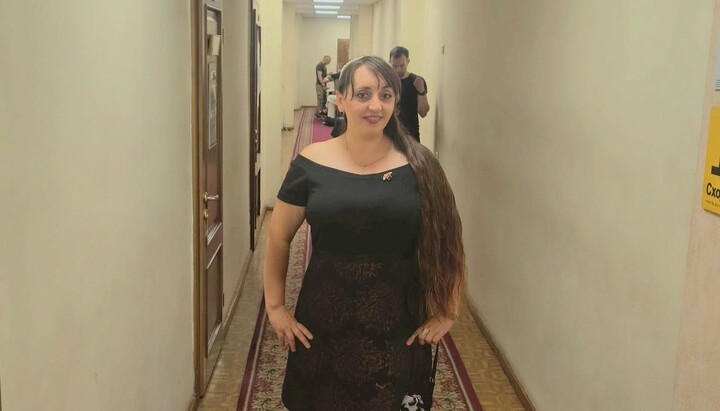
Viktoria Kokhanovska. Photo: Kokhanovska's Facebook
A fierce debate has erupted online over Metropolitan Agafangel of Odesa’s decree barring human rights advocate Viktoria Kokhanovska from Holy Communion. Shortly beforehand, she released a sharp and highly critical video about the activities of the Odesa hierarch and members of his eparchy, whom she accuses of pushing the Ukrainian Orthodox Church toward an unlawful autocephaly. The video was blunt, emotional, and at times abrasive. Yet the reaction it provoked from the eparchy’s clergy – and from priests and bishops sympathetic to them – proved even more emotional.
Archpriest Maximian Pogorelovsky called Viktoria “a wolf in sheep’s clothing” and claimed that because of her actions, “our faithful were driven out of the Lavra and prevented from defending their holy place from within.” Archbishop Iona has described her as a “hysteric” and a “vulgar troublemaker.” Metropolitan Varsonofiy has called her “Moscow-minded” and “unbalanced,” while Archbishop Sylvester has accused her of “actively discrediting our Church.”
Clergy, hierarchs, and faithful of the UOC are now locked in a bitter argument: did the Metropolitan of Odesa have the authority to bar Victoria from Communion, or could such a measure be imposed only by His Beatitude Onuphry? Each side cites canons in abundance, determined to prove its case.
But what do we have as a result?
Archbishop Sylvester insists that sanctions against Kokhanovska were necessary because she was “trying to sow enmity and confrontation.” Father Maximian says much the same, arguing that she is “spreading confusion and division among the faithful at a time when we should be united in order to endure this difficult hour.”
And here a question inevitably arises: are the present disputes not themselves “enmity and confrontation”?
Why was no one saying that Kokhanovska was “discrediting our Church” when she spent years defending dozens of UOC parishes in court? Why did none of her current critics come to the Lavra in 2023 as she did, stand watch there around the clock, and, in the process, “earn” several criminal cases against themselves? And can we seriously accept the claim that the faithful were expelled from the shrine solely because of Kokhanovska’s actions?
Is Victoria right today when she rudely tells Metropolitan Agafangel that it is time for him to retire? Certainly not.
But are those who now insult her right, having done not even a tenth of what she has done in defense of the Church? No, they are not.
Because the current quarrel is precisely the “confusion,” the “enmity,” and the “confrontation” that everyone claims to oppose.
All of this serves the cause of division within our Church. And perhaps more importantly, it endangers our souls. For in furiously condemning one another, we move away from the central commandment of Christ – love.
The modern philosopher Grigory Pomerants once wrote:
“The devil begins with the foam on the lips of an angel who has entered the battle for a holy and righteous cause.”
What is unfolding around Viktoria Kokhanovska today seems almost a living illustration of that thought.
Each side is arguing itself hoarse, passionately proving its own righteousness. Yet through all the shouting, all the accusations, all the certainty, what emerges is not the light of truth, but the faint outline of a dark and crooked smile.
Read also
Why is it legal to kill a person before birth but not after?
Children are the most privileged members of society. Yet that same society officially permits children to be killed – and on a massive scale.
Honoring the Bolsheviks’ successors at Kyiv Lavra
It was under the Reserve that the relics of the saints were desecrated, Lavra churches were turned into an atheism museum, and toilets were installed in sanctuaries.
"Degenerates" and "stupid animals": anti-UOC activists turn on children
Future historians will wonder how a vast country’s information agenda could have been shaped for so long by people so petty, vicious, and utterly contemptible.
Zelensky sees murder of Polish priest but not of Sviatohirsk monk
Why does Zelensky react so emotionally and swiftly to the murder of a Catholic cleric while remaining completely silent about the murder of an Orthodox monk?
UOC vs. OCU numbers: pollsters count, social media recount
Official polling suggests Dumenko’s structure has an overwhelming lead in the number of parishioners, while social media polls paint a very different picture. Which should we believe?
Who is working for the Kremlin in Poland? OCU, Uniates and Catholics versions
Who in the conflict between Poland and Ukraine is "an agent of the Russian Federation"? Zelensky, who gave the UPA name to an AFU special operations center? Nawrocki, who stripped him of an order for it? Polish MEPs?