Will those who praised the Nazis be included in Ukraine's Pantheon of Heroes?
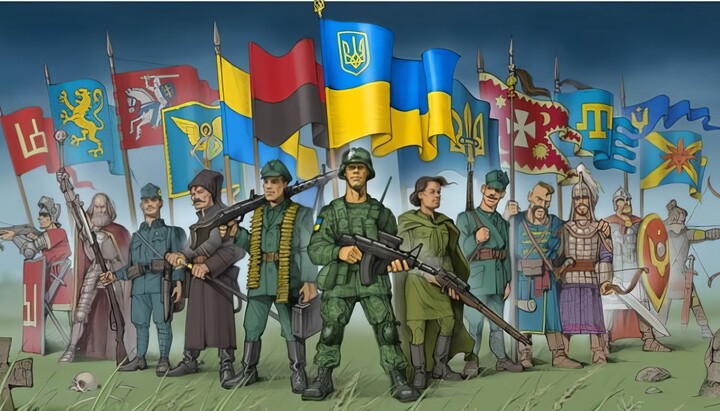
Heroes of Ukraine according to the Institute of National Memory. Photo: Institute of National Memory
Eighty-five years ago, on June 30, 1941, the “Act of Proclamation of the Ukrainian State” was announced in Lviv. Clause 3 of the document stated:
“The Ukrainian State will work closely with National Socialist Greater Germany, which, under the leadership of its Leader Adolf Hitler, is creating a new order in Europe and the world.”
The Act glorified OUN leader Bandera and OUN founder Konovalets.
On the same day, a National Assembly was held, where UGCC Metropolitan Yosyf Slipyj and the Uniate chaplain Ivan Hrynioch delivered speeches. In addition, a greeting from Metropolitan Andrey Sheptytsky was read aloud containing the words:
“We welcome the victorious German Army as the liberator from the enemy.”
At the conclusion of the assembly, participants sent “greetings to the Creator and Leader of Great Germany, ADOLF HITLER, and greetings to the Glorious German Invincible Army.”
The record further noted that
“all those present especially warmly and sincerely greeted the high-ranking officers of the German army who attended the Assembly.”
On July 1, the Verkhovna Rada passed the law on the “Ukrainian National Pantheon.”
The law states that the Pantheon may commemorate, among others, individuals who made an outstanding contribution to the development of religion in Ukraine. Given the privileged position currently enjoyed by the UGCC, there is little doubt that efforts will be made to include figures such as Sheptytsky or Slipyj.
There is, however, a problem.
According to the law, the Pantheon may not commemorate persons who fall under the restrictions established by Ukraine’s laws “On the Condemnation of the Communist and National Socialist (Nazi) Totalitarian Regimes...”
As we understand it, it may be rather difficult to prove that individuals who sent greetings to Hitler and praised the Nazi army do not fall within the scope of legislation condemning Nazism.
Incidentally, this issue applies not only to Uniate bishops, but also to Bandera, Stetsko, Melnyk, Shukhevych, and others.
Still, there is a suspicion that nobody will attempt to prove anything at all.
It may be far easier simply to remain silent and pretend that none of it ever happened.
Read also
Ternopil post on Feast of Intercession: Has calendar reformn failed?
A significant number of believers have rejected the new church calendar introduced by the OCU and UGCC with government support.
Shoulder straps or a cassock: who writes the script for UOC "fighters"?
Everything indicates that both Veliar and Pshenychny are ordinary performers of someone else's script. There is only one question – does the scriptwriter wear shoulder straps or a cassock?
Why is it legal to kill a person before birth but not after?
Children are the most privileged members of society. Yet that same society officially permits children to be killed – and on a massive scale.
Honoring the Bolsheviks’ successors at Kyiv Lavra
It was under the Reserve that the relics of the saints were desecrated, Lavra churches were turned into an atheism museum, and toilets were installed in sanctuaries.
"Degenerates" and "stupid animals": anti-UOC activists turn on children
Future historians will wonder how a vast country’s information agenda could have been shaped for so long by people so petty, vicious, and utterly contemptible.
Zelensky sees murder of Polish priest but not of Sviatohirsk monk
Why does Zelensky react so emotionally and swiftly to the murder of a Catholic cleric while remaining completely silent about the murder of an Orthodox monk?