Eucharist in Roman slums
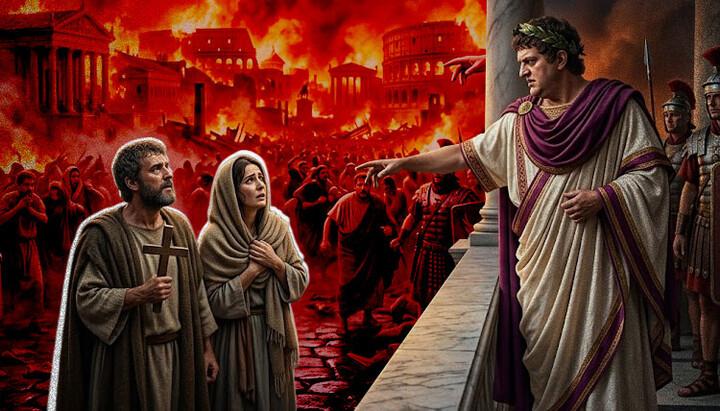
Roman persecutions of Christians. Photo: UOJ
The history of ancient antiquity is usually filled with pious images of dark underground passages, flickering torches, and Christians hiding from the wrath of the Caesars among tombs. This cinematic portrayal has made its way into monographs and textbooks on Church history, creating the misleading impression that the Church of the third century existed in a parallel world.
In reality, the catacombs, such as the burial vaults of Saint Callixtus, were located far beyond the boundaries of Rome. The law strictly prohibited burying people within the city limits. There, underground, communities gathered only occasionally, for memorial services. The main life, however, unfolded in entirely different, far more prosaic settings. Christians of the era of the great persecutions lived, prayed, and celebrated the Sacraments in ordinary urban insulae – ancient multi-story tenements, little different from pre-revolutionary tenement houses or Soviet communal apartments.
Fear behind a clay partition
The Roman insula was a rather grim construction. Wealthy citizens occupied spacious apartments on the lower floors, where there was at least some primitive sewage and plumbing. The upper floors, rising up to the very roof, were rented out to the urban poor. The rooms there were tiny, with cheap wooden frames instead of walls, hastily daubed with straw and thin clay. A pagan neighbor through the wall would fry cheap fish, curse the rising prices of olive oil, and could perfectly hear every breath in the adjacent closet where a Christian lived.
In such conditions, gathering ten to fifteen people for the Liturgy was an extremely difficult task. The slightest sound or creak of a warped floorboard could end with a visit from the prefect.
But it is important to understand that the Church survived underground not so much by disappearing from the authorities' sight as by means of well-established discipline.
In his Apology, Tertullian quotes an appeal by the Christians of his time to Roman citizens: "We live among you, we share the same food, wear the same clothes, and have the same customs... We are not Brahmins or Indian gymnosophists, dwelling in the forests and banished from human society." Christians went to the same baths and bought vegetables from the same merchants as pagans did. But once they returned home and shut the flimsy door behind them, they completely changed the rules of the game.
The underground was always bound up with fear, where the risk of betrayal outweighed any romanticism. To protect the Eucharistic gatherings, communities had to develop a system of internal security, in which the key role was assigned to ostiarii – doorkeepers. They were entrusted with strict face control. The ostiarius was obliged to know every community member by sight. He stood on the staircase of the upper floor of the insula and identified Roman informers, delatores, while in the stuffy closet the faithful whispered as they broke bread.
The paper idol of Emperor Decius
In 250 AD, the situation escalated. Emperor Decius Trajanus decided to approach the destruction of Christianity with purely Roman bureaucratic thoroughness. He understood that targeted executions of individual bishops were not producing the desired result, and so the authorities launched a total loyalty check.
Every citizen, under pain of death or confiscation of property, was required to appear before a state commission, perform a ritual libation before idols, taste sacrificial meat, and receive an official document called a libellus.
Without this scrap of papyrus, a person automatically became a state criminal. He was stripped of all civil rights. He could no longer legally sell a craft item, buy flour at the market, or contest fraud in court.
With the introduction of such a reform, a crack appeared within the Christian communities that split the Church. The pressure of the bureaucratic machine proved so unbearable that thousands of people broke down.
Some, out of fear for their children, went to the pagan altars. But there was another, far more numerous category of believers. These were Christians who tried to find a compromise: they did not go to shed the blood of animals before the statue of Jupiter, but for large sums of money they bought from corrupt officials certificates stating that they had supposedly fulfilled all the requirements.
In the reality of that time, this was a terrible drama. The head of a large family whose craft feeds dozens of relatives, or a merchant whose entire life is at stake, made this deal with their conscience for the sake of their loved ones' survival. After the persecutions ended, communities argued for years over whether these faint-hearted people could be received back. The internal schisms of that time nearly destroyed the Christian world.
Holy Gifts smuggling
Those who flatly refused to obtain libelli instantly found themselves outside the law. They had no legal income; their homes could be confiscated at any moment. And here, a fully decentralized network of mutual support among Christians came to the fore. The deacons took upon themselves the task of supplying communities with bread and wine for the Liturgies. In conditions where the appearance of a person without a certificate at the market could end in arrest, the delivery of provisions became a mortally dangerous act of smuggling.
The outward splendor of the services was cut away as unnecessary. Instead of costly Chalices, simple red-glazed ceramics were used – vessels that the Roman poor bought at markets for next to nothing. In the event of a sudden search, such a clay cup on the table aroused no suspicion among the guards. After the service, the Holy Gifts were wrapped in simple linen cloths and carried home. Christians communed themselves each morning, before going to work. None of them knew whether the community would manage to gather together the following Sunday because of the raids.
This underground network required complete trust among people.
Once, a young acolyte – a deacon's assistant named Tarcisius – was carrying the Bread of Life on his chest beneath his cloak for condemned Christians languishing in prison. When a crowd of pagan youths surrounded him in the street and demanded that he show what he was clutching so desperately to his heart, the boy refused to reveal the secret. He was stoned to death right on the pavement, but when the soldiers searched his body, they found nothing in his hands but clean linen. The Gifts had miraculously disappeared, preventing their desecration.
The Empire tried to destroy Christianity by dismantling the hierarchy, arresting bishops, and seizing property, but it failed to account for the invisible spiritual bonds of the communities, which proved stronger than iron. It turned out that if the Church was stripped of its legal status, it retreated to a place where faithfulness and solidarity become the only measure of truth. Roman bureaucracy ultimately proved powerless against the Eucharistic prayers of the confessors, offered in a cramped capital communal apartment.
Read also
Why holy monasteries turned into state prisons
The history of Christian Europe has preserved the memory of times when monasteries became places of state exile. The fates of monarchs and righteous men were decided there.
A shepherd boy with a letter from Christ to French king
In the summer of 1212, thousands of pilgrims carrying staffs waited for the sea to part before them. Later chroniclers added ships, slave traders, and a pope's lament to their story.
Facade of bones and facade of light
Antoni Gaudí spent forty-three years building a church in Barcelona, knowing that this construction was for the ages.
Trial of a dead pope
Once in Rome, the body of a deceased pope was seated on the throne and put on trial. The accusation relied on a church canon that had once saved his see.
Monastery built in defiance of king
When Orthodox believers in Minsk were left with just one church, townspeople decided to build another – and even a royal decree did not stop them.
Young Mother and Sleeping Christ
Michelangelo carved a Virgin Mary who looks younger than her Son – and signed his name in marble for the only time in his life. Neither of these peculiarities was accidental.