The Comedy of an Italian exile
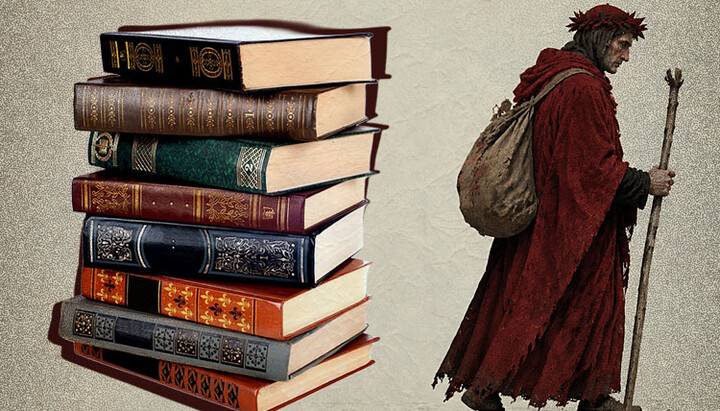
A homeless genius. Photo: UOJ
Dante Alighieri was homeless for twenty years. In Verona, Lucca, and Ravenna, he slept on staircases, ate at strangers’ tables, and wore garments passed down from others. One of the first noble households to take in the exile was that of Bartolomeo della Scala, lord of Verona. There Dante performed humble duties for his patrons, existing as a tolerated guest rather than a member of the household.
He himself described this difficult period of his life as follows: "How bitter is the taste of another man’s bread, how hard it is to go up and down another man’s stairs.” These were the words of a man who, in the most literal sense, counted the steps beneath him each night.
Life sentence
On March 10, 1302, the court of Florence, which by that point had already come under the rule of the "Black Guelphs", sentenced Dante in absentia to be burned at the stake should he ever return there again. The writer's property was confiscated.
In the medieval world, this meant not only inevitable poverty. A homeless citizen ceased to exist within the legal system.
It was much as if a modern person had their passport taken away, their bank account annulled, and their right to property revoked indefinitely, with no possibility of appealing the decision.
Dante lived with this sentence until his death in 1321. He never returned home, even when Florence later offered amnesty in exchange for a public act of repentance. He refused: the price of returning home seemed to him more unbearable than the price of exile.
Labor instead of complaint
In such a situation, it would be easy to become bitter, drown oneself in alcohol, write pamphlets against one’s enemies, turn suffering into a public performance, or transform the pain of loss into an endless monologue about injustice.
Dante chose the opposite. He quietly sat down at another man's table in yet another inn and began to write a literary masterpiece.
Reading his "Divine Comedy", we find a poem in three parts: Inferno, Purgatory, and Paradise. Each contains thirty-three cantos, while the part on Hell has one additional introductory canto. The total comes to exactly one hundred cantos.
Philologists will note that the work is written in terza rima: a stanza of three lines with an interlocking rhyme scheme of "a-b-a, b-c-b," where each such tercet, through its rhyme, is linked to the previous one and draws the next one along, joining fourteen thousand lines together without a single break.
A self-supporting vault
The literary device of terza rima closely resembles what was happening in European architecture during those same decades.
Gothic vaults were no longer built with massive load-bearing walls. They were replaced by ribbed structures – slender stone ribs that bore the weight of the roof and transferred it downward to the supporting columns, distributing the pressure with precision. The construction was no longer sustained by the sheer mass of its materials, but solely by the precision of engineering calculations.
Dante’s terza rima follows the same principle. The central line of each tercet provides the rhyme that supports the next: the “b” of one stanza becomes the supporting element for the “b-c-b” pattern that follows.
Each stanza passes its semantic load to the next, just as a vault rib transfers the load to the adjacent bay. Remove a single tercet, and the entire chain woven from fourteen thousand linked lines will lose the tension that holds it together.
The threefold structure here is not a literary ornament, nor is it merely a symbolic reference to the Trinity for the sake of piety. It is the load-bearing framework on which the entire vault of the text literally rests. A work of this kind is not simply composed – it is constructed like a Gothic cathedral, bay by bay, with the mathematical precision of engineering calculations. This painstaking labor reveals how important it was for Dante to take control of at least something, while everything else in his life was being decided by other people without his involvement.
An unfunny comedy
It is worth dwelling for a moment on the title Dante himself chose for his masterpiece. He called the poem simply "Comedy." The epithet "Divine" appeared later – it was added by Boccaccio in his biography of Dante, and it first appeared in the title of the book only in 1555, in the Venetian edition of Lodovico Dolce, nearly two and a half centuries after the author's death.
For a medieval reader, "comedy" did not imply the presence of anything humorous.
The Aristotelian tradition classified literary works according to the nature of their plot. Tragedy began with prosperity and ended in catastrophe; comedy, on the contrary, began with misfortune but concluded with a favorable outcome. Dante follows the same logic: the first line of his Comedy – "Midway upon the journey of our life / I found myself within a forest dark" (Inferno, I, 1–2) – is, in essence, the very lowest point of life, from which the ascent begins.
By naming his work a comedy, Dante seems to tell the reader: the path through hell toward the light is not only a reflection of his personal fate but a vivid example of the truly Christian way. The Savior's sufferings on Golgotha, after all, did not end with the Cross. They ended with the Resurrection.
The binding power of love
At the very end of the work, after hell, the mountain of purification, and the description of the nine celestial spheres, there is a final, most important line, reminiscent of that very load-bearing wall of a cathedral: "The Love that moves the sun and the other stars" (Paradise, XXXIII, 145).
In a Gothic vault, there is a structural element known as the keystone. It is the final wedge inserted at the very highest point of an arch. Before it is placed, the structure depends on scaffolding and supports; afterward, it becomes self-supporting and can stand for centuries without external support.
The final line of the "Comedy" works in precisely the same way.
The exile who was stripped of his home and his right ever to return to his homeland declares at the conclusion of his work: the universe is held together by the same thing that holds his own shattered life together – love.
With this line, Dante symbolically places the keystone into the structure of his written cathedral and removes the scaffolding, making this literary masterpiece eternal.
Read also
Golgotha in the midst of a pogrom
In the autumn of 1938, the Jewish artist Marc Chagall painted the crucified Christ. Synagogues burn and refugees flee around the cross, while the Crucified One Himself is wrapped in a prayer shawl.
Stories of the Early Church. Level of governance: patriarch
How did several episcopal sees rise above the rest, why did the Church’s administrative map come to mirror that of the empire, and is the patriarchate a sacred form of Church governance?
A Chronicle without an author
We are accustomed to calling The Tale of Bygone Years the work of St. Nestor. Yet another monk left his signature on it, while the chronicle itself passed from one generation of scribes to the next.
How a wedding stopped a war
The young princess of Slutsk was married off to keep two powerful noble families from drowning the city in blood. Soon afterward, a Uniate metropolitan complained that Orthodoxy had been reborn in Slutsk.
Man before the forces of nature
A solitary figure on the shore seems insignificant before the immense power of the sea, yet it is he who stands before the Creator.
The mysteries of Golgotha in the light of archaeology
The veil of centuries obscures what really happened in the fourth century. Archaeology and ancient texts shed light on the true history of one of Christianity’s greatest sacred sites.