The pocket сodex of persecuted Christians
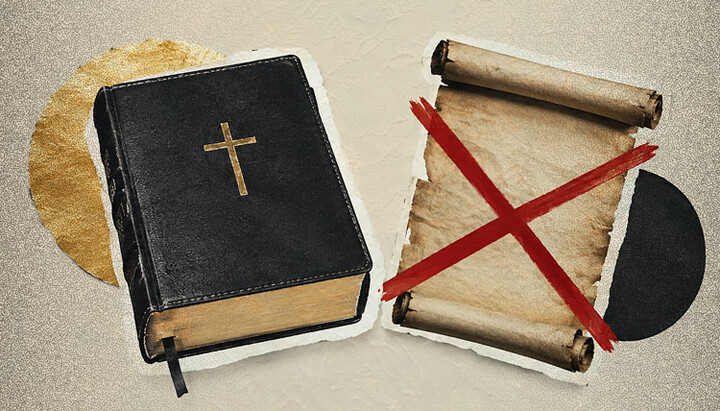
A book instead of a scroll. Photo: UOJ
By the end of the 2nd century, the scroll was an almost unrivaled means of preserving text in the pagan world. Papyrologists have calculated that among non-Christian literary texts of the 1st–2nd centuries, only 1.43% were written in the form of a codex – a book with sewn pages. Everything else was contained in scrolls.
Christian texts of the same period yield the opposite statistics. According to the Leuven Database of Ancient Manuscripts, no fewer than 91.6% of surviving copies of the New Testament were made in the form of a codex, and only 1.1% in the form of a scroll.
A sheet written on both sides
The oldest piece of evidence is kept in the John Rylands Library in Manchester. Papyrus P52 looks like a scrap the size of a palm. On one side is written a verse from the 18th Сhapter of the Gospel of John about the interrogation of Christ before Pilate; on the other side is the continuation of the same episode.
Most scholars date this fragment to the middle of the 2nd century, although some contemporary papyrologists insist on a more cautious dating, extending to the end of that same century.
But the value of the document lies in the very fact that the text is written on both sides of the sheet. In those times, scrolls were written on only one side. The reverse side ran along the outer surface of the roll and gradually wore away. A sheet written on both sides means one thing: we are looking at a page from a book.
Half a century to a century later, the Book of Books grew increasingly voluminous. The Chester Beatty Papyri, kept in Dublin, include a codex from the early 3rd century into which a scribe fitted all four Gospels and the Acts of the Apostles. Of the original 220 leaves, only 30 have survived, but even that was a breakthrough. No papyrus roll could have combined five books in a single volume.
Resource-efficient technology
The emergence of the codex solved a major problem of ancient book production. A standard commercial scroll (a "scapus") was approximately five meters long. The text of the Gospel of Luke alone would have occupied about 9.5 meters on a scroll. The reader would have had to unroll a length equivalent to a two-story building, holding it with both hands and constantly rolling up what had already been read. The Acts of the Apostles would have required roughly the same length.
Fitting all the Gospels and the Acts onto a single scroll was technically unthinkable. But thanks to the codex, it became an entirely feasible task.
It was not only a matter of reading convenience. The English papyrologist Theodore Skeat calculated that writing on both sides of a sheet saved approximately 26% of papyrus. For a Christian community that often included craftsmen and people of modest means rather than only wealthy patrons such as those Luke mentions among the disciples of Christ, a difference of a quarter of the cost of materials was significant.
A century and a half later, the state adopted what the persecuted Christian communities had pioneered. Around AD 331, Emperor Constantine the Great commissioned Eusebius of Caesarea to produce parchment codices of the Bible for the new churches of Constantinople. The commission was as follows: "to write on prepared parchment fifty copies of the Sacred Scriptures, legible and easily portable for use." What had been compiled underground three centuries earlier became the state standard of ecclesiastical book production.
Two letters in place of the God's name
Alongside the form of the book, Christian scribes developed their own system of text notation – less conspicuous but no less original. From the very earliest manuscripts that have come down to us from the first half of the 2nd century, sacred names and titles – God, Lord, Jesus, Christ, and about a dozen other words – were abbreviated to two or three letters beneath a horizontal line above. The word "Θεός" (God) became "ΘΣ."
Scholars call this practice nomina sacra – "sacred names." It was not a general tendency toward abbreviation: scribes abbreviated ordinary words rarely and unsystematically, and nothing of the kind appears in pagan texts of the same period. At the same time, the system of abbreviations followed a strict order: if the name "Jesus" referred not to Christ but to his namesake, for example, to the Old Testament Joshua, no abbreviation was used. This is similar to the practice of using the titlo in Church Slavonic manuscripts.
The uniformity of this practice is remarkable. Communities in different parts of the Mediterranean, with no connection to one another, applied the same technical device in the same way. It became a common rule somehow assimilated by the entire early Church at once.
The eternal debate about first causes
There is a temptation to explain all these innovations by pragmatism alone: it was cheaper, more convenient, more compact. But Larry Hurtado himself, one of the leading specialists in early Christian manuscripts, rejected pure practicality as the decisive factor in the choice of the codex form. He suggested that the codex may have served as a kind of identifying mark — a way of distinguishing the sacred book of Christians from Jewish scrolls and pagan literature.
The economy of papyrus can explain why the codex was more advantageous to use. But it does not explain why it was used specifically for recording the sacred text.
The question remains open. But what is known for certain is this: a persecuted community was able to change both the form of the book and the way of designating within it the name of God – the most important name for Christians. Moreover, neither innovation was borrowed from the pagans. Both inventions were created by the community independently, and they outlived antiquity, surviving to the present day.
Read also
Golgotha in the midst of a pogrom
In the autumn of 1938, the Jewish artist Marc Chagall painted the crucified Christ. Synagogues burn and refugees flee around the cross, while the Crucified One Himself is wrapped in a prayer shawl.
Stories of the Early Church. Level of governance: patriarch
How did several episcopal sees rise above the rest, why did the Church’s administrative map come to mirror that of the empire, and is the patriarchate a sacred form of Church governance?
A Chronicle without an author
We are accustomed to calling The Tale of Bygone Years the work of St. Nestor. Yet another monk left his signature on it, while the chronicle itself passed from one generation of scribes to the next.
How a wedding stopped a war
The young princess of Slutsk was married off to keep two powerful noble families from drowning the city in blood. Soon afterward, a Uniate metropolitan complained that Orthodoxy had been reborn in Slutsk.
Man before the forces of nature
A solitary figure on the shore seems insignificant before the immense power of the sea, yet it is he who stands before the Creator.
The mysteries of Golgotha in the light of archaeology
The veil of centuries obscures what really happened in the fourth century. Archaeology and ancient texts shed light on the true history of one of Christianity’s greatest sacred sites.