Everyday life and labors of the Lavra brotherhood
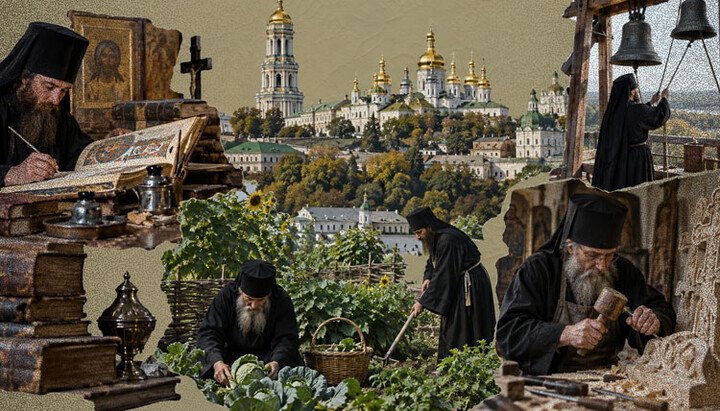
The monastic daily life of the Lavra brotherhood. Photo: UOJ
Among the cardboard folders of the Central State Historical Archives of Ukraine is collection No. 128, preserving the memory of centuries past. As you turn the yellowed pages and study the scribes’ strokes of ink, living people begin to emerge from behind the dry lines of official reports.
Monastic life in the 19th century was far from an uninterrupted existence of contemplation and prayer. The Lavra’s buildings bustled with complex and often arduous work. The brethren labored, argued, fell ill, went to court against their neighbors, and lit oil lamps before wonderworking icons. Archival documents reveal the monastery’s life without embellishment, in all its earthly detail.
Thirty thousand files of monastic history
The sheer scale of the Lavra collection is striking. It contains more than 30,000 archival files – more than all the other monastic collections in Ukraine combined. The documents span the 15th through the 20th centuries.
The history of the archive itself is dramatic. Some of the records were evacuated, while in the early 1950s archivists sorted through a ton and a half of Lavra documents that had been discovered loose among the records of the ecclesiastical consistory. Every surviving folder preserves a fragment of a vanished era.
Consider the actual number of people living at the monastery. In July 1838, the community consisted of 134 monks, 200 novices, and 100 staff members.
Decades later, the brotherhood had grown considerably. By the beginning of the 20th century, more than 500 monks and over 600 novices were living and laboring at the Lavra and its outlying sketes.
Government decrees strictly limited the official size of monastic communities, prescribing a fixed number of residents. But the realities of monastic life invariably defied bureaucratic plans. The constant flow of pilgrims, the monastery’s practical needs, and the steady arrival of new members made such regulations impossible to follow.
Librarians, beekeepers, and the Lavra choir
Behind every figure in the records lies the story of a real person. Take the Lavra librarian, Hieromonk Nikolai (Rzhanitsin). In 1857, the monastery authorities entrusted him with compiling a detailed catalog of its book collection. Father Nikolai painstakingly carried out this obedience for seven long years.
Then there was an ordinary laborer – Monk Timofei. By the beginning of the 20th century, the monastery owned four apiaries with 1,500 beehives, producing hundreds of poods of honey each year. Monk Timofei successfully represented the Lavra’s beekeeping operation at an international exhibition in Kyiv, earning an honorary silver medal for improvements in its management.
The archives have even preserved the names of 19th-century members of the kliros choir. A list of singers from 1848 includes Ianuariy Solukha, Stefan Balandinsky, Theophylact Kalinovsky, Prokhor Stotsky, and Ivan Antonovsky. Nearby, records from the icon-painting school mention the young novices Afanasy Petukhov, Isidor Chernyavsky, and Dmitry Lavrinenko. They learned to mix paints, apply gold leaf, and paint the faces of saints on wooden panels.
A brickworks and mills on the Lybid
Monastic labor was not confined to prayer in church. The monastery ran an enormous economic operation. A brickworks on the Lybid River produced more than two million bricks a year following a technical modernization. Dozens of hired workers were employed there.
The monastery also owned watermills in Holosiiv and on the Lybid, which ground thousands of poods of grain. Its guesthouses accommodated as many as 200,000 travelers and pilgrims each year.
Special attention was devoted to medical care. The monastery’s hospital department looked after both the health of the brethren and sick pilgrims. During this period, construction was completed on a new hospital with its own chapel, funded by Metropolitan Flavian (Gorodetsky).
Such archival records bring us closer to a genuine understanding of the monastic calling. Behind the outward splendor of the ancient churches stood the hard daily labor of hundreds of people who dedicated their lives to serving God and their neighbors.
Read also
Golgotha in the midst of a pogrom
In the autumn of 1938, the Jewish artist Marc Chagall painted the crucified Christ. Synagogues burn and refugees flee around the cross, while the Crucified One Himself is wrapped in a prayer shawl.
Stories of the Early Church. Level of governance: patriarch
How did several episcopal sees rise above the rest, why did the Church’s administrative map come to mirror that of the empire, and is the patriarchate a sacred form of Church governance?
A Chronicle without an author
We are accustomed to calling The Tale of Bygone Years the work of St. Nestor. Yet another monk left his signature on it, while the chronicle itself passed from one generation of scribes to the next.
How a wedding stopped a war
The young princess of Slutsk was married off to keep two powerful noble families from drowning the city in blood. Soon afterward, a Uniate metropolitan complained that Orthodoxy had been reborn in Slutsk.
Man before the forces of nature
A solitary figure on the shore seems insignificant before the immense power of the sea, yet it is he who stands before the Creator.
The mysteries of Golgotha in the light of archaeology
The veil of centuries obscures what really happened in the fourth century. Archaeology and ancient texts shed light on the true history of one of Christianity’s greatest sacred sites.