Again Ptichia…
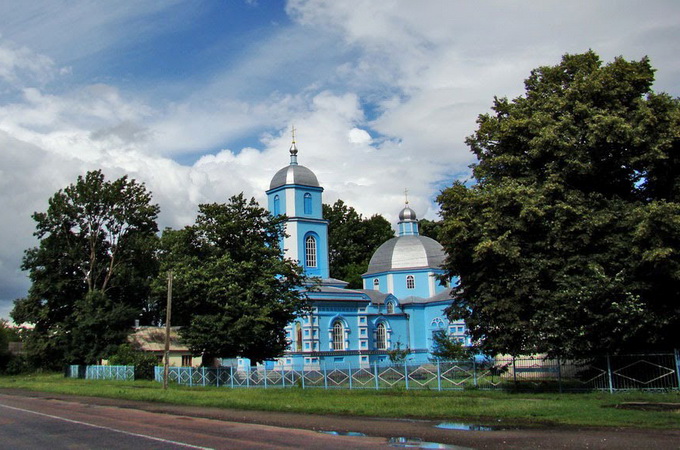
Since the church in the village of Ptichia in the Dubno district was temporarily seized by the judicial authorities, conflicts between the religious community of the Ukrainian Orthodox Church and the supporters of the Kiev Patriarchate have acquired a new colour: the period has seen a lull there in the village, neighbour’s wars and fights have ceased, the two denominations go to specially adjusted premises for regular Sunday and feast services, cherishing a hope that the church doors will once open again. However, if the UOC faithful have to be patient, waiting for the restoration of their legitimate title rights to the church assets, the Kyiv Patriarchate alone has flooded the Ukrainian court with claims, which have long been decided on.
The human rights activist of the UOC eparchy of Rivne Catherine Ivaniuk, having opened recently the Unified State Register of court decisions, made several discoveries. Thus, a resident of the village of Ptichia Alina V. Dubovskaya requested the Rivne Regional Administrative Court to overturn decision №173 of the Rivne Regional State Administration of 25.09.1991, which returned the church property in the village of Ptichia to the religious community of the UOC.
- On her page in the social network Ms. Dubovskaya noted that the date of her birth is 13 April 1990, and she is trying to challenge the decision of 25.09.1991. Therefore, a question arises how this decision violated the rights of an eighteen-month child at the time of its publication. The transfer of ownership to the UOC religious community and the registration of its title rights to the church building were made in accordance with existing legislation at that time. The grounds for declaring the act invalid is its inconsistency with current laws or specific statutory authority jurisdiction that issued the act. A prerequisite for recognizing the act invalid is also violations of the rights and lawful interests of the plaintiff in the case on the date of its adoption, - comments the human rights activist.
During 2016, Alina Dubovskaya has filed 5claims, however, none of them has been considered by the Ukrainian Themis as the plaintiff did not pay the court fee (551 UAH). On August 29, 2016, the supporter of the UOC-KP community of Ptichia managed to pay the court fee and again filed another lawsuit. As follows from the text, Alina Dubovskaya, who has previously positioned herself as a journalist, now calls herself a lawyer and submits a legal request to the Rivne Regional State Administration. Here it is worth noting that, according to the information taken from the Register of Advocates of Ukraine, the lawyer A.V.Dubovskaya does not exist.
Yet, the Rivne RSA addressed the request. Having the document on hands, Ms. Dubovskaya says that before she received the answer from the State Administration she had been unaware of the decision of 25.09.1991or the fact that the Supreme Economic Court confirmed it on 26.01.2016, so she asks the court to consider it is in the Ptichia case. However, the page is a social network of the notorious defender of justice and seeker of truth proves the opposite. Ever since December 21, 2015 Dubovskaya Alina has known about the decision of RSA. Moreover, she wrote about this in her claim to Arsen Avakov, in which she requested him to intervene in the religious conflict in Ptichia village and help the Kiev Patriarchate to take over the church.
Read also
Concubine or daughter? On words that cannot be used about the Church
An archon of the Church of Constantinople likened the UOC to Moscow’s “concubine.” But for St. Epiphanius of Cyprus, “concubines” are heresies.
Shameful chronicle of one week: how the OCU was born
Exarchs under escort, a call from the operations room, and 36 votes for Epifaniy: what a member of the Phanar delegation revealed about the 2018 "Council".
Can UOC eparchies be dissolved before court ruling on Metropolia?
DESS is launching separate proceedings against UOC eparchies, monasteries, and institutions while the case involving the Kyiv Metropolia is still pending.
Two murders, one silence
Zelensky condemned the killing of a Catholic priest in Poland the very same day. A month earlier, a UOC monk was murdered at the Sviatohirsk Lavra – and the president has remained silent ever since.
A bow to Phanar? Why did UOC academy congratulate Constantinople’s exarch?
A delegation from the Kyiv Theological Academy congratulated the Phanar’s exarch, who has remained silent about the persecution of the UOC. Who authorized this gesture, and why did even OCU supporters fail to appreciate it?
“De-Moscowize” for unity: Shevchuk’s recipe for bringing Ukrainians together
The head of the UGCC assures that internal division threatens the country's existence, while simultaneously calling to fight against the "wrong" ones. Is this cognitive dissonance or something more?