
Pantheon instead of monastery: For whom Lavra’s Far Caves were “opened”?
The authorities have ceremonially “opened” the Far Caves that they themselves closed three years ago. Is monastic life returning? No. A very different future is being prepared for the Lavra.
On July 14, 2026, the authorities “opened” the Far Caves of the Kyiv-Pechersk Lavra. Officials and church figures gathered for the ceremony: Culture Minister Tetiana Berezhna, Lavra Reserve Director Maksym Ostapenko, Head of the Institute of National Memory Oleksandr Alferov, MPs Mykyta Poturaiev and Mykola Kniazhytskyi, and, on behalf of the OCU, its head Serhii Dumenko and Avraamiy Lotysh, accompanied by Athonite Archimandrite Bartholomew and several monks.
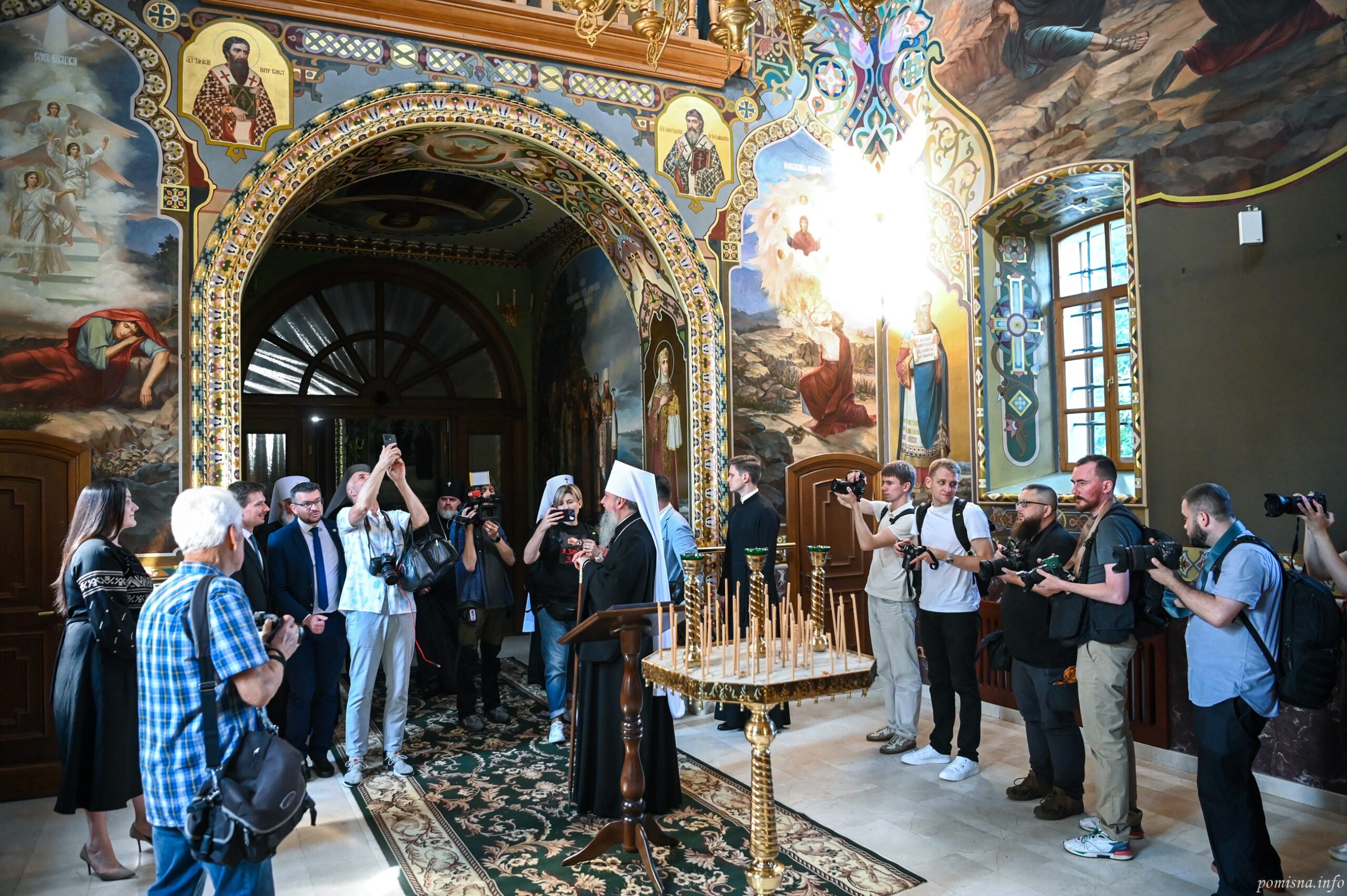
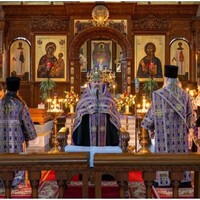
This photograph, taken during the ceremony, perfectly captures what is happening to the Lavra today.
At the center of the Church of St. Anna’s Conception stands Serhii Dumenko. Around him are officials, politicians, photographers. There are no monks. There are no faithful. They are not needed, because none of this is being done for religious life. That is not sarcasm – it is what the participants themselves are saying.
Tetiana Berezhna declared that the state is “returning the Lavra to its historical Ukrainian context” and that it must become a place where people feel themselves part of the “Ukrainian cultural, religious, and state tradition.” On the official website of the Ministry of Culture, the Lavra is described as a “center of Ukrainian state-building.”
Serhii Dumenko called for developing the Lavra “as a Ukrainian and pan-Christian shrine,” eradicating the “Russian world” spirit from it, and praying for the Ukrainian state and military.
If the Lavra was once a functioning monastery whose life revolved primarily around prayer and worship, it is now being transformed into an instrument of state-building.
Who сlosed the Caves that are now being “opened”?
Oleksandr Alferov, head of the Institute of National Memory, claimed that under the UOC the Caves “were effectively closed to a significant part of Ukrainian society for a long time.”
What part of Ukrainian society was that? Whom exactly did the UOC prevent from entering the Caves?
The claim is false.
While the UOC monastic community lived in the Lavra, everyone was allowed into the Caves: Orthodox and Catholics, Ukrainians and foreigners, believers and non-believers alike, regardless of nationality or convictions. There was only one thing absent from the Caves – political agitation. Instead, there was prayer, the Eucharist, and veneration of the saints.
All of that ended on August 10, 2023, when the administration of the Kyiv-Pechersk Lavra National Reserve suddenly announced that the Lower Lavra would be closed to everyone except monks, clergy, and monastery employees. The Ministry of Culture called the measure “temporary.”
That “temporary measure” has now lasted almost three years.
Throughout this period, believers have been unable to freely enter the Caves, venerate the relics of the saints, or visit the holy springs.
Particularly revealing was Alferov’s statement that the “return of the caves to the full control of the National Reserve took place lawfully – through state decisions, inspections, and court proceedings.”
Those words may create the impression that the courts ruled the previous status of the Caves unlawful, ordered them transferred to the reserve, and then directed that they be opened to the public.
None of that is true.
The legal disputes between the monastery and the reserve are far from over. In fact, on June 25, 2026, the Northern Commercial Court of Appeal suspended proceedings in the case concerning the Lower Lavra.
What the “opening” means in practice
On February 24, 2026, the authorities similarly announced the “opening” of the Near Caves. The same officials – Berezhna, Ostapenko, and Alferov – took part.
Behind the attractive public relations campaign, however, was a less attractive reality.
Visits were allowed only from Wednesday through Sunday, only from 9:00 a.m. to 11:00 a.m., only by prior registration, and only in groups of ten people.
A UOJ correspondent later described what the experience was actually like. Visitors were met by representatives of the OCU and a reserve employee. They were then escorted through both the Upper and Lower Lavra, with every movement controlled. Inside the Caves, they were shown only a small section before being led back outside. The entire visit lasted exactly thirty minutes, of which only seven to ten minutes were spent in the Caves themselves.
The rules for the Far Caves are no better.
According to official statements from the Ministry of Culture and the OCU, until August 15 the Caves may be visited only on Fridays and Sundays from 9:00 a.m. to noon. Groups of up to twelve people will be admitted either by reservation or on a first-come, first-served basis. After August 16, the authorities promise to allow tourist visits.
Of course, even such a limited opportunity to pray to the saints of the Caves and venerate their relics is better than a complete ban.
But compared to the freedom of access that existed under the UOC, the current system is a mockery of believers.
This is not pilgrimage. It is not the veneration of a holy place.
It is controlled access to a museum exhibit – nothing more.
Athonite monks for a Ukrainian performance
Another element of the ceremony was the presence of several monks from the community commonly known as New Esphigmenou.
This small monastic brotherhood was established in 2005 as an alternative to the “old” Esphigmenou monastery, whose monks accused Patriarch Bartholomew of ecumenism and refused to commemorate him during services.
Archbishop Jonah (Cherepanov) wrote on Facebook that the visiting Athonite monks cannot fail to know that the Lavra already has rightful custodians – the genuine and numerous UOC brotherhood that prayed within these walls for decades.
It is precisely this brotherhood that is now losing its churches and monastic buildings. It is their faithful who are being denied free access to the shrines.
These are the monks who restored the Lavra from ruins, cared for its churches, and welcomed pilgrims. Yet in the “new Lavra” they are no longer wanted.
A National Pantheon has no need for a monastic brotherhood.
What it does need is a visually appealing display of supposed Athonite support. The abbot of New Esphigmenou provided exactly that.
From a living monastery to a national pantheon
On the same day, July 14, 2026, Serhii Dumenko participated in the unveiling of a memorial to Ivan Mazepa on Lavra grounds and enthusiastically endorsed the creation of the National Pantheon.
According to him, the state should bring home the remains of historical figures buried abroad and rebury them in a specially created pantheon. He also suggested that the memory of contemporary Ukrainian soldiers be commemorated there.
An interesting pattern emerges.
The authorities, together with the OCU and other “approved” religious communities, appear to be attempting to create a kind of alternative set of “caves.” The logic seems to be this: if people venerate the saints, then let them also venerate our “heroes of the pantheon.”
The Lavra is a holy place, and perhaps for that very reason it has been chosen as the platform for a new state ideology – almost a religion of its own, complete with heroes, mythology, monuments, a pantheon, and a religious structure tasked with sanctifying it.
That structure is the OCU. Its role is simple: to provide ecclesiastical approval for the veneration of the “correct” figures of history.
We have seen this before
Yes, we have seen all this before. And not very long ago – only about a century ago.
The Bolsheviks also closed monasteries and lavras. They also expelled monks. They too attempted to replace Orthodoxy with a cult of revolution and Soviet power. They likewise created a pantheon of “heroes”: Lenin, Stalin, Kirov, Dzerzhinsky, and others. Some of them even lay in state as a kind of secular “relics” – not incorrupt, but embalmed.
These men, responsible for the deaths of millions, were venerated almost as saints.
There was also a religious body willing to bless whatever the Soviet government demanded – the so-called Living Church, or Renovationist Church.
The same things happened in the Lavra itself. Monks were expelled. Reserve employees were installed. The relics of the saints were turned into museum exhibits. Foreign delegations were escorted through for carefully staged presentations.
Why do none of today’s participants in this performance realize that they are repeating precisely what the Bolsheviks did?
Why does no one say that, no matter how hard they try, the people will not follow them?
Why does no one cry out, like the child in Andersen’s tale, that “the emperor has no clothes”?
A naked emperor in monastic garb
Andersen’s fairy tale inevitably comes to mind.
Everyone is expected to admire the “revival” of the Lavra, although empty churches stand before their eyes. Everyone is expected to thank the authorities for “opening” the Caves, although it was the authorities who closed them. Everyone is expected to embrace this “authentic Ukrainian spirituality,” although it is little more than a state-directed project.
Let us return to the photograph from the ceremony: Serhii Dumenko, Athonite monks, the culture minister, members of parliament, a prayer service, the caves, state flags, cameras.
But where are the people?
Where are the faithful who filled the Lavra for decades?
They are absent.
They have been driven away, branded supporters of the “Moscow Church,” labeled “wrong” believers and “wrong” Ukrainians, and denied access to the churches and the Caves.
Very well, then where are the “right,” state-oriented believers?
They are absent too – not only from this ceremony but from similar events generally.
The project is attractively packaged, but inside there is emptiness.
And that emptiness must be concealed by organized groups, civil servants, invited monks, politicians, photographers, and reserve employees.
Conclusion
The people of God have not disappeared. They remain where the true Church of Christ is.
Look at how full UOC churches are on ordinary Sundays. Look at how many people come to pray with His Beatitude Metropolitan Onuphry, with bishops and priests.
They come voluntarily. No one forces them. No one buses them in.
They come despite the risk of persecution.
The people continue to go where they believe the true Church is.
In 1848, the Eastern Patriarchs issued their Encyclical, declaring: “The guardian of religion among us is the very body of the Church, that is, the people themselves, who desire always to preserve their faith unchanged and in agreement with the faith of their fathers.”
The Ukrainian church people preserve the piety of their fathers and “do not walk in the counsel of the ungodly.”
For that reason, the outcome is not in doubt.
Difficult times will pass. Black will again be called black, and white will be called white. Free prayer will once more resound in the Caves.
The Bolsheviks pass away – the Lavra remains.
That was true a hundred years ago.
It will be true again.