
How the authorities are trying to destroy UOC abroad
Ukrainian communities across Europe are being accused of espionage and “Russian influence.” The evidence? Holding church services, helping refugees, working with children, and singing Ukrainian Christmas carols.
In July 2026, Kyiv hosted a forum titled “The Russian Orthodox Church in Europe: Infrastructure of Russian Influence,” organized by the Institute for National Resilience and Security. The event brought together representatives of the Office of the President, the Ministry of Foreign Affairs, the Cabinet of Ministers, the Main Intelligence Directorate of the Ministry of Defense, law enforcement agencies, religious organizations, and the expert community. Viktor Yelensky, head of the State Service of Ukraine for Ethnopolitics and Freedom of Conscience (DESS), also took part.
The organizers claimed that up to 130 Ukrainian Orthodox Church (UOC) communities are active across Europe and classified them as part of a network of religious structures linked to the Moscow Patriarchate. However, they presented no evidence demonstrating that any specific UOC parish belongs to either the Russian Orthodox Church or the Russian Orthodox Church Outside Russia (ROCOR).
Even more striking was the way the organizers described the alleged influence of these parishes on Ukrainian refugees: “Influence often does not take the form of direct propaganda. It may come through trust, humanitarian assistance, children's educational initiatives, religious ritual, a familiar environment, a sense of home, and by mimicking Ukrainian communities.”
According to the report, possible signs of such “mimicry” include conducting services in Ukrainian, using Ukrainian names and symbols, and publicly expressing support for Ukraine.
Just consider what this means.
The accusations against these Ukrainian communities are not that they transmit classified information, recruit agents, finance sabotage, or engage in anything of that sort. Instead, they are accused of holding worship services, helping their fellow Ukrainians who have fled abroad, working with children, and giving refugees a sense of home.
But isn't that precisely what any normal church community is supposed to do?
Replacing facts with assumptions
Although the Council of Feofania declared the UOC fully independent from the Moscow Patriarchate, the Church's critics continue to portray Ukrainian parishes abroad as part of the ROC's structure and transfer every accusation leveled against Moscow onto them.
The language of the report presented at the forum is revealing. Everything rests on the word “may.” UOC communities allegedly connected with ROC structures “may serve” as elements of an influence network. Services “may be conducted” in Ukrainian as a form of disguise. Ukrainian symbols “may be used” as camouflage.
This is the language of speculation rather than established fact. Yet in the public sphere, such speculation rarely remains speculation for long. It quickly turns into accusations, and those accusations just as quickly become grounds for state pressure.
In February 2026, the clergy of the UOC's Western European Vicariate responded to similar allegations. They reminded the public of several straightforward facts: the overseas mission was established by the Council of Feofaniya after millions of Ukrainians were forced to leave their homeland because of the war; the parishes abroad are under the omophorion of His Beatitude Metropolitan Onuphry; and both their clergy and founders are Ukrainian citizens. The clergy stated that equating UOC communities with overseas structures of the Russian Orthodox Church is artificial and does not correspond to reality.
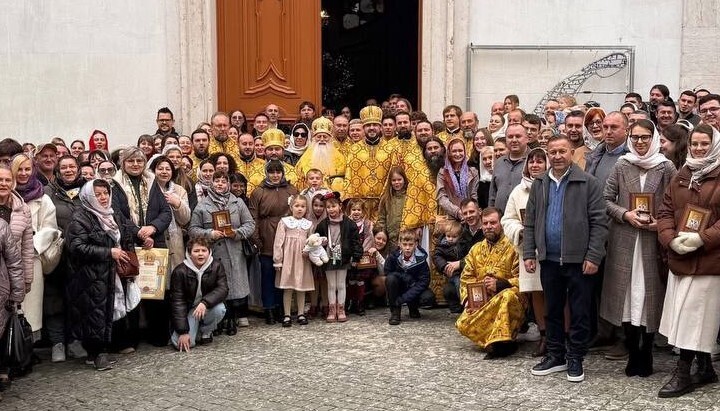
The reasons why UOC parishes have appeared abroad are obvious. Millions of Ukrainians were forced to leave their homeland because of the war. Among them are many faithful members of the UOC who wish to worship in their own Church, participate in the Holy Mysteries, and receive pastoral care. The Church did not abandon them in their time of need but established parishes in many countries.
Yet this entirely natural and understandable response is now being portrayed as a covert operation serving the Kremlin's interests. According to the logic of the accusers, believers do not come to church of their own free will –they are somehow “lured” there. If people receive assistance from these communities, then shadowy forces must be winning their trust. If parishioners find a sense of home in church life, they are supposedly being manipulated. If children participate in parish activities, then a long-term network of influence is allegedly being built.
In other words,
every normal manifestation of church life is turned into an accusation against the UOC.
If you are innocent, you serve as cover
This very argument was voiced by OCU cleric Heorhii Kovalenko, who said: “Not all of them necessarily carry out espionage assignments. The very presence of those who do not can provide excellent cover.”
If you are guilty, then you are guilty. But if you are innocent, you are still guilty because your innocence allegedly provides cover for someone who is guilty, making you an accomplice. It is an absurdity worthy of George Orwell's 1984.
Kovalenko also expressed concern that Ukrainian priests might tell Europeans about the pressure being exerted on their Church, thereby creating “an alternative reality and point of view.”
In other words, telling the truth becomes a crime, while expressing an opinion that differs from the government's position is treated as espionage.
If your husband serves in the Armed Forces, then you are a potential spy
In March 2025, Ukrainian MP Mykola Kniazhytsky accused UOC communities abroad of spreading “enemy propaganda” and suggested that they could function as “spy cells.” He pointed out that among Ukrainian refugees are women whose husbands serve in the Armed Forces of Ukraine and therefore “may possess sensitive information.”
Consider the scale of this reversal of logic. In the patriotic value system, a family in which the husband and father is serving at the front is regarded as a hero's family. Yet if someone in that same family attends a UOC parish, the family suddenly becomes a potential “spy cell.”
Moreover, Kniazhytsky expressed concern that children in these UOC communities take part in traditional Ukrainian Nativity plays and sing Christmas carols. One might think this is among the most patriotic of activities. Yet, in his view, it is merely an attempt to “blend in.” And if a UOC priest provides humanitarian aid and spiritual support to wounded Ukrainian soldiers receiving treatment in Europe, that, too, is considered suspicious.
As the UOJ previously wrote, the logic is absurd: “Your husband serves in the Armed Forces? Then you're a spy. You sing Christmas carols? Then you're pretending.”
If a community does not display a Ukrainian identity, it is branded pro-Russian. If it does, it is accused of “camouflage.” If a priest does not help the military, he is condemned as disloyal. If he does, he is said to be “gaining people's trust.”
Membership in the UOC thus becomes a crime in itself. And, according to an OCU cleric who took part in the seizure of a church in Cherniavka, belonging to the UOC makes a person “an enemy of the people.”'
The campaign against UOC communities abroad
The campaign against UOC communities outside Ukraine did not begin with the 2026 forum. It developed gradually: the accusations became increasingly severe, while evidence never materialized.
In December 2024, Major Archbishop Sviatoslav Shevchuk, head of the Ukrainian Greek Catholic Church, claimed that UOC parishes abroad were allegedly being established by “pro-Russian oligarchs” using Russian money. According to him, priests visit social centers to “lure” Ukrainian refugees and then turn them into a “protest potential” against the policies of the Ukrainian state. As expected, he offered no evidence to support these claims.
In September 2025, OCU head Epifaniy Dumenko discussed with Ukrainian diplomats the activities of what he called the “structures of the Moscow Patriarchate” abroad – by which he meant UOC communities – and their alleged “destructive influence” on Ukrainian refugees.
Yet the OCU did not identify a single UOC parish, cite a single specific violation of the law, name a single victim, or present a single documented case of this supposed “destructive influence.”
What UOC communities abroad actually do
The life of UOC communities abroad is simply the normal life of a church parish: celebrating the divine services, providing pastoral care, preaching the Gospel, and helping anyone in need. A few examples illustrate this.
In March 2025, believers from the UOC's Western European Vicariate raised funds to purchase refrigeration equipment for an evacuation vehicle used to transport the bodies of fallen Ukrainian servicemen as part of the General Staff of the Armed Forces of Ukraine's humanitarian project, "On the Shield."
In December 2025, a UOC parish in Freiburg, Germany, organized a charity concert and fundraiser in support of Ukrainian soldiers.
In September 2025, the city authorities of Cologne presented the UOC parish dedicated to the Pochaiv Icon of the Mother of God with a certificate of appreciation for its volunteer, cultural, and social work. A city representative emphasized that the parish helps Ukrainians integrate into German society while preserving their own cultural identity.
In June 2026, the same parish donated an ultrasound machine to a medical center in Ukraine's Chernivtsi region.
The list could go on. Virtually every UOC parish abroad provides assistance, to the best of its ability, to the Armed Forces of Ukraine, to refugees, and to anyone facing hardship. Yet the Ukrainian authorities and what the author describes as the country's “patriotic public” simply choose not to notice any of this.
What European law says
Ukraine seeks to become a member of the European Union and is investing enormous diplomatic effort into demonstrating its compliance with European standards. Yet what the author characterizes as baseless accusations that UOC believers are spies or spread Russian narratives only undermine that effort.
Every individual has the right to choose the religion and denomination to which they wish to belong. Article 9 of the European Convention on Human Rights protects the freedom to manifest one's religion or belief, individually or together with others, in public or in private, through worship, teaching, religious practice, and observance.
Restrictions on this freedom are permitted only under the conditions expressly set out in paragraph 2 of Article 9. Furthermore, the Guide on Article 9 prepared by the Registry of the European Court of Human Rights specifically notes that "national security" is not among those grounds and cannot serve as an independent justification for restricting religious freedom.
The Church's critics, however, appear to overlook this. The European Convention identifies worship and religious instruction as fundamental expressions of religious freedom, while participants in the Kyiv forum portrayed religious activity, spiritual support, and work with children as possible indicators of hostile foreign influence.
Ukrainian citizens living abroad have every right to belong to whichever religious denomination they choose. No angry statements by officials and no unsubstantiated accusations can deprive them of that right.
Why UOC parishes abroad are subjected to pressure
According to the author, the reason is that the UOC is a Church the state cannot control. This is even more true of its overseas parishes. Simply by existing, these communities demonstrate that Ukrainians can support their country, assist the Armed Forces of Ukraine, speak Ukrainian, and still remain faithful members of the UOC.
In the author's view, this challenges the current state narrative that divides religious bodies into “acceptable,” patriotic confessions, such as the OCU or the UGCC, and an “unacceptable” one – the UOC. That narrative suggests that if you are a patriot of Ukraine, you have no place in the UOC; conversely, if you belong to the UOC, you cannot be a patriot.
Today, the author argues, believers are being presented with a choice: renounce their Church or accept the label of a “pro-Russian element.” No matter how patriotic they may be, they are still accused of being agents of the Kremlin.
Within Ukraine, UOC believers are seeing their churches taken away and their Church subjected to attempts at legal prohibition. Abroad, where the Ukrainian authorities lack such powers, the author contends that they instead resort to discrediting campaigns, diplomatic pressure, and similar methods.
Yet, the author concludes, the Church of Christ cannot be destroyed. In the Book of Acts, the Pharisee Gamaliel warned the Sanhedrin, which was preparing to persecute the apostles: “Leave these men alone! Let them go! For if this plan or this undertaking is of men, it will fail; but if it is of God, you will not be able to overthrow it. You might even be found fighting against God” (Acts 5:38–39).
The Church does not exist by permission of government officials or by the favor of the state. As long as believers gather around Christ and the Holy Eucharist, it remains the Church – and no campaign to discredit it can change that.