On OCU’s сanonical mindset, or “your suspension is invalid”
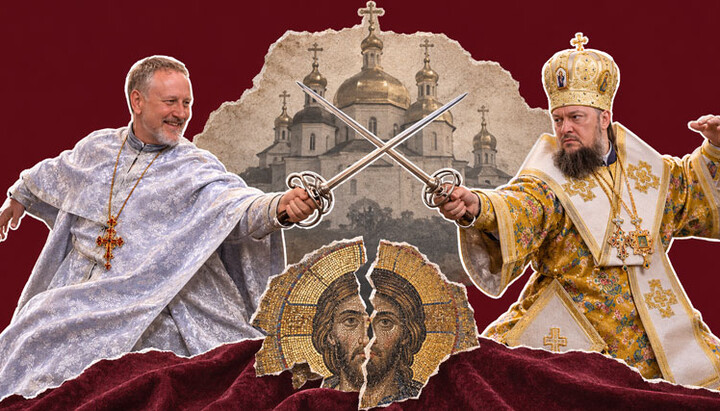
The case of an OCU cleric who refused to obey his own “bishop,” along with other similar incidents, raises questions about the canonical mindset of the OCU’s “clergy.”
OCU cleric Yurii Matveitsov was suspended from priestly ministry by his “archbishop,” Herman Semanchuk. But rather than comply, he declared the suspension “canonically null and void,” accused the hierarch of usurping power, and announced that he would continue serving as though nothing had happened.
“My authority as dean and parish rector remains in force,” Matveitsov assured his parishioners, adding that Liturgies, sacraments, and other religious services would continue to be celebrated at his church.
Priests sometimes disagree with bishops. Bishops sometimes make unjust decisions. Abuses of authority happen. But for a priest to simply declare his “bishop’s” decision invalid reveals a particular kind of religious mindset. And the OCU has no shortage of similar cases.
The “bishop” suspends, the “priest” refuses
Matveitsov accused Semanchuk of usurping authority, unlawfully interfering in parish affairs, attempting to seize church property, and even using the threat of military mobilization to pressure clergy who had fallen out of favor.
These accusations may well be justified. But can a “priest” simply declare his “bishop’s” decisions canonically invalid at his own discretion?
Even the OCU’s own charter presents a very different understanding of episcopal authority. It states that a diocesan bishop leads the local Church through authority inherited from the holy apostles, possesses the fullness of hierarchical authority, appoints and dismisses clergy, and serves as the court of first instance in ecclesiastical proceedings.
But the issue goes beyond the OCU’s charter.
The obedience of presbyters to their bishop is one of the fundamental principles of Church governance, dating back to the earliest centuries of Christianity.
As early as the beginning of the second century, Hieromartyr Ignatius of Antioch wrote: “Let no man do anything connected with the Church without the bishop” (Epistle to the Smyrnaeans).
He also wrote: “Let all reverence the deacons as Jesus Christ, and the bishop as Jesus Christ, who is the Son of the Father, and the presbyters as the council of God and assembly of the apostles. Apart from these, there is no Church” (Epistle to the Trallians).
Apostolic Canon 39 requires presbyters and deacons to do nothing without the consent of their bishop: "Let not the presbyters or deacons do anything without the sanction of the bishop; for he it is who is entrusted with the people of the Lord, and of whom will be required the account of their souls."
Commenting on this canon, the 12th-century Byzantine canonist John Zonaras wrote: “Presbyters and deacons who are under the authority of the local bishop are not permitted to do anything on their own.”
There are many similar canonical rules and statements by the Church Fathers. They repeatedly affirm that the bishop is a successor to the apostles and the visible center of unity in the local Church, entrusted by the Church with administering the sacraments and bringing people into communion with God.
A priest, in turn, receives his authority to celebrate the sacraments from his bishop. He does not act independently but ministers under the bishop’s authority and only in communion with him.
Of course, this does not mean that a bishop is infallible or that every decision he makes is necessarily correct. A priest certainly has the right to challenge orders he considers unjust. Canonical procedures for appeal exist precisely for that purpose.
What he cannot do is unilaterally declare those orders invalid before an ecclesiastical court has ruled on them.
Yet that is exactly what we see in Matveitsov’s case. For him, episcopal authority apparently exists only as long as he approves of the bishop’s actions.
When a church becomes private property
Matveitsov’s case is far from unique. In fact, a similar conflict has already occurred in the same Kamianets-Podilskyi Eparchy.
In February 2024, Herman Semanchuk was appointed head of the OCU’s newly established eparchy. However, dean “Archpriest” Oleksandr Tsysar refused to let him enter the Church of Sts. Peter and Paul in Kamianets-Podilskyi, where the “bishop” was supposed to meet with the clergy. As a result, the ceremony had to be moved to a village church.
The picture is striking. A “bishop” arrives in his own eparchy, only to find that a local “priest” refuses to admit him to the church.
Orthodox ecclesiology is effectively turned upside down. Instead of a priest ministering with his bishop’s blessing, the bishop can serve in a church only with the rector’s permission.
Consider a few more examples.
In April 2020, Uzhhorod “Bishop” Varsonofiy Rudnyk suspended his cleric Anatolii Natolochnyi for disobedience and failure to comply with directives. The suspension notice stated that any cleric who dared to serve despite the prohibition should be “completely cut off from the Church.”
Nevertheless, Natolochnyi soon resurfaced under another OCU “bishop,” Viktor Bed, and even began receiving awards there.
In October 2025, OCU cleric Yaroslav Yasenets announced that he was withdrawing from Epifaniy Dumenko’s jurisdiction, citing disagreement with his policies and leadership methods.
He also declared in advance: “I do not consider any subsequent suspensions, sanctions, or decisions concerning me to be valid.”
In April 2026, OCU cleric Oleksandr Halas made a similar announcement. He, too, declared that he was leaving the organization and would not recognize any potential suspensions or sanctions imposed by its leadership.
To be fair, Yasenets and Halas announced their departure from the OCU, whereas Matveitsov continues to consider himself one of its clerics.
Yet all these cases reveal the same attitude toward ecclesiastical authority: personal opinion takes precedence over decisions made by the “hierarchy.”
Why do OCU clerics demonstrate this attitude with such remarkable consistency?
Perhaps the answer lies in the history of the organization’s creation.
The OCU was established in 2018 through the merger of two religious groups whose hierarchies were not in canonical communion with the fullness of the Orthodox Church. Filaret Denysenko had personally been anathematized – a fact recognized by every Local Orthodox Church, including the Patriarchate of Constantinople. It was while under this anathema that Filaret performed the “ordinations” of a significant number of the “bishops” and “priests” who now serve in the OCU.
In other words, these individuals had become accustomed from the outset to disregarding canonical rules and the judgment of the wider Church.
Then the Patriarchate of Constantinople established the OCU through an administrative decision, granted it a Tomos, recognized its “hierarchy,” and so forth. But can an administrative decision change people’s religious mindset? Can it instill an understanding of the Church as a divine-human organism in which obedience to the bishop flows from the very nature of ecclesiastical unity?
From the revered hierarch to an elderly man in cognitive decline
The OCU’s attitude toward Church authority is evident not only among ordinary clergy. The behavior of its leaders is no less revealing.
Consider Filaret Denysenko.
Before the OCU was established, Filaret enjoyed virtually unquestioned authority within the Kyiv Patriarchate. Yevstratii Zoria, one of his closest associates, publicly called him “our Teacher,” “our Elder,” and “our Patriarch.”
But as soon as Filaret announced his break with the OCU in 2019, Zoria began portraying him as an elderly man suffering from age-related mental decline. “It is very disappointing to talk about it and it’s not my personal impression, but a lot of specialists who have reflected on what is happening said that it is largely related to age-specific changes typical of elderly people,” he said.
Zoria later publicly speculated about the possible effects of medication on Filaret’s condition. The dispute escalated to the point that, in August 2019, Filaret filed a defamation lawsuit against his former ally.
Even more revealing is the reverse transformation in the OCU’s portrayal of Patriarch Theodoros of Alexandria.
In 2015, when he supported the canonical UOC and urged Ukrainians to remain faithful to Metropolitan Onuphry, Zoria dismissed his support as “Alexandrian paid publicity” and suggested that the Patriarch’s opinion had been bought.
But once the Patriarchate of Alexandria recognized the OCU in 2019, attitudes toward Theodoros changed dramatically.
By February 2021, Zoria was speaking warmly of him: “Not so long ago, Patriarch Theodoros of Alexandria was considered ‘Moscow’s main ally,’” he recalled, adding that now “we all rejoice in the support of the Churches of Alexandria, Cyprus, and Greece.”
In other words, for OCU members, what is right and “canonical” appears to be whatever serves their interests at a particular moment.
And if leading OCU spokesmen can change their assessments of prominent Church figures whenever they see fit, should it surprise us that ordinary “priests” do the same?
What if a council decides otherwise?
Now imagine that a Pan-Orthodox Council is convened to resolve the Ukrainian Church issue. The Churches of Albania, Poland, Romania, and Jerusalem have supported such an initiative. In 2020, Patriarch Theophilos III of Jerusalem even convened a meeting of Church primates in Amman to discuss the issue.
Suppose the council decides that, to restore unity, OCU “clergy” must receive canonical ordinations. This is an entirely plausible scenario, since many Local Orthodox Churches identify the lack of valid ordinations as one of the principal obstacles to recognizing the OCU.
How would the OCU leadership respond to such a conciliar decision? Would it accept the ruling or declare it “canonically invalid”?
The answer is far from obvious.
Significantly, in October 2026, Epifaniy Dumenko compared the UOC’s demands concerning the OCU’s canonical status to terms of surrender. Responding to the demand that the OCU acknowledge problems with the canonical standing of its hierarchy, he declared: “But we will never accept this, because we have fought and will continue fighting to the end.”
Of course, Epifaniy is currently disputing the issue with the UOC, not with a Pan-Orthodox Council. But if a future decision by the wider Church proves equally unacceptable to the OCU, might its leaders also denounce it as another attempt to force their “surrender”?
And might the Orthodox world then hear the same response Herman Semanchuk has now heard from Matveitsov: We do not recognize it. We consider it invalid. We will continue serving as before.
A Church or a civic organization?
Critics of the OCU argue that this religious organization cannot be considered a Church because it admitted excommunicated schismatics without repentance and because its “hierarchy” lacks canonical ordinations.
OCU supporters reject these arguments.
Yet beyond questions of formal canonical status, there are other considerations: the forcible seizure of churches, intimidation of UOC clergy and believers, and false accusations directly contradict the Church’s moral teachings.
Equally revealing is the OCU’s canonical mindset, as illustrated by the cases discussed above.
The Church is the Body of Christ. Its unity rests on a shared faith, the Eucharist, and apostolic succession. A bishop is not the head of an administrative division. He is an image of Christ, a shepherd without whom there is no Church. This is the exalted understanding of episcopal ministry taught by the Church Fathers.
Yet within the OCU, we see numerous examples of a very different attitude toward “bishops.” Their authority is recognized only as long as they act in the interests of those who are supposed to obey them. The moment a “hierarch” makes an unwelcome decision, his authority ceases to be sacred, and he becomes an ordinary administrator whose orders can simply be ignored.
This raises a question: How is such a structure fundamentally different from an ordinary civic organization, where members can challenge leadership decisions, establish new associations, and leave existing ones?
After all, through their actions, Matveitsov and others demonstrate that, in their eyes, a bishop is not a shepherd appointed by God but an administrator whose authority ends wherever their disagreement with his decisions begins.
And if that is the case, can the OCU truly be called a Church?