Insults instead of canons: Why the OCU brands Patriarch Kirill a heretic
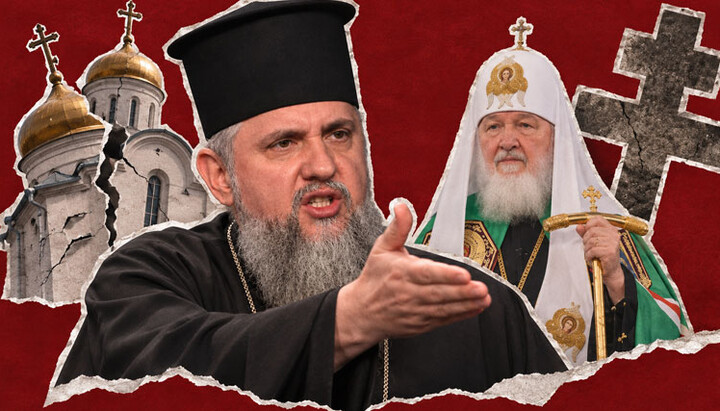
The OCU Synod's November 19, 2026, statement branding Patriarch Kirill a heretic came just eleven days before a meeting of Church Primates at the Phanar. What kind of document is it – and how seriously should it be taken?
On November 19, 2026, the OCU Synod met in Kyiv and issued a document titled "Statement on the Anti-Church and Heretical Activities of Kirill (Vladimir Gundiayev), Head of the Moscow Patriarchate." The timing was hardly accidental, and the text makes no attempt to hide it: it opens by noting that its target has turned 80. Celebrations marking Patriarch Kirill's 80th birthday are taking place in Moscow on November 20, 2026, and the statement was clearly timed to coincide with them. But that was not the only reason, as we shall see.
The document makes several accusations. It calls Patriarch Kirill a successor to Nestorius, the Monothelites, and the iconoclasts. It brands his book War: Beyond Visible Causes and Consequences an exposition of impious teachings, pagan and Manichaean in spirit. It condemns his 2022 sermon suggesting that death in war washes away sins, along with a Russian Orthodox Church Synod document concerning the reception of believers from Ukrainian schismatic groups.
The statement ends by addressing the Patriarch with the familiar singular "you," invoking a biblical passage from the Epistle of Jude, and proclaiming the Greek word Anaxios – "Unworthy."
But what is most shocking about the document is its tone: deliberately mocking and insulting. It reads more like a polemical hit piece than a serious theological or canonical statement.
The real question, however, is not how harshly the statement is worded. It is what the document actually amounts to in terms of canon law, history, and basic logic.
A document without canons – or a verdict
Accusations of heresy follow a specific procedure in Church tradition. First, the accuser identifies the dogma allegedly violated. Next come the accused person's actual words, followed by a reference to the council that condemned the teaching in question. If necessary, the matter of convening a new council is raised.
The OCU's November 19 statement does none of this.
It cites not a single canon allegedly violated by the Patriarch, not one passage from his book with a page reference, and not one dogma contradicted by his supposed teaching. Indeed, it never even explains what that teaching is or what it consists of. The Ecumenical Councils receive only a passing mention, with no indication of which council condemned which teaching attributed to Patriarch Kirill.
Nor does the statement contain an actual ruling. The OCU Synod excommunicates no one, summons no one to trial, and asks no Church authority to examine the alleged new "heresy."
The contrast with a document issued four years earlier is striking.
On July 27, 2022, the same OCU body appealed to Patriarch Bartholomew and the Primates of the Local Orthodox Churches with three requests: condemn the "Russian world" doctrine as heretical, recognize Patriarch Kirill's activities on the canonical territory of the Patriarchate of Alexandria as schismatic, and strip him of the right to occupy the Moscow patriarchal throne.
Whatever one's assessment of that appeal, it at least followed a procedural logic. It identified an accusation, an authority to address, and a specific request.
Four years later, there has been no public announcement that the request was ever examined. More remarkably, the OCU's new statement does not even mention the 2022 appeal. It merely says that the Synod is once again affirming its position.
In other words, in 2022 the OCU requested a trial. In 2026, having received none, it simply announced the verdict itself – skipping both the investigation and the proceedings.
The statement also contains a factual error. It dates the Russian Orthodox Church Synod's decision on receiving believers from Ukrainian schismatic groups to October 2, 2026. In fact, Resolution No. 83 was adopted at the Holy Synod's October 22 meeting.
A minor mistake, perhaps. But in a document accusing the Primate of a Local Church of heresy, it is revealing. Apparently, no one bothered to check even the dates.
What exactly is the OCU "Synod" quoting?
The central piece of evidence in the statement is the book War: Beyond Visible Causes and Consequences, published by the Moscow Patriarchate's publishing house in late July 2026.
Here, we need to distinguish three different layers of material that the OCU statement lumps together.
The first is the publisher's promotional description.
The language about the metaphysics of war, its redemptive significance, metaphysical frontiers, and Russia's historical purpose – the very language with which the "Synod" opens its accusations – comes from the publisher's announcement, circulated by its press office and subsequently reproduced in news reports.
For the OCU's "synodal fathers," a brief reminder: publishers write promotional descriptions. Building a heresy case on one is rather like judging an author's theology by the address of the printing house.
The second layer is the book itself, and matters are more complicated here.
According to historian Ilya Venyavkin's analysis, this is not an original theological treatise. Editors assembled it from fragments of sermons, reports, and speeches delivered over several years. A single chapter may combine five excerpts from addresses given between 2022 and 2024. The material was compiled by an outside editor.
The words belong to the Patriarch, but the structure, sequence, and juxtaposition of passages belong to the editor. In the process, the context of each original address is lost.
It is methodologically indefensible to extract a coherent "teaching" from such an editorial compilation and declare it heretical without examining the individual sermons.
That would require studying each sermon in full, with its date, occasion, and context. The OCU did nothing of the sort.
Another detail is telling. The accusations in the OCU statement almost exactly mirror a journalistic summary of the book: the blurring of the distinction between martyr and soldier, the term "co-crucifixion," and the explanation that victory has not come because mobilization has been insufficient.
All these points appeared in a review published back in August. One gets the impression that the OCU statement's authors were working not from the book itself but from newspaper articles about it.

The third layer consists of texts unrelated to the book.
These include Patriarch Kirill's September 25, 2022, sermon, in which he said that dying in the performance of military duty constitutes a sacrifice that washes away all sins, and a declaration adopted by the World Russian People's Council on March 27, 2024, describing the so-called "military operation" against Ukraine as a holy war.
These texts are authentic, and they deserve serious examination.
But the World Russian People's Council's declaration was adopted by a public organization, not by the Russian Orthodox Church's Council of Bishops or its Synod. It therefore cannot be regarded as an official doctrinal document of the Russian Church.
We will return to the sermon below.
Heresiarchs from the throne of Constantinople
Perhaps the most unexpected passage in the OCU statement is the spiritual "genealogy" it constructs for Patriarch Kirill.
It calls him a successor to the heresiarch Nestorius; the Monothelites Sergius, Pyrrhus, Paul, and Peter; and the iconoclasts Anastasius, Constantine, and Nicetas.
The list is clearly designed to sound formidable. But every person named shares one feature that the authors apparently overlooked – most likely through ignorance. Every one of these heresiarchs occupied the see of Constantinople.
Nestorius was Archbishop of Constantinople and was condemned by the Third Ecumenical Council at Ephesus in 431.
Sergius, Pyrrhus, Paul, and Peter were Patriarchs of Constantinople in the seventh century. The Sixth Ecumenical Council anathematized all four Constantinopolitan Patriarchs as Monothelites, along with others, including Pope Honorius and Patriarch Macarius of Antioch.
Anastasius, Constantine, and Nicetas were successive Patriarchs of Constantinople during the eighth-century iconoclastic period. They were condemned by the Seventh Ecumenical Council.
If the authors of the OCU statement were unaware of this, we recommend that they familiarize themselves with the history of these councils, described in detail by A. P. Lebedev.
So all eight names belong to former heads of the Church of Constantinople.
If "successor" is understood in its usual ecclesiastical-historical sense – succession to a particular see – then the list identifies predecessors of Patriarch Bartholomew, not Patriarch Kirill.
The Moscow see has no historical, geographical, or, for that matter, theological connection to these figures.
One might object that the authors meant spiritual kinship. But then they would need to demonstrate what that kinship consists of.
Nestorius was condemned for dividing Christ into two persons. The Monothelites taught that Christ had only one will. The iconoclasts rejected sacred images.
The OCU statement attributes none of these teachings to Patriarch Kirill. Nor does it establish any connection between the Christological controversies of the fifth through eighth centuries and his sermons about war.
In short, the OCU used the names of ancient heresiarchs as insults – and chose them so poorly that they inadvertently reminded readers of a distinctly inconvenient fact for the Phanar: the throne of Constantinople has repeatedly been occupied by men condemned as heretics by Church councils.
Primacy of honor has never meant infallibility.
Patriarchs and war: Where does a disputed opinion end and heresy begin?
Strip away the grandstanding and outright farce, and one substantive accusation remains: Patriarch Kirill draws a parallel between a soldier's death and martyrdom, suggesting that death in war is a sacrifice that washes away sins.
This objection cannot simply be dismissed. It rests on a genuine canonical tradition.
Canon 13 of St. Basil the Great does not equate killing in war with ordinary murder, but it recommends that soldiers abstain from Communion for three years.
In his commentary on this canon, the Byzantine canonist Zonaras recounts how Emperor Nikephoros Phokas demanded that soldiers killed in battle be recognized as martyrs. The bishops of the time refused, citing precisely St. Basil's canon.
Thus, the words of Patriarch Kirill's 2022 sermon can certainly be challenged – and have been, including by writers on our website. Others, however, argue that the Patriarch said nothing unprecedented in Church tradition.
But a highly controversial judgment and a heresy are two different things.
Heresy involves the conscious and persistent rejection of dogma, and declaring someone a heretic requires a conciliar judgment.
An imprecise or even erroneous statement in a sermon calls for theological examination, not an anathema. The example of Nikephoros Phokas makes the distinction clear: the bishops rejected the emperor's demand, but no one declared him a heretic.
The accusation of Manichaeism also collapses when tested against the very text on which the OCU Synod relies. Manichaeism teaches the existence of two equally powerful principles, one of light and one of darkness. Yet the book's promotional description explicitly states that the outcome of war is determined by God – a claim incompatible with such dualism.
Finally, Church history offers countless examples of Primates supporting wars waged by their own states. The throne of Constantinople is no exception.
In January 2018, for example, Patriarch Bartholomew sent a letter to Turkish President Recep Tayyip Erdoğan concerning Operation Olive Branch in Syria's Afrin region, saying that the Patriarchate was praying for the operation's success.
Turkish media at the time quoted him as saying: "We wish success to you personally and to the Turkish army."
In 1821, under pressure from the Ottoman authorities, Patriarch Gregory V of Constantinople condemned the Greek insurgents who had risen against the Ottoman Empire.
Neither Patriarch was declared a heretic for these actions. Indeed, Patriarch Gregory V is venerated as a hieromartyr.
A Primate's political position may be considered mistaken or even sinful. That does not automatically make it a dogmatic offense.
Apply the same standard consistently, and Church history offers a vast number of other cases that would have to face similar accusations.
Who has the authority to judge the Patriarch
The canons describe the trial of a bishop as a procedure, not a press statement.
Apostolic Canon 74 requires that an accused bishop be summoned to trial by other bishops. If he fails to appear, he must be summoned a second and third time, with two bishops sent to deliver the summons. Only then may the council reach a decision.
Canon 12 of the Council of Carthage stipulates that even an extraordinary trial of a bishop must involve twelve bishops.
The accused must be summoned and heard, and the case must be judged by those with jurisdiction over him.
The Primate of a Local Church is subject to the council of his own Church or, in exceptional circumstances, to a broader council involving other Primates.
Russian Church history provides an example.
Patriarch Nikon was tried by the Great Moscow Council of 1666–1667, attended by the Patriarchs of Alexandria and Antioch alongside Russian bishops. The question of summoning Nikon three times was considered separately.
Even that trial, which historians have criticized on numerous grounds, observed the formal procedure: a council, a summons, specific charges, and a verdict.
The OCU Synod is neither Patriarch Kirill's own council nor a council of Church Primates.
It is the governing body of another ecclesiastical structure – one that, moreover, remains unrecognized by most Local Orthodox Churches.
Such a body may express an opinion about another Church leader's teachings. But it has no authority to rule on that Primate's canonical standing.
Yet that is precisely what the statement's final exclamation attempts to do.
The cry of Anaxios – "Unworthy" – is associated with deposition from holy orders. It is pronounced following a trial by those who have rendered the judgment.
Uttered in absentia, without a trial or the necessary authority, it remains an empty accusation. Worse, it raises a host of questions whose answers may prove uncomfortable for both the OCU and other Churches.
The authors seem to recognize this themselves.
Their statement acknowledges that many people still regard its target as a Patriarch. Yet its authors never once address him by that title, referring to him only as the head of the Moscow Patriarchate.
The result is a document that denies a man's ecclesiastical standing while simultaneously acknowledging that many others continue to recognize it.
Why now?
The first explanation is obvious. The statement was timed to coincide with Patriarch Kirill's 80th birthday and intended to make a splash amid the congratulations.
But there is a second circumstance that cannot be ignored.
Patriarch Bartholomew has invited the Patriarchs of Alexandria, Antioch, and Jerusalem to a meeting at the Phanar on November 30, the feast of the Apostle Andrew.
Officially, the meeting's purpose is broadly defined: to examine together the major challenges facing the Church, within the framework of the ancient Pentarchy.
This raises a possibility: the statement may have been prepared with that meeting in mind, as a reminder of the OCU's 2022 appeal, intended to place the question of Patriarch Kirill before the four Patriarchs.
Perhaps the meeting itself was even envisioned as a forum for discussing such a trial.
The timing and the Greek exclamation at the end of the OCU statement lend some support to this theory.
Another possibility is that the statement followed a "recommendation" from colleagues at the Phanar: perhaps someone thought it would be useful to remind everyone that Patriarch Kirill had already been accused of heresy.
But if such instructions were given, their execution was so careless and comical that it risks embarrassing the supposed initiators themselves.
The form, tone, and selection of "facts" are so poorly judged that the document is unlikely to be taken seriously anywhere.
That makes it equally unlikely that anyone will place it before the Primates gathering at the Phanar on November 30.
For if the statement is taken seriously, as its authors may have intended, it produces consequences about which the OCU has said remarkably little.
Church canons do not recognize a situation in which someone is declared a heretic and unworthy of holy orders while communion with him remains a matter of personal preference.
Apostolic Canon 10 excommunicates anyone who prays with an excommunicated person, even in a private home.
Apostolic Canon 45 excommunicates a bishop, priest, or deacon who merely prays with heretics. If he recognizes them as ministers of the Church, he is to be deposed.
Canon 2 of the Council of Antioch excludes from communion any cleric who maintains communion with those who have been excommunicated.
Canon 33 of the Council of Laodicea prohibits praying with heretics or schismatics.
All four canons express the same principle: those who remain in communion with someone formally condemned share in the consequences of that condemnation.
Now consider who remains in communion with Patriarch Kirill.
The Patriarchate of Constantinople continues to commemorate the Patriarch of Moscow according to the order of the diptychs.
Thus, by the OCU's logic, Patriarch Bartholomew commemorates at every Liturgy a man whom the very structure he established has called a heretic and a successor to ancient heresiarchs.
The cases of the Patriarchs of Antioch and Jerusalem are even more striking.
On November 20, the day after the OCU statement, Patriarch Kirill presided over the Divine Liturgy at Moscow's Cathedral of Christ the Savior.
Concelebrating with him were Patriarch Theophilos of Jerusalem, Patriarch John of Antioch, Patriarch Porfirije of Serbia, and Metropolitan Rostislav of the Czech Lands and Slovakia.
This was not merely the commemoration of a name in the diptychs. It was concelebration at the same altar and Communion from the same Chalice.
If Patriarch Kirill is a heretic, then, according to this reasoning, Apostolic Canon 45 applies directly to the Patriarchs of Jerusalem, Antioch, and Serbia, as well as Metropolitan Rostislav.
But the same conclusion would also affect the OCU itself.
Its Tomos requires its head to commemorate the Ecumenical Patriarch and all the Primates of the Local Orthodox Churches in the order of the diptychs.
The OCU removed Patriarch Kirill's name from its diptychs in 2022.
Yet Dumenko continues to commemorate Patriarch Bartholomew, Patriarchs John, Porfirije, and Theophilos, and Metropolitan Rostislav.
If his Synod's position is correct, then he is commemorating those who pray and serve with a heretic. Under Canon 2 of the Council of Antioch, Dumenko himself would therefore fall outside communion.
There is only one way out of this contradiction – and the OCU once supplied it.
In January 2019, explaining why "Metropolitan" Epifaniy had commemorated Patriarch Kirill during the Liturgy, OCU spokesman Yevstratiy Zoria wrote that such commemoration was necessary until the Primate had been canonically condemned.
That is correct.
The canons cited above concern those condemned by a Church court, not people merely labeled heretics in a statement.
But the reverse must also be acknowledged.
If there has been no trial, there has been no canonical declaration of heresy, no valid Anaxios, and no canonical substance to the November 19 statement.
So if the theory is correct that the statement was intended to lay the groundwork for a trial of Patriarch Kirill, it has achieved precisely the opposite.
A meeting of four Primates is not, by itself, a court under the canons cited above. A trial requires summoning the accused and presenting charges that can be examined.
Putting a pamphlet before the Patriarchs – one containing not a single canon, a mistaken date, and a list of heresiarchs who once occupied the throne of Constantinople – would only weaken the case.
How it looks from the outside
Someone unfamiliar with canon law will judge the document by its tone. And here the statement makes a bizarre impression.
The Primate of a Local Church is compared to the high priests Annas and Caiaphas and to a cancerous tumor. He is accused of collaborating with intelligence services without a shred of evidence. He is addressed by his first name and the familiar "you."
And so on.
Is this really supposed to be a conciliar judgment?
Readers familiar with Ukrainian culture will inevitably be reminded of the legendary letter from the Zaporozhian Cossacks to the Turkish sultan.
There, too, the addressee is showered with insulting nicknames, and the letter is written not to elicit a response but to deliver an insult.
The comparison is worth pursuing.
Researchers regard that famous letter not as a diplomatic document but as a literary satire composed by writers and incorporated into anti-Turkish polemical literature.
In other words, it belongs to a genre written for the already convinced. Its intended audience reads it for pleasure, not persuasion. It changes no minds among those who have doubts.
And that is the OCU statement's greatest weakness.
Across the Orthodox world, many people are deeply critical of Patriarch Kirill's rhetoric about the war. They would be willing to consider a calm, serious theological examination of his sermons.
Instead, they have been offered Kvartal 95 in cassocks.
A serious reader will put such a text aside. It will merely reinforce the impression that the OCU is acting not as a Church council but as a political organization speaking the language of farce.