How are thugs at UOC court hearings different from those in Borshchahivka?
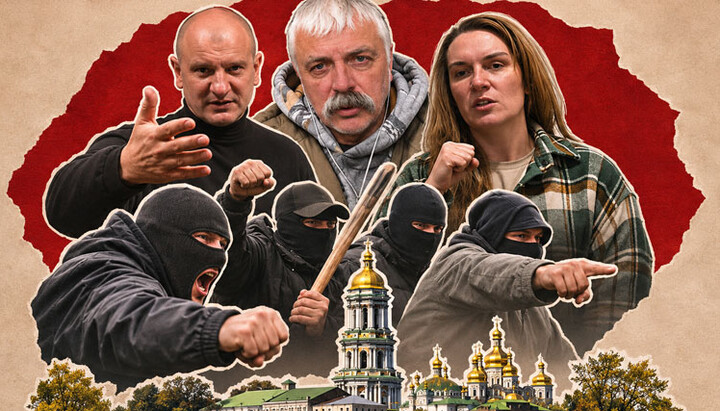
The reaction to events in Petropavlivska Borshchahivka recalls the years-long campaign against the UOC. The same people, the same accusations – and the same lack of evidence.
On November 9, 2026, Volodymyr Zelensky visited the Kyiv-Pechersk Lavra. Not to pray or reflect on spiritual matters. His purpose was more straightforward: he decided to use the Refectory Church to meet with popular entertainers and present them with awards. The meeting could have taken place anywhere – at the Presidential Office, Mariinsky Palace, Ukrainian House, or any of a hundred other venues in Kyiv. But Zelensky chose the Lavra. Why? After all, he did not say a single word there about faith or Christianity.
The reason seems obvious: Zelensky regards the Kyiv-Pechersk Lavra as one of the government's own facilities, available for routine state events.
Meanwhile, the Ukrainian Orthodox Church continues its fight for its holy site. Several court hearings are scheduled for November alone. But rather than focus on the twists and turns of the legal proceedings, I would like to draw attention to what has been happening around them in recent months.
Just six months ago, the hearings were relatively quiet and peaceful. At some point, however, UOC attorneys and believers became the targets of a series of apparently coordinated attacks – both in the media and through physical intimidation.
As it happens, these attacks began in the summer, after a Russian drone struck the Dormition Cathedral and the Lavra became a recurring theme in Zelensky's public statements. Since then, dozens of international delegations have visited the monastery, and several foreign governments have allocated substantial funds for the cathedral's restoration. The Ministry of Culture regularly holds symposiums and conferences in the Lavra's churches, while Olena Zelenska organizes the Summit of First Ladies and Gentlemen. On August 15, Zelensky also staged a formal state ceremony at the Lavra marking the monastery's 975th anniversary.
This surge in government activity surrounding the Lavra coincided, remarkably, with increased activity by self-described "patriots" at court hearings. Young men wearing balaclavas began arriving and staging various "protests." Among them were well-known figures from radical movements: Bratstvo leader Dmytro Korchynskyi; Davyd Pshenychnyi, one of the organizers of the seizure of the cathedral in Cherkasy; and members of Yevhen Karas's Osnova Maibutnioho (Foundation of the Future), formerly C14. Current and former members of parliament, including Solomiia Bobrovska and Andrii Lozovyi, also attended the hearings.
UOC attorneys have already been physically attacked, while groups of activists have intimidated believers in courthouse hallways. The activists then proudly posted videos of their actions online.
Here is what providnyk.project, which brings together nationalists from Osnova Maibutnoho, Chorni Korsary, Providnyk, and other organizations, wrote:
"Fights right inside the courtroom during trials of the FSB-linked UOC have already become a tradition. Veterans and patriots need to force their way into the courtroom to hear the case concerning the eviction of Russia's mercenaries from the Kyiv-Pechersk Lavra. We need to fight our way into court – and we're ready."
Notably, these activists are transported to courthouses in organized groups aboard minibuses that, according to media reports, were purchased for military needs.
This is the muscle behind the campaign: its role is to intimidate lawyers and parishioners who come to court to support the Church.
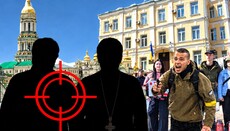
There is also a media component. At one of the latest hearings, MP Solomiia Bobrovska called UOC believers "brainwashed admirers of the Russian world" and said she expected the Security Service of Ukraine (SBU) to respond to the Kyiv-Pechersk Lavra proceedings. Andrii Lozovyi, meanwhile, used crude graphics like these to summon his supporters to court.
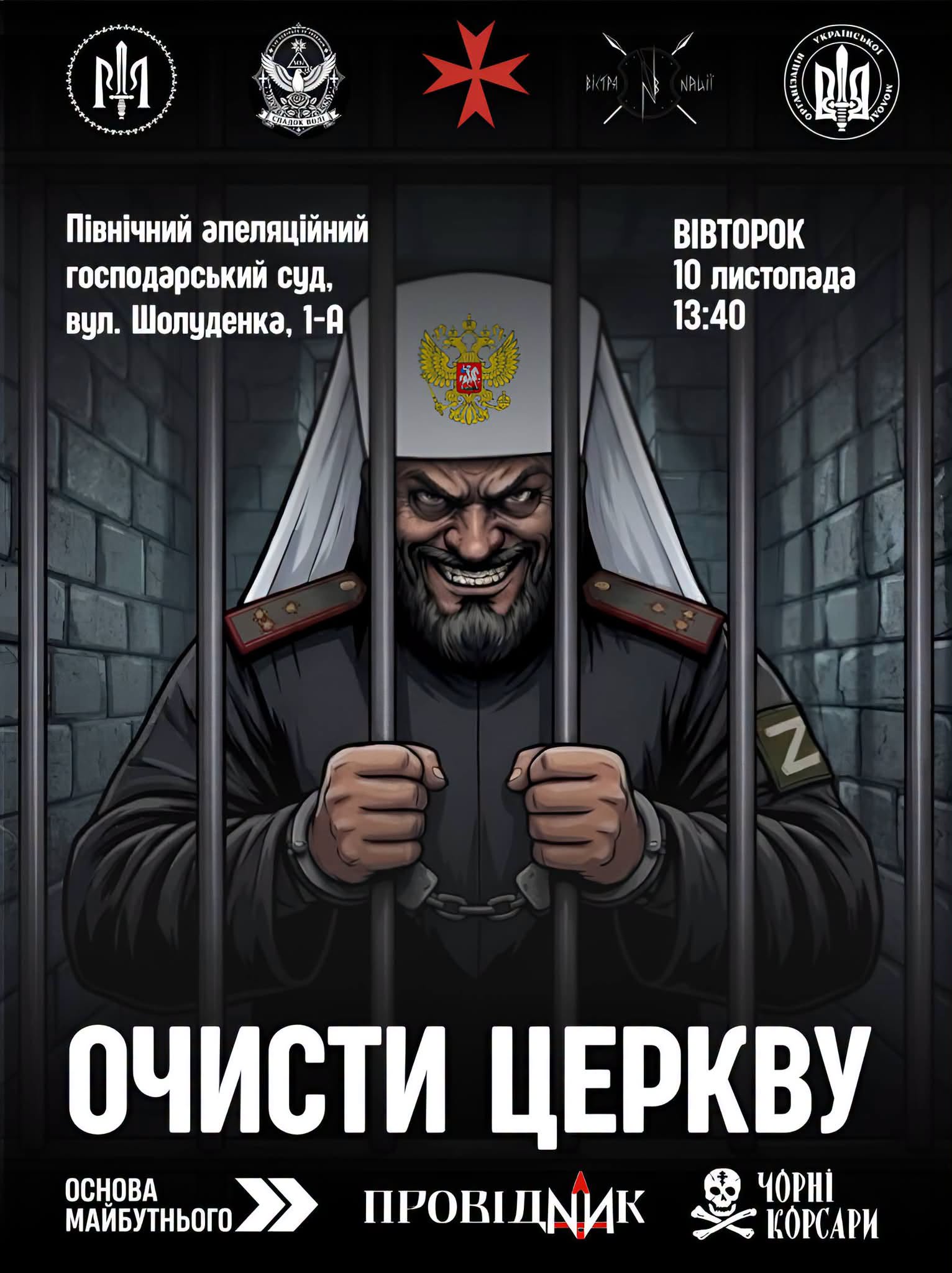
Yevhen Karas, who spent years organizing provocations against the Kyiv-Pechersk Lavra, is now calling for people to "finally de-occupy all our churches and places of worship and deprive Putin of his strategic reserve of saboteurs and agents."

Coincidentally, Karas has received state awards from Zelensky.
All this looks remarkably like coordinated action by radicals and certain members of parliament to pressure judges, attorneys, and UOC believers so that the Kyiv-Pechersk Lavra case reaches the "correct" outcome.
The strategy is simple: first, ordinary Ukrainians who belong to the UOC are branded as "Moscow supporters." Then that label is used as a pretext to harass and terrorize them.
Now let us turn to an issue that, at first glance, appears unrelated to the radicals' activities outside the courts handling the Lavra case.
The basement "prison" in Petropavlivska Borshchahivka
On November 2, a scandal erupted in Petropavlivska Borshchahivka, near Kyiv, over a military "prison" allegedly operating in the basement of a private house. The entire country is still discussing the incident, and much has already been said about it, so there is no need to repeat everything. Instead, let us focus on two points.
- First, after protesters "freed" the detainees – reportedly a mixture of soldiers who had left their units without authorization and recently mobilized Ukrainians – a group of burly young men armed with bats and wearing balaclavas arrived at the scene. They recited the "Prayer of a Ukrainian Nationalist" in unison, then immediately began brutally beating and dispersing those present. The authorities supposedly do not know who these men were.
For example, National Guard commander Oleksandr Pivnenko said: "Those wearing masks and balaclavas are definitely not our soldiers – 100 percent. Our servicemen will be in uniform. They haven't even arrived yet. I don't know who these people in balaclavas are."
- Second, consider how radical leaders reacted to the confrontation at the "prison." They did more than simply support the authorities. Their responses create the impression that the men who dispersed the protesters were, at the very least, well known to them.
For example, Yevhen Karas posted footage of the crackdown on his channel, calling it the "complete suppression of the monkey uprising":
"A spectacular crusade by the Cossacks against evil spirits, accompanied by the Prayer of a Ukrainian Nationalist. The punks scattered in terror like vampires fleeing sunlight. They all realized they had to get home instantly, in a split second. And you say fools can't be taught sense. A kick in the ass can knock some brains into any idiot!"
Karas referred to a 14-year-old boy whom the "prison" guards had reportedly knocked into the yard with a shovel as a "larva," a "little monkey," and a "Russian-screeching creature."
Dmytro Korchynskyi, another radical who has spent years "working" against the Church, reacted in much the same way. He described the incident as a "rebellion of civilian freaks against military order and discipline" and claimed that those supporting the protesters were helping the occupiers.
After the crackdown, Korchynskyi released a video titled "The FSB's Success in Petropavlivska Borshchahivka," effectively branding everyone involved as FSB agents.
MP Solomiia Bobrovska did not mention the FSB directly, but during a television appearance she compared the protesters to the organizers of pro-Russian rallies in Luhansk and Donetsk in 2014.
Of course, clashes near a "military facility" and the seizure of churches are different events involving different people. But the language used to describe those involved is suspiciously similar.
And the pattern is the same: label people "FSB agents" or "Muscovites" without offering any evidence, then use those accusations to justify violence or persecution against specific individuals.
Just a coincidence
Not long ago, the Kyiv-Pechersk Lavra was being called an "FSB cell," UOC churches were described as Russian "strongholds," and priests were labeled "FSB colonels."
Under these slogans, groups of young men wearing balaclavas stormed churches. This happened during the seizures of the Holy Spirit Cathedral in Chernivtsi, the Nativity Cathedral in Ivano-Frankivsk, St. Michael's Cathedral in Cherkasy, and in many other cases.
The authorities did nothing to stop these seizures. They merely shrugged and claimed they did not know who the attackers were.
Now a similar situation has unfolded in Petropavlivska Borshchahivka. A crowd of unidentified men armed with bats and wearing balaclavas dispersed protesters, while the authorities threw up their hands in bewilderment, claiming they had no idea who these men could possibly be.
At the same time, radical leaders have groups of physically imposing young men at their disposal who periodically carry out violent operations.
And somehow, these operations happen to align with the government's interests, including on matters involving the Church.
Of course, we understand that all of this is pure coincidence, and that such freedom-loving individuals could never possibly be serving those in power.
It just happened that way. These things happen.