Why OCU hierarchy lacks canonical ordination: what Local Churches say
OCU head refuses to address invalidity of his ordinations. But almost all Local Churches speak of it – even those that recognized the OCU.
The head of the OCU, Serhiy Dumenko, has once again touched on the issue of the legitimacy of his structure's ordinations. Answering a question in a recent interview about dialogue with the UOC and the problem of the invalidity of OCU ordinations, he stated: "But we will never accept this, because we have fought and will continue to fight to the very end.
The Ukrainian Orthodox Church has indeed pointed out that, for an equal dialogue, the OCU, besides ceasing its seizures and recognizing the shortcomings of its canonical status, must resolve the problem of its representatives lacking holy orders.
The Council in Feophania declared in its resolutions: "to resolve the issue of canonicity of the OCU hierarchy, because for the Ukrainian Orthodox Church, as well as for most of the Local Orthodox Churches, it is quite clear that for the recognition of canonicity of the OCU hierarchy it is necessary to restore the apostolic succession of its bishops."
Dumenko is trying to present these words as an ultimatum and an element of "war" – hence the promise to "fight to the end." However, the Council of the UOC did not exaggerate anything: for the majority of Local Churches, the absence of holy orders in the OCU is indeed "quite clear." Four and a half years have passed since then, but nothing has changed.
After all, the Patriarchate of Constantinople has still been unable to provide a coherent explanation of where the OCU’s canonical ordinations came from.
The fact is that Filaret Denysenko, who performed these ordinations, had been defrocked in 1992 and anathematized in 1997. In 2019, Filaret himself spoke about this as follows: "It’s good if the Ecumenical Patriarch removed the anathema from me in 2018,” reflects Filaret. Yet, until 2018 – was I anathematized or not? If I was, it means that all these hierarchs (OCU – Ed.) are invalid. Therefore, Epiphany not only cannot be a metropolitan – he is not even a priest. If the Ecumenical Patriarch removed the anathema from me in 2018, then the entire episcopate is invalid!"
And here the question arises: was there an anathema or not?
There are two letters from Patriarch Bartholomew to Patriarch Alexy of the Russian Orthodox Church concerning Filaret.
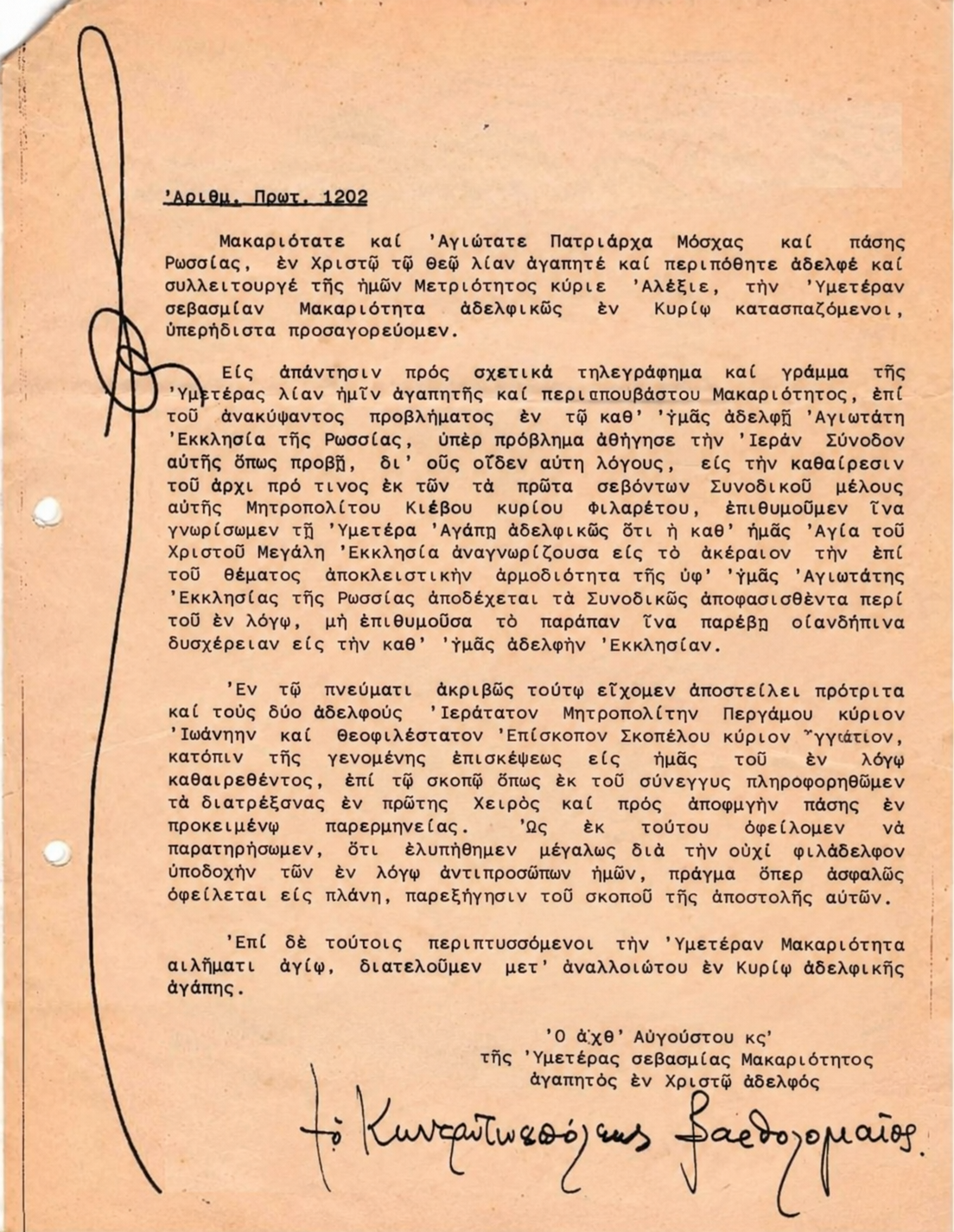
In his letter of August 26, 1992, Patriarch Bartholomew writes: "In response to the relevant telegram and letter from Your Belovedness, whom we deeply love and highly esteem, concerning the problem that has arisen within the sister Church of the Holy Russian Church, which prompted its Holy Synod, for reasons known to it, to proceed with the deposition of Metropolitan Philaret of Kyiv, until recently one of the senior members of that Synod, we wish to inform Your Love in a brotherly spirit that our Holy Great Church of Christ, fully recognizing the exclusive competence of the Holy Russian Church, presided over by Your Belovedness, in this matter, accepts the decisions adopted synodally concerning the aforementioned person."
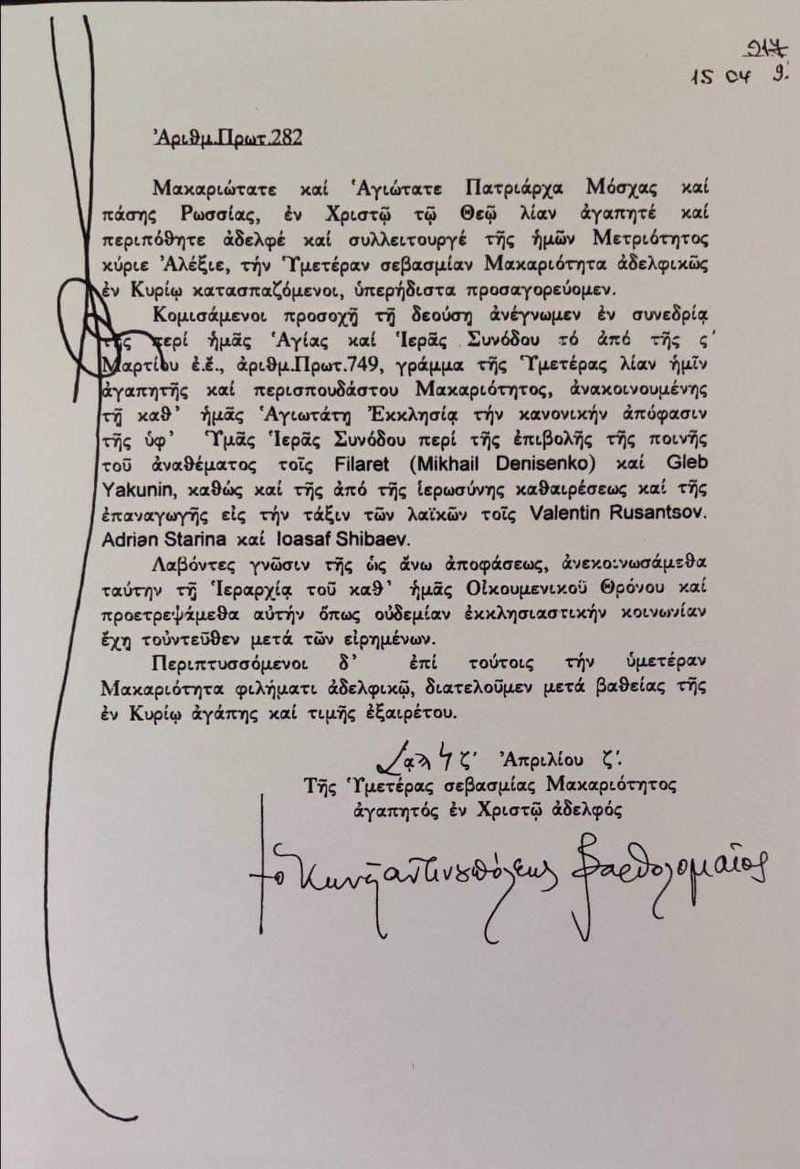
In a letter dated April 7, 1997, the Patriarch writes: "Having received the Letter of Your Beloved and Most Holy Beatitude dated March 6 of this year, ref. No. 749, we read it with due attention at the session of the Holy and Sacred Synod. In it, You inform our Most Holy Church of the canonical decision of the Holy Synod headed by You to impose anathema on Filaret (Mikhail Denisenko) and Gleb Yakunin, as well as to strip Valentin Rusantsov, Adrian Starina and Ioasaf Shibaev of holy orders and relegate them to the rank of laymen. Having taken the aforementioned decision into account, we have communicated it to the Hierarchy of our Ecumenical Throne and called upon it henceforth to have no ecclesiastical communion with the mentioned persons».
As we can see, the Patriarchate of Constantinople fully recognized both the deposition of Filaret and the anathema imposed on him. One may argue about whether Constantinople lawfully or unlawfully lifted the anathema from Filaret. But the fact that from 1997 to 2018 he was excommunicated from the Church is beyond doubt.
And here it is time to recall Filaret's own words: "If I was under anathema, then this means that all these bishops (of the OCU, – Ed.) are invalid. And Epifaniy <…> is not even a priest."
And, paradoxically, a number of Local Churches agree with Filaret's logic.
The Albanian Church
The late Primate of the Albanian Church, Archbishop Anastasios, wrote to Patriarch Bartholomew: "All the while that Mr. Filaret was defrocked and anathematized, he was performing non-canonical rites, which were not valid Sacraments. As a main pan-Orthodox ecclesiological principle, it is recognized that the ordinations of heretics and schismatics, and especially those deposed and excommunicated, as well as "sacraments", performed outside the Church, are not valid. This basic principle is inextricably linked with the Orthodox doctrine of the Holy Spirit and forms the unshakable foundation of the apostolic succession of Orthodox bishops. We are convinced that this principle should not be neglected."
Regarding the "the consecutive ordinations of Serhiy Dumenko, now Metropolitan Epifaniy, to the deacon, the priest, and finally, to the bishop", Archbishop Anastasios writes: "However, we ask ourselves the question: to what extent did the ordination, performed by Mr. Filaret, while he was deposed and anathematized, become true in the Holy Spirit and receive the true seal of the apostolic succession ex post facto, without the canonical ordination? <…> We find it difficult to understand how the void and empty becomes spirit-bearing 'by oikonomia', in what way are the actions that constituted blatant blasphemy against the Holy Spirit <…> retroactively recognized 'by oikonomia'?"
The Polish Church
Both the episcopate and the Primate of the Polish Church, Metropolitan Sawa, have consistently stated since the emergence of the OCU that there are no canonical ordinations in this structure.

"Filaret was deprived of his ordination and has no right to ordain others. We mean the uncanonical nature of the ordination of Epifaniy, the head of this new Ukrainian church,» the Polish Primate said in 2022. “Epiphany was 'ordained' by the former Metropolitan Filaret, who had been deprived of episcopal ordination, and was therefore formally a layman."
Metropolitan Sawa stressed that the Polish Church does not recognize Filaret’s "ordinations". He recalled that Patriarch Bartholomew himself held the same position not so long ago.
"For 22 years, Ecumenical Patriarch Bartholomew recognized the decision of the Moscow Patriarchate to deprive Metropolitan Filaret of his ordination and depose him to the status of a layman as a schismatic. However, various forces intervened: some sought to persuade Patriarch Bartholomew to grant autocephaly to the Ukrainian Church under the leadership of Epiphanius," Metropolitan Sawa said.
The Polish Primate notes that "all the Orthodox Churches, including ours, recognize that Filaret was deprived of ordination and has no right to bestow it upon others."
In the opinion of the Polish Metropolitan, there is only one way out for Dumenko – canonical ordination. Only in that case will it be possible to speak of the lawful status of the OCU hierarchy: "Then it may become part of the Ukrainian clergy."
The Bulgarian Church
Bulgarian Patriarch Daniil, while still Metropolitan of Vidin, published in 2019 an Address to the Primates of the Local Churches on the OCU issue. It states, in particular: "In the ongoing expressing of opinions by various orthodox hierarchs and theologians, including the exchange of letters of some Primates with Patriarch Bartholomew, very serious concerns have been raised. One of which that has been identified is the gravely problematical uncanonical status of the 'hierarchy' of the ecclesiastical structure to which the Tomos was granted."
Having already become Patriarch, Daniil continues to speak of «significant canonical obstacles» to the recognition of the OCU.
The Church of Cyprus
The statement of the Synod of the Church of Cyprus, made in February 2019 regarding the formation of the OCU, says: «The two-thousand-year experience of the Church of Cyprus, and of the whole Orthodox Church in general, gives us grounds to doubt the possibility of legalizing ‘retroactively’ those ordinations that were performed by bishops who had been forbidden, excommunicated, and anathematized. The prohibition, excommunication, and anathema of the individuals who became the initiators of the Ukrainian crisis were recognized by all the Orthodox. The right of appeal, when it is submitted, must have certain time limits for its submission [under these rights] and for its consideration.»
The Romanian Church
In February 2019, the Romanian Patriarchate also issued its statement on the OCU. The Synod of that Church declared that it would ask the Ecumenical Patriarchate to clarify the problem of the uncanonical hierarchs and priests who belonged to the «Kyiv Patriarchate». Almost 8 years have passed since then, but the Romanian Church has still not recognized the OCU. Thus, one may conclude that the Phanar’s explanations did not satisfy Bucharest.
The statement of the Romanian Patriarchate of July 2025 says that, with regard to the OCU, the position set out by the Synod of the Romanian Church on February 21, 2019 remains in force, which stated, among other things: «For almost 30 years the problem of the schism in Ukraine was not resolved, and no appeal was made to pan-Orthodox mediation, as was done in the case of the schism in Bulgaria».
The Church of Greece
Like the Church of Cyprus, the Church of Greece recognized the OCU under pressure. But in both of them there are hierarchs who, almost 8 years after the creation of this structure, speak of the absence of canonical ordinations within it.
In September 2026, Metropolitan Seraphim of Kythira and Antikythira stated that he does not recognize Epiphany Dumenko as a canonical bishop and head of the OCU because of the canonical invalidity of his ordination.
The Greek metropolitan pointed to a fundamental canonical problem: Epiphany Dumenko received his «ordination» from Filaret Denisenko at a time when the latter was under deposition from holy orders. He also criticized the Church of Greece's recognition of the OCU in 2019. According to him, various opinions about the OCU were voiced at the Synod's session, yet no vote – neither secret nor by a show of hands – was held. The hierarch stressed that a decision to recognize the OCU required an official vote, and rejected claims that Ukrainian autocephaly was approved by opinions being «shouted out».
Another Greek metropolitan, Seraphim of Piraeus, pointed out that «the "Unification Council" is invalid because people who do not hold holy orders took part in it, and therefore the granting of autocephaly to this canonically non-existent "church" structure is also invalid».

The Serbian Church
On February 28, 2019, the Synod of the Serbian Church published an extensive statement on the OCU, which contains a paragraph concerning the «ordinations» of this structure as well:
«The Serbian Church does not recognize the schismatic episcopate as an Orthodox episcopate, nor the schismatic clergy as Orthodox clergy, since those belonging to the Denisenko wing received their "existence" from a bishop who had been deposed, excommunicated from the Church and placed under anathema (a fact that Patriarch Bartholomew himself officially acknowledged in his time), while those belonging to the Maletych group are devoid of apostolic succession and of the priesthood in general.
By no document, not by a single, as they say, stroke of the pen, can what was be turned into what was not, and what does not exist into what exists. Consequently,
the Serbian Church does not recognize Mr. or citizen Dumenko (Epiphany) as even a bishop, let alone as the primate of an autocephalous Church
(this latter office is not recognized for him even by his "spiritual father" Mr. or citizen Denisenko, the "true primate" and, moreover, "patriarch" for life)».
Since then, the Serbian Church has changed its Patriarch, but its position regarding the presence (or, more precisely, the absence) of holy orders among the members of the OCU has not changed. Both the Primate and the hierarchs of this Church have made many statements that only confirm the formulations of the Synod of February 2019.
The Macedonian Church – Archdiocese of Ohrid
In March 2023, the Synod of Bishops of the Macedonian Church decided not to concelebrate with the "hierarchy" of the OCU until the problem of its status is finally resolved at the level of all world Orthodoxy.
The Macedonian Church – Archdiocese of Ohrid has not spoken conciliarly on the problem of the OCU's ordinations, but there are statements by individual bishops.
In particular, Metropolitan John of Kruševo and Demir Hisar said of the OCU: "In order for someone to become a deacon, I must perform the ordination, that is, the deacon must receive apostolic succession from one who already has it. This group in the Ukrainian church has not received apostolic succession."
The Synods of the Jerusalem, Georgian, Antiochian, and Czechoslovak Churches have not spoken publicly about the problem of the absence of the OCU's ordinations. But the very fact that for almost 8 years they have not recognized this structure speaks for itself.
Conclusions
Quite a lot of time has passed since the OCU came into being. Over these years, the OCU has become considerably stronger within Ukraine. Having secured the support of the authorities, representatives of this structure have forcibly seized almost 2,000 churches of the Ukrainian Orthodox Church.
But no "successes" can eliminate the flaws built into the very creation of the OCU. The main one is the absence of canonical ordinations. And this is not simply an attempt by the UOC to hurt the Dumenko followers: one way or another, almost all Orthodox Churches speak about this problem, even those that have recognized the OCU.
And this means that we are not simply dealing with an element of the "church wars." The problem lies much deeper: whether the OCU's religious services are church sacraments or not. For now, Patriarch Bartholomew, despite all objections, is trying with an iron hand to force the Orthodox world to recognize the OCU and enter into communion with it. But the Patriarch is already 86 years old. It is quite possible that the next Patriarch of Constantinople will have a completely different view of the "Ukrainian problem."
As for the final resolution, this problem must be settled at the pan-Orthodox level. And sooner or later this will certainly happen.