
What a pilgrim saw in the reopened Lavra's Near Caves

A UOJ correspondent visited the Kyiv-Pechersk Lavra after the reopening of the Near Caves and shares his impressions.
When it became known that the Ministry of Culture finally opened the Near Caves of the Kyiv-Pechersk Lavra for visits, the first feeling was, of course, joy – for almost three years the shrine had remained under lock and key, for almost three years believers could not venerate the relics of the Venerable Fathers of the Caves, and finally the doors opened. But this joy turned out to be very short-lived, because what we encountered on site hardly matched what the believing heart expected.
To enter the Caves, one had to register in advance. But since only 4 groups of 10 people are conducted per day, we had to wait several days for our turn. During registration, you need to provide your personal data, but documents are not requested during the pilgrimage.

In the morning, our small group was met at the entrance to the Lavra, near the Trinity Gate Church, where the excursion bureau is located. There were three people meeting us: a couple of OCU seminarians – one in a cassock, the other for some reason without one – and a reserve employee with a badge, a man with some kind of wary, sharp gaze.
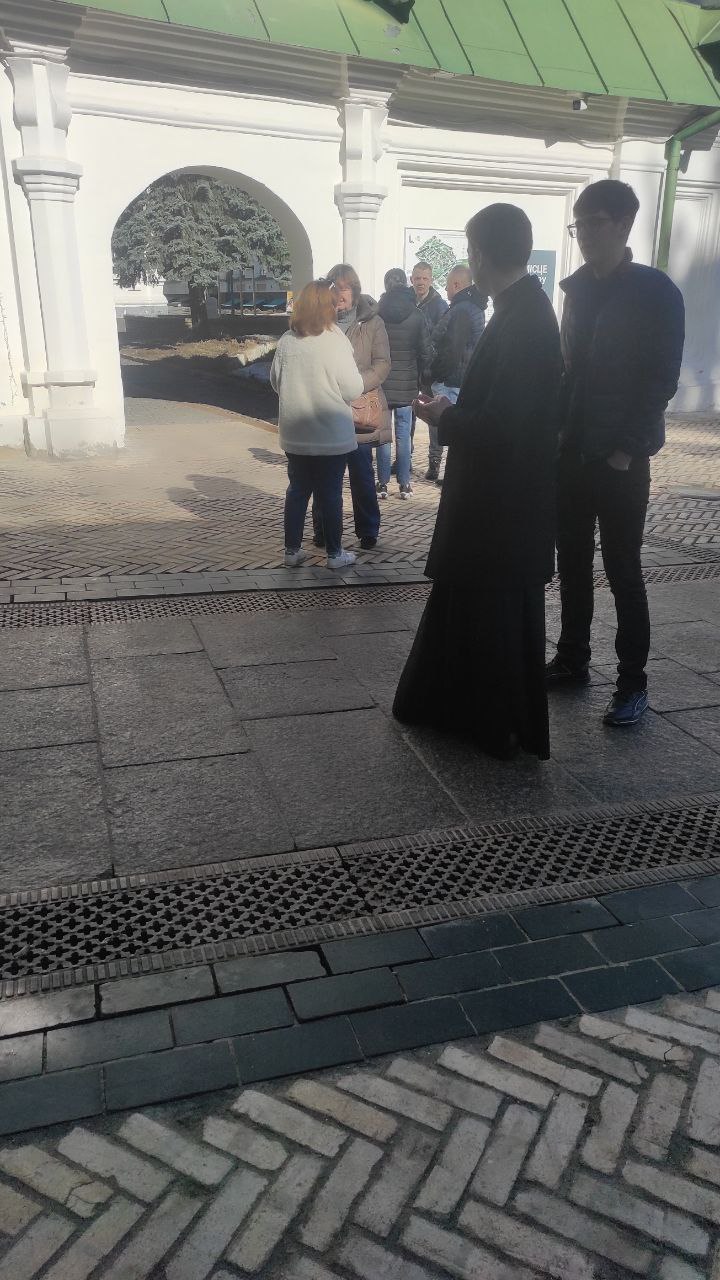
In general, the reserve employees, all men of roughly the same type as if selected, make a strange impression – it's quite possible that they have much less relation to museum work than to certain other departments. They didn't conduct tours for us, didn't tell us anything but simply led us forward, like a convoy. First through the territory of the Upper Lavra, then – past the Dormition Cathedral through the passage – to the Lower Lavra. At the same time, the seminarians looked utterly exhausted and irritated, and when they thought no one could hear them, one muttered to another something like: "When will these pilgrims finally end?"

There were ten of us in the group, and out of these ten, real pilgrims – church people who came to pray at the relics of the saints – turned out to be at most two or three. The rest were clearly secular people, dressed in jackets, sweaters, jeans and sneakers, women without headscarves, with loose hair – classic, if one may put it this way, museum-type pilgrims, for whom caves with relics of thousand-year-old saints differ little from an exhibition in a local history museum. It's hard to blame them for this – this is exactly the format in which all this was presented to them.
The Lavra itself, upon closer examination, produces a distressing impression of neglect and some kind of universal restlessness.

Yes, in the monastery garden they trim trees here and there, weed out weeds somewhere, but this is cosmetics, behind which weathered plaster shows through, crumbling masonry, a general feeling that this place is being maintained for reporting purposes and for show, and not because it is dear to someone. When monks lived here, they treasured every stone, every tree, and every path because this was their home and their shrine, the center of their life. Now the Lavra is a "cultural heritage object," a line in a balance sheet, and the attitude toward it is exactly corresponding.

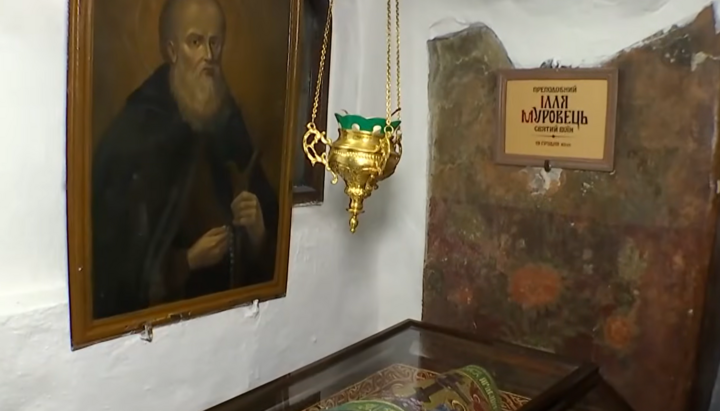
We were led into the Caves under the strictest supervision by the same "trio": two seminarians and a man with a reserve badge. Everyone closely controls every step, and every movement. They led us through a small gallery, past the relics of the Venerable Ilya Muromets (on the new, Ukrainian-language plaque, he is called Murovets) – and immediately led us out. Under supervision they let us in, under supervision they let us out, carefully counted us, made sure that no one lingered or remained in the caves – as if we were not pilgrims who came to the Venerable Fathers but visitors to a restricted facility who need to be led along a route and quickly escorted beyond the perimeter.
But into the large circuit of the Near Caves – the very one where dozens of the saints rest in shrines, where the cell of the Venerable Anthony is located, where spacious galleries are situated that constitute the heart of this underground shrine – there they didn't let us go. The explanation is simple and bureaucratic: there, they say, some kind of property inventories are still being conducted, and access will presumably be opened after March 20-25.
In what exact format – for pilgrims free of charge or for "excursionists" for considerable fee for entrance tickets – is still unknown. However, when they say "forbidden," this apparently doesn't apply to everyone, because right in front of our group, some people in "pixel" camouflage were calmly allowed to go exactly where we were forbidden to go – to the full circuit of the caves, which used to be open to every pilgrim without any restrictions.
The entire visit to the Lavra – from gate to gate – is strictly half an hour, not a minute more. Accordingly, time in the caves is about 7-10 minutes.
They also don't allow access to the springs of the Venerable Anthony and Theodosius – a couple of people from our group wanted to collect holy water, but they were turned away without much ceremony and clear explanations. The springs, sanctified by the prayers of ascetics, which flowed on the Lavra slopes for centuries and to which every believer freely came, are now simply locked and inaccessible.
Police are everywhere: in the galleries, on the territory, at entrances and exits. There are practically no people at the same time – empty and dreary. But not with that blessed silence that prayer-filled monasteries breathe, but with the dead, official emptiness of an institution where no one has really lived for a long time.
In the caves themselves, visitors behaved exactly as they behave in a museum – they photographed relics through glass, talked quietly, and stared around with idle curiosity. It's hard to condemn them for this, because it was exactly to a museum that they were brought, exactly this attitude toward the shrine was set for them from the threshold. Before, when you descended the narrow stone steps toward the cave coolness, the world seemed to fall silent behind you, and in this silence, among flickering candles and quiet whispers of prayers, the soul opened toward something incomprehensible and eternal. Now it is nothing like that, just an exhibition.

And here's what hurts most: the reliquaries stand in their places, the relics of the venerable ones are in their places, the walls are the same, the vaults are the same, the cast iron plates underfoot are the same, everything physically remained as it was – and yet nothing remained.
Of course, this is all subjective. But the feeling that there is no grace, no peace, no that invisible but completely real presence that every believing person unmistakably felt when entering these caves. As if the saints have withdrawn into their shrines, and the shrine has fallen silent and waits for prayer to return instead of the "struggle for spiritual independence."
One longtime pilgrim who had traveled to the Lavra for many years expressed this with bitter accuracy: "As they say in Odessa – two big differences. Before, you enter the Caves – and your soul feels warm, and tears flow from joy, and you feel that you're home, that you were expected. And now – it's like entering a museum, moreover a museum of good old Soviet traditions: where everything is official and on schedule."
The Venerable Pechersk Fathers haven't gone anywhere. They survived the Mongol invasion and the closure of the monastery by godless Soviet power, decades of persecution and desecration. And now they wait again – wait patiently and humbly, as only saints know how to wait – for when genuine, living, fervent prayer will again resound in their monastery, when the Lavra will again become the Lavra, and not an "instrument of national identity."
And for now – one can come to them literally for just a few minutes only by advance registration, under the supervision of the reserve and police. Such is today Lavra's reality. But after three years of blockade, for many even this is happiness.