
Vagrants from the Sermon on the Mount
We tend to think that faith requires an infinite amount of resilience. But Christ speaks to those who no longer have the strength to take the hits, offering something completely different.
We're used to keeping up appearances. We ask each other when we meet "How are you?", and respond with the routine "Hanging in there" or "Taking it slow." This has become almost automatic. Admitting that you can't handle anything anymore is somehow shameful. You need to remain a reliable support for your family, maintain clarity of mind when sirens wail outside the window, and still try to be an exemplary Christian who regularly attends services and doesn't fall into despondency.
We spend enormous energy just trying to appear stable. And when this facade finally cracks, when overwhelming apathy takes over, the first thought strikes like a blow – I'm a bad believer. The exam is failed.
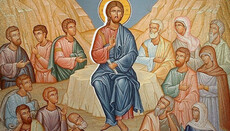
But if you open the text of the Sermon on the Mount, you'll discover something strange for our cult of success. Before Christ on the grass sit people from an occupied country – crushed by taxes, sick, exhausted by the constant presence of foreign troops and their own fears. They were already at rock bottom. And the Savior doesn't ask them to pull themselves together and become spiritual athletes. He allows them to be weak.

A Word for those who have nothing
We often translate "poor in spirit" as a metaphor for good upbringing and modesty. But in the Greek text of the Gospel of Matthew, there's a semantic nuance that puts everything in its place.
In the ancient vocabulary, there were two different concepts of poverty. One meant a person who works hard from dawn to dusk. Yes, he's poor, barely scraping by, but he relies on his own calluses, supports his meager household himself. But Christ uses a completely different word, describing total, absolute poverty. The poverty of a vagrant who has absolutely nothing, and can only survive if someone extends him a piece of flatbread.
When the Gospel transfers this concept to the realm of spirit, a completely different picture emerges.
It turns out the blessed are not spiritual honor students who earned righteousness through their own efforts. Blessed are those who honestly acknowledged their complete bankruptcy.
Those who understood: in my own reserve of strength, there's not a drop of resource left to save myself, protect loved ones, or find meaning in this prolonged madness. Acknowledging the fact that you're actually not coping – this is the starting point.
Open palms
Metropolitan Anthony of Sourozh has a very precise observation on this matter. He often spoke about open hands. While we convulsively clutch our imaginary riches – our intellect, erudition, our timid attempts to control tomorrow – we remain closed to God. He simply has nowhere to enter, because our entire inner territory is tightly barricaded with anxiety and stubborn certainty that we must figure everything out ourselves.
The poor in spirit is one who stands before the Lord with empty palms, without pretensions and plans.
Here, however, it's easy to confuse evangelical poverty with the self-flagellation we're used to. Sometimes it seems that humbling oneself means endlessly repeating "I'm worse than everyone," subconsciously expecting someone to pat you on the shoulder and say: "Come on, you're wonderful." Saint John Chrysostom didn't call pride the worst of evils for nothing. This theatrical self-abasement is the same pride, just turned inside out. Our painful self-love still remains at the center of attention.
But true spiritual poverty is extremely sober. There's no point for a vagrant to be offended that he's a vagrant, or to suffer picturesquely about it. He simply knows this as a fact and calmly asks for help, without straining himself or overdramatizing.
When batteries run down
C.S. Lewis once noted that it's difficult for God to bless us until He receives us completely. We constantly try to keep a small autonomous zone for ourselves, where we decide everything, calling on Him only in moments of emergency danger or when it becomes really painful.
Chronic stress, uncertainty, and the pain of recent years mercilessly burn out these illusions of control. And perhaps our current fatigue, when we collapse exhausted after another sleepless night, isn't a reason for guilt. This is a reason to finally stop resisting to say honestly: I can't handle it. My mind cannot contain what's happening around me. My heart can't cope with such a volume of news. Take it all into Your hands, Lord, because my strength is no longer enough!
When we stop pretending to be indestructible people, the exhausting fear of not meeting someone's expectations disappears.
The first Beatitude gives us the legal right to be weak.
We don’t need to impress God with our spiritual exploits. Sometimes it is enough to just breathe out, admit our emptiness, and wait for the One who is greater than all our anxieties to take a step toward us.