

Time could not erase a saint’s hurt at his best friend

St. Gregory the Theologian carried the hurt caused by someone dear to him for decades – yet never stopped loving him.
When someone close to us suddenly leaves, stops speaking to us, or cuts us to the quick with their words and actions, we are quick to brand them a traitor. The most painful part is that the person who hurt you still remains dear to you. You cannot simply cross them out of your life as you would a betrayer – because you remember all too well how kind they were when they were by your side, when there was peace and harmony between you.
Church history offers a vivid and painful example of what it means to live through such hurt in the story of two of its greatest saints, whose friendship was exemplary but nearly shattered against the rock of resentment.
Let us travel to the family estate near Nazianzus in the final years of the fourth century. An elderly, ailing archbishop is living out his final years here, having turned down every episcopal see offered to him. Several years earlier, his closest friend, St. Basil the Great, Archbishop of Caesarea in Cappadocia, had died. Now alone, the old man is writing an oration about him – one destined to become a literary masterpiece of Church rhetoric. We come to ask him about something he himself would rather leave unspoken.
A friendship that began with hurt
“Your Grace, we remember your exemplary friendship with St. Basil the Great. And yet he hurt you by making you bishop of an obscure little town without even asking whether you wanted it.”
St. Gregory gazes out the window for a long time, toward the road leading to Caesarea.
“It began much earlier, back in Athens. We were finishing our studies, and both of us were asked to stay and teach rhetoric. I wanted to leave together with him, but he persuaded me to stay – then slipped away alone, without waiting for me to get ready and follow him.”
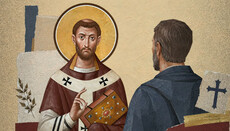
“And you weren’t angry?”
“Of course I was angry. And even years later, when I wrote my oration about him, I still remembered it bitterly. I wrote it plainly: you betrayed me. We were so close that it felt like one body being cut in two.”
“And what about Sasima?”
“That was even worse. Along the main road through Cappadocia there is a crossroads where one road splits into three. A waterless place, without a blade of grass. Dust from carts everywhere, tax collectors all around. The locals – transients and strangers. That was my ministry in Sasima. That was the town my former friend sent me to – a man for whom fifty chorepiscopi apparently were not enough.”
When friendship gives way to duty
“Your Grace, did you ever forgive him?”
The saint is silent for a long while before answering slowly.
“I’ll tell you the truth. Even in the funeral oration I wrote in his honor, I said that time had not erased my grief over what happened. It had not.”
There is no need to pretend that wounds have healed when they have not. God never justifies a lie.
“Then how were you able to write about him with such love?”
“Because I came to understand something that proved stronger than my hurt. Basil did not treat me that way because he was my enemy or because he did not care. Cappadocia was being torn in two, the heretics were poised to seize half the eparchies, and Basil had no one he could truly rely on except me. He did not act out of malice. At that moment, he simply chose the salvation of the Church over our friendship.”
“But he could have warned you beforehand – explained himself, at least?”
“You are right – I won’t argue with that. But people rarely act perfectly, even when they act according to their conscience. For a long time, I suffered because I had been treated badly and because I thought my friend had stopped loving me. But eventually I understood that Basil cherished our friendship, yet when the trial came, he put the interests of the Church first. And for that, he cannot be condemned.”
Pain that does not need explaining away
“Your Grace, you spent many years reflecting on what happened and gradually forgave your friend for the old hurt. But what should those do whose wound of betrayal has not yet healed?”
He turns and looks at me with understanding.
“I did not write my oration praising Basil while I was still in Sasima. I wrote it years later, after his death – after living through my anger, after writing him letters filled with open reproach, and after years in which we barely saw each other. My anger was entirely justified, and God did not condemn me for it.”
“So should we simply wait for the anger to subside on its own?”
“There is something else we must understand: mourning a broken relationship is not the same as breaking the bonds of love. You can carry a bleeding wound for years without ceasing, even for a moment, to love the person who inflicted it. Anyone who tells you that true love requires instant forgiveness is confusing holiness with numbness.”
For a while, we leave the elderly archbishop who has taught us how to endure pain with dignity – and how to allow that pain to coexist in the soul with love for the person who caused it.
At the end of his literary tribute to his friend, St. Gregory would describe himself this way: “half-dead, half-severed, torn away from a great union.” Yet he immediately adds that even after death, his friend continues to instruct him in visions at night.
St. Gregory’s love and respect for St. Basil ultimately proved stronger than his hurt. The Apostle Paul had written about this long before the conflict between the Cappadocian Fathers: love “bears all things, believes all things, hopes all things, endures all things” (1 Cor. 13:7).