Hermit flees worldly honors
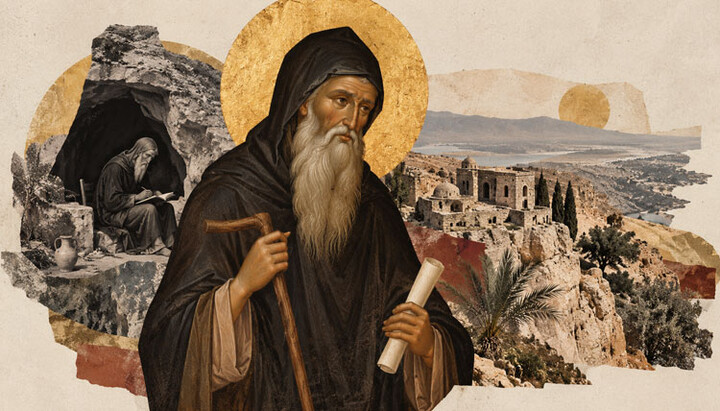
In ancient Palestine there lived a man who longed above all else to be forgotten by people, yet whose ascetic feat resounded throughout the whole Christian world.
At the end of July 2024, UNESCO inscribed the ancient sandy hill of Tell Umm el-Amr near Gaza on the World Heritage List. Archaeologists found here the ruins of an ancient monastery with a crypt and mosaics. It was here, sixteen centuries ago, that the story began of a man who sought to hide himself from the whole world.
The Venerable Hilarion the Great was born around 291 into a pagan family. His parents sent the gifted boy to Alexandria to study with a renowned grammarian. His studies with the grammarian led the young man to a Christian community.

Having heard of the great ascetic Anthony, the young man set out for the Egyptian desert. He stayed with the abba for about two months. But people thronged around the great elder: they brought the sick and sought counsel. The fifteen-year-old youth realized that the bustle hindered solitary standing before the Creator. Having received his teacher's blessing, he returned to his homeland.
By that time his parents had died. Mighty paganism still dominated the Palestinian coast. Not far from his native village lay the bustling sea harbor of Maiuma, and nearby rose the wealthy city of Gaza with the enormous temple of the god Marnas. The sanctuary drew thousands of worshippers.
The youth distributed his inherited possessions to the poor and went to the sandy strip by the sea.
The desert greeted him with wind and scorching heat. But the main battle unfolded in the ascetic's soul. St. Jerome of Stridon, who composed the saint's Life, described the daily routine of the young hermit. The ascetic built a tiny cell out of clay and broken brick. With its occupant standing five Roman feet tall, the cell was so low that, according to his biographer, it «more resembled a tomb than a house». There the elder slept on the ground, prayed, and sang psalms.
The Ascetic's Life in Seclusion
The monk's diet was a ledger of self-restraint. In his youthful years, his daily allowance was a sextarius of lentils soaked in cold water. Later the lentils gave way to dry barley bread with salt, and then to bitter wild herbs and raw roots. Only at the age of 35, when his eyesight weakened from hard labor and fasting, did the elder add boiled vegetables with a small drop of oil to his six ounces of barley bread.
At night there were sounds of a child's crying, a woman's murmuring, and the roaring of wild beasts. But the monk overcame fear with prayer.
The fame of the young ascetic spread throughout Palestine. The sick and those seeking spiritual guidance flocked to his tiny hut. The Lord granted His servant the gift of healing illnesses and casting out unclean spirits. Disciples began to settle around his cell. The Palestinian desert blossomed spiritually.
Victory over the Idol Marnas
Pagan Gaza watched closely what was happening in the desert. The city was preparing for the races at the hippodrome. The main event of the festival was the chariot races. The local duumvir, a zealous devotee of the god Marnas, resorted to the help of a sorcerer to paralyze, by means of incantations, the horses of his rival, a Christian named Italicus.
Helpless before sorcery, Italicus came to the desert to Venerable Hilarion. The ascetic shunned worldly spectacles and at first refused to become involved in the dispute over the racing prizes. But then the elder ordered a clay cup to be brought, the one from which he himself drank, filled it with water, and blessed the Christian.
Italicus sprinkled the stable, the chariot, and the horses with this water. The Christian's team broke ahead. The stands erupted, and the pagans cried out loudly that Christ had conquered Marnas. This event turned hundreds of townspeople to Christ.
Tears over ten thousand petitioners
In his old age, a numerous brotherhood gathered around Venerable Hilarion. Hundreds of pilgrims stayed in the monastery, and thousands of petitioners assembled. The ascetic, who had fled from worldly noise, once again found himself at the center of attention.
Looking at the crowds of people, Venerable Hilarion wept: "Once again I have returned to the world and received my reward during my lifetime." The great elder feared that human veneration would deprive him of spiritual fruit.
He resolved to leave the monastery. When the people learned of the beloved abba's departure, more than ten thousand gathered to hold him back. The petitioners blocked the roads, wept, and begged him not to leave Palestine. But the abba remained unshakable.
Thus began a years-long flight from human glory. The ascetic made his way to Egypt, visited the dwelling place of his teacher Venerable Anthony, and then departed for the Oasis. But even there the sick found him. Then the abba, together with a companion, set out for Sicily.
At Cape Pachynus the elder had nothing with which to pay for the crossing. Venerable Hilarion held out to the ship's captain a handwritten Gospel that he had copied with his own hand in his youth. The helmsman, struck by the old man's holiness, carried the travelers to shore free of charge.
In Sicily the abba gathered and sold firewood, hoping to remain unnoticed. But a demoniac from Rome, whom he had healed, pointed out the hidden elder to the locals, and long lines of the sick once again flowed to him.
The ascetic fled to Dalmatia, to Epidaurus. There, during a severe earthquake, the sea waves surged toward the coastal city. The inhabitants brought the abba to the water. The elder traced three crosses in the sand and stretched out his hands to heaven, and the raging waves halted before the line in the sand.
From Dalmatia the elder sailed to Cyprus. After living for a time near Paphos, Venerable Hilarion went far into the mountains. Among the rocks he found an abandoned pagan sanctuary with a small garden and a spring of water. The elder rejoiced that the steep paths would protect him from unwelcome visitors.
The last journey to the heavenly home
In Cyprus the ascetic spent his final years. Sensing the approach of his end, the eighty-year-old elder summoned his few disciples. His last words are full of sacred awe: "Go forth, my soul, why do you hesitate? For almost seventy years you have served Christ, and are you afraid of death?" With this gentle question the elder departed to the Lord.
His disciples buried him in the same mountain garden. But the struggle for solitude did not end even after his repose. His faithful disciple Hesychius soon arrived in Cyprus. Pretending that he wished to settle in his teacher's monastery, he waited for a suitable hour, secretly dug up the body, and carried it off to Palestine.
The relics returned to Majuma, to the monastery founded by the abba in his youth. The local inhabitants received the incorrupt remains.
Saint Jerome of Stridon remarked with a kindly smile that a pious dispute had arisen between Cyprus and Palestine: the Cypriots believed that the saint's spirit had remained with them, while the Palestinians rejoiced at possessing his bodily relics.
Decades later, the pagan Marneion burned down, and a Christian cathedral rose in its place. Time shattered the pagan circuses, the marble porticoes, and the gilded idols. But the name of the man who fled from earthly honors into the remote wilderness has been preserved in the memory of mankind.