Jephthah's vow: Did the Biblical judge sacrifice his daughter?
The tragedy of a reckless promise in the Old Testament raises troubling questions about the limits of faithfulness, God's mercy, and the terrible price of words spoken in haste.
A father returns home victorious. His only daughter runs out of the gates to greet him, singing, dancing, and playing a tambourine (Judges 11:34). This was how ancient Israel welcomed its heroes home from war. Miriam had sung in celebration after the crossing of the sea (Exodus 15:20), and women would later come out to greet David in the same way (1 Samuel 18:6–7). It should have been the happiest of days, the kind a man waits years to experience.
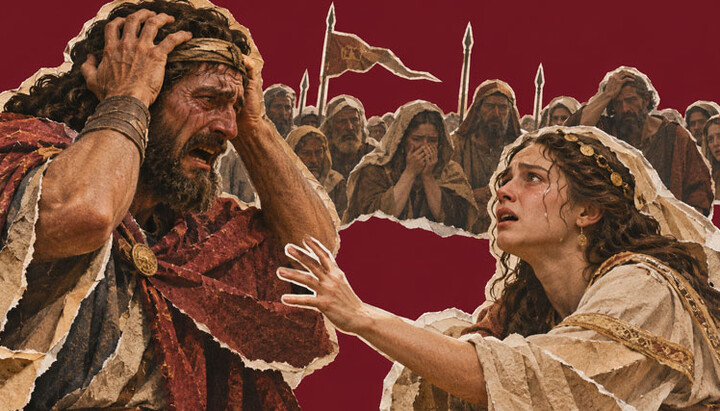
But instead of embracing the girl, the leader Jephthah, in horror, tears his clothes – with the same gesture with which Jacob once mourned Joseph (Gen. 37:34). He cries out: "Alas, my daughter! You have brought me very low, and you have become the cause of great trouble to me; for I have opened my mouth to the Lord, and I cannot take back my vow" (Judg. 11:35).
Anyone reading this passage in the Bible is immediately confronted with a bewildering question: What on earth is happening? After all, the Law of Moses was perfectly clear. If someone vowed to dedicate a person to God, the priest simply determined the redemption price: 50 shekels of silver for a man between 20 and 60 years old, and 30 for a woman (Leviticus 27:2–4). Pay the money, and life could go on.
Yet Jephthah's story is not about legal technicalities. It is about a rashly spoken promise that trapped a father and daughter with no apparent way out.
An outcast accustomed to bargaining
To understand why Jephthah drove himself into such a trap, one must know who he was and what his origins were. The Bible plainly calls him the son of a harlot (Judg. 11:1). His half-brothers simply drove the young man out of the house, saying: "You shall not inherit in our father's house" (Judg. 11:2). He went off to the land of Tob and gathered a band of desperate but idle men (Judg. 11:3).
When the Ammonites attacked the land, the elders of Gilead promptly ran to the outcast for help. Jephthah could not refrain from a reproach: "Did you not hate me and drive me out of my father's house?" (Judg. 11:7). But he still agreed to fight.
He was by no means an ignorant man. Before the battle, Jephthah sent messengers to the Ammonite king, recounting the history of Israel's Exodus from memory and warning him against attacking.
Then Jephthah marched into battle and struck a dangerous bargain with God: "If You will indeed deliver the people of Ammon into my hands, then it will be that whatever comes out of the doors of my house to meet me, when I return in peace from the people of Ammon, shall surely be the Lord's, and I will offer it up as a burnt offering" (Judges 11:30–31).
In those days, livestock were often kept on the ground floors of houses, so a sheep might easily have been the first creature to come out and greet its owner. But Jephthah never specified exactly whom or what he intended to sacrifice. His reckless promise was made blindly.
As fate would have it, the first person to greet the victorious warrior was his own daughter. The most heartbreaking part of the scene is the young woman's gentle response: "My father, if you have given your word to the Lord, do to me according to what has gone out of your mouth" (Judges 11:36). She asks only one thing: to be allowed to spend two months in the mountains with her friends, mourning her virginity (Judges 11:37–38).
Why was the redemption price never paid?
Here we come to the central question: Why did Jephthah not revoke his terrible vow? The Law of Moses explicitly prohibited human sacrifice, condemning it as an abomination practiced by pagans who "burn even their sons and daughters in the fire to their gods" (Deuteronomy 12:31).
The Bible offers no explanation. We do not know whether Jephthah remembered the provision concerning the 30 shekels. Perhaps he was relying on another commandment of the Law, which declared that anything devoted irrevocably to God – "whether man or beast or field" – could neither be sold nor redeemed (Leviticus 27:28–29). Whether the redemption provision applied to a vow involving a burnt offering remains unclear.
For contrast, consider the righteous Hannah. She too promised to dedicate her son Samuel to the Lord "all the days of his life" (1 Samuel 1:11). When the boy grew older, his mother sacrificed a bull, brought him to Eli the high priest, and declared: "I have lent him to the Lord; as long as he lives he shall be lent to the Lord" (1 Samuel 1:25, 28). Seemingly the same kind of vow – yet an entirely different fate.
Jewish tradition, particularly the Midrash, attributes Jephthah's tragedy to human pride. Phinehas the high priest supposedly had the authority to release him from his foolish vow but refused to approach the leader first. "I am the high priest, the son of a high priest. Should I humble myself and go to Jephthah, an uncouth man?" he reportedly said. Jephthah, for his part, refused to go to Phinehas.
While the two stubborn men clung to their pride, the girl perished.
The judgment preserved in this tradition is unequivocal: "Both were responsible for her blood." As punishment, the Spirit of God departed from Phinehas, while Jephthah's body began to fall apart piece by piece.
Did the father actually sacrifice his daughter?
Scripture describes the conclusion of this horrifying story with remarkable restraint. After two months, Jephthah "carried out his vow with her which he had vowed. She knew no man" (Judges 11:39). Afterward, the daughters of Israel established a custom of going into the mountains for four days each year to mourn her – or, as the Hebrew word is sometimes translated, to commemorate her (Judges 11:40).
Because the text never explicitly says "he killed her," many interpreters have sought a less bloody explanation. Jewish commentators of the 12th–14th centuries, followed by some Christian writers beginning in the 16th century, suggested that Jephthah did not slaughter his daughter but instead condemned her to lifelong celibacy.
Ancient writers, however, understood Jephthah's act as a literal sacrifice. The historian Josephus condemned the leader's actions in his Antiquities of the Jews. St. Ambrose of Milan likewise declared: "It is better not to make a vow than to vow something God does not wish to receive."
But why did God Himself not stay the father's hand? Blessed Theodoret of Cyrus offers an answer: "God the Master, teaching how vows should be made to Him, did not prevent the sacrifice." St. John Chrysostom held a similar view. God did not desire bloodshed. He permitted a terrible mistake to occur so that its consequences would forever teach people not to make reckless vows.
How a killer came to be on the list of the faithful
After his daughter's death, Jephthah did not become a gentler man. Before long, war broke out with the neighboring tribe of Ephraim. Jephthah's men seized the fords of the Jordan and tested fleeing Ephraimites with a single word: "Say Shibboleth." Anyone whose local accent caused him to pronounce it "Sibboleth" was killed on the spot. Forty-two thousand men died in the conflict (Judges 12:5–6). Jephthah ruled Israel for six years and, according to Scripture, was buried "in one of the cities of Gilead" (Judges 12:7).
That might seem to be the end of the story. Yet centuries later, Jephthah's name unexpectedly appears in the Epistle to the Hebrews among the great examples of faith – alongside Gideon, Barak, and Samson (Hebrews 11:32).
St. John Chrysostom, the great teacher of the Church, anticipated the bewilderment of believers and offered this answer: "Do not tell me about the rest of their lives, but only whether they believed and shone with faith."
Thus, the Church does not justify Jephthah's reckless vow, but neither does it disregard the faith of a man who could defeat his enemies yet proved utterly powerless against his own tongue – the very tongue that sealed his daughter's death sentence.