What did blind saint write with trembling hand?

A conversation about the Spirit's innermost sanctuary and calling upon the Creator amid street noise and everyday haste.
The night in the north drags on endlessly, and the days are short and gloomy. In the White Chamber of the Rostov house, a candle is burning low on the table. A stooped elder in a dark-green cassock bends over a sheet of paper, tracing uneven lines to his friend Theodore Polikarpov. Infirmities more and more often take his hands from him, and "besides, the eyes, seeing, see little, and spectacles do not help much, and the writing hand trembles."
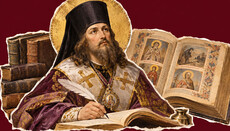
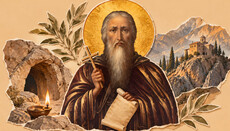
Surrounded by three hundred folios and portraits of his father, he spent his whole life over manuscripts – from his youth at the Kirillov Monastery to cold Rostov. But it was with this trembling hand that St. Demetrius of Rostov wrote a small book in four chapters entitled "The Inner Man, Secluded in the Chamber of His Heart, Learning and Praying in Secret." In the preface, the author explained that he wrote it "for the instruction of the simple" – for ordinary people, laymen.
– Vladyka, I read your lines about blindness and trembling fingers and think about our weariness. Only, what takes our strength is not work over manuscripts, but the constant din around us. Queues, packed minibuses, the noise of shelling during an air-raid alert, a multitude of work chats, and endless conversations of people right in our ears. It is so exhausting! We read in the Gospel the words of the Savior: "But thou, when thou prayest, enter into thy closet, and when thou hast shut thy door, pray to thy Father which is in secret" (Matt. 6:6). But what if a person simply has nowhere to shut himself away? If he does not even have a corner of his own at home, nor even five minutes of peace – is his prayer then fruitless?
The Rostov archpastor adjusts his spectacles and shakes his head with a smile, so that his wedge-shaped, graying beard barely touches the green cloth.
– You look for a bolt on an oak door, my friend, to lock yourself away from everyone, but the Lord speaks of something else entirely.
A man, after all, has two chambers. The first is outward, built of logs or brick. The second is spiritual. It is your mind, your hidden thought.
An ordinary room is bound to a place: the master leaves the yard – and it is no longer beside him. But the inner chamber is arranged differently: "it is carried about everywhere with a man, wherever the man is, it is always within his heart." Wherever your hard lot may cast you, you carry your chamber of the heart with you.
A Chamber in the Midst of the Crowd
– But how is one to close this inner door, Vladyka Demetrius, when you are being jostled by elbows in a bus, or when endless arguments are going on all around? Is it normal always to pray silently, so that those around do not take you for an oddball?
– And why does God need a Prayer Book or the movement of the lips, if your very soul has turned to Him? – the holy writer reasonably asks. – When a person goes inward and gathers his scattered thoughts, nothing hinders him. Inner prayer (even if one happens to turn to it with the soul in the midst of people) requires neither lips nor book.
One can sit at a common table, walk through a noisy market, listen to other people's talk – and at that very moment rise to God with an unseen sigh.
We are accustomed to think of prayer as a special rite, for which icons, lamps, and a rule read from cover to cover are obligatory. But the saint brings us back to an understanding of the Gospel freedom of communion with God.
Let us recall Bartimaeus by the roadside near Jericho. Dust hung in the air around him, and the crowd was noisy. Learning that Christ was passing by, the beggar began to cry out loudly, piercing the thick of the crowd with his voice: "Jesus, Son of David, have mercy on me!" (Mk. 10:47). Passersby hushed him and told him to be quiet, but he "cried out all the more, 'Son of David, have mercy on me!'" (Mk. 10:48). And the Lord responds to that cry in the midst of the roadside bustle.
An Armful of Firewood for a Cooled Mind
– And yet, Vladyka, our conscience often gnaws at us for laziness. It seems to us that the spiritual life is when a person unfailingly reads through long canons. We take up the rule late in the evening after a shift, our eyes are drooping, our thoughts are racing, our tongue thoughtlessly rattles off the lines... And the Apostle Paul even demands the impossible: "Pray without ceasing" (1 Thess. 5:17). How can a working person pray without ceasing at all?
Saint Demetrius leans closer.
– Judge for yourself, brother: the day does not belong to us entirely. There is a time for work, a time for conversation, a time for eating and drinking, a time for rest and sleep. Is it conceivable, with such a way of life, to stand in prayer without a break?
The Vladyka holds out his chilled fingers to the stove, trying to warm himself.
– Do not chase after many words, in which the mind quickly tires and wanders off to trifles. Better ask yourself: "How do you expect to be heard by God if you do not hear yourself?"
It is far more reliable to turn to the Lord throughout the day a little at a time, but sincerely. A short and frequent prayer is preferable to a long and rare one. It is better accomplished in the mind, turned to God even for a brief time.
– So a few sincere words spoken on the run are worth more than a forced hour spent over the Prayer Book?
– Look at the hearth," the archpastor nods toward the glowing coals. "If you throw a whole pile of damp logs into the stove at once, they will only extinguish the spark. But the ancient priests who were entrusted with guarding the heavenly fire acted more wisely: they kept the embers alive and added dry logs little by little. So too, short appeals to God in the midst of daily labors do not let the heart grow cold.
A Single Word at the Edge of the Abyss
– So God has no need of our long reports about our thought-of and unthought-of sins?
– Recall the Gospel," replies the wonderworker of Rostov. "One phrase from the publican won God's mercy, and one faithful word saved the thief on the cross. The publican did not make grand speeches, after all; he stood afar off and only beat his breast: "God, be merciful to me a sinner!" (Lk. 18:13). And the crucified thief, in the agony of death, did not read through any rules, but managed to say one request: "Remember me, Lord, when You come into Your Kingdom!" (Lk. 23:42) – and immediately heard the answer: "Today you will be with Me in Paradise" (Lk. 23:43).
Outside the windows the October wind howls. Very soon the singers will come into this room. The elder, gasping with coughing, will sit by the stove and listen to the chants, and then he will dismiss everyone except the singer and the scribe Savva Yakovlev. He will recall his Kievan youth and his earlier prayers and say in parting: "You too, children, pray likewise." And then, having seen his guests off, he will bow to the scribe almost to the ground for his labors, retire to his cell – and in the morning he will be found there kneeling, already departed to the Lord.
But for now the candle on the table is still burning. The half-blind hierarch takes up his pen in an unsteady hand and, speaking in a low voice, now addresses his own soul, carefully tracing out the lines of his book.