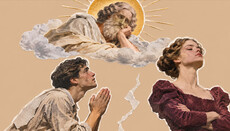
Alone before the Absolute: Søren Kierkegaard's central challenge
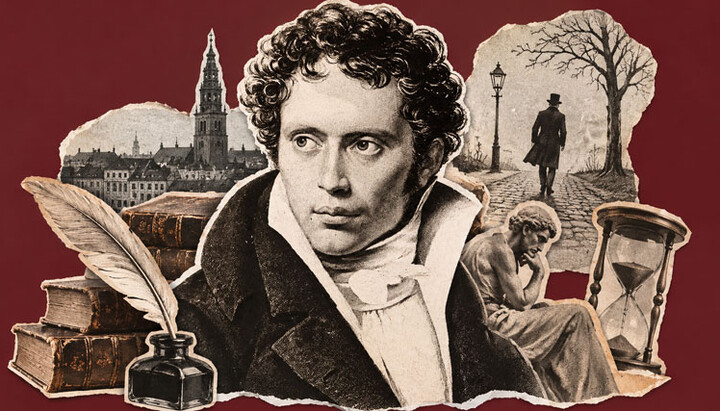
The Danish thinker's revolt against "cultural Christianity" remains a formidable mirror for every believer.
In November 1855, a forty-two-year-old man died in Frederik's Hospital in Copenhagen. During his lifetime, his name provoked in most of his contemporaries only irritation, bewilderment, or caustic mockery.
On the eve of his death, already crippled by paralysis, he flatly refused to receive Communion from the hands of an official Lutheran priest. His faithful friend, Pastor Emil Boesen, asked why he was so unyielding. The dying man answered harshly: he could not commune from the hands of "civil servants of the state," who had turned the Sacrament into an element of bourgeois comfort, a household convenience, and a social obligation.
This rebel was Søren Aabye Kierkegaard.
What, one might ask, could a Danish thinker of the mid-nineteenth century, who lived in the Protestant world, have to do with the living experience of Orthodoxy? At first glance, nothing at all. He possessed neither our patristic fullness, nor liturgical depth, nor a developed Eucharistic theology.
Yet Kierkegaard made an unprecedented breakthrough toward what the Eastern Holy Fathers called sacred sobriety (nepsis). He arrived at an uncompromising understanding of faith as a personal catastrophe for human egoism and as the point of the complete transformation of the mind. For us this philosopher is important as a mirror: he helps us see what we ourselves have ceased to notice—our own spiritual slumber and formalism.
In the Trap of "Cultural Christianity"
The chief enemy against whom Kierkegaard waged war to his last breath was the so-called "Christian society"—a world in which faith had long since lost its inner transforming power and had turned into an empty ethnic and social bond.
In Denmark at that time, Lutheranism was the state religion. Being born in that country, a person automatically received baptism, paid the church tax, and was obliged to attend services. This was perceived as a one-hundred-percent guarantee of salvation. A place in Paradise was issued as a matter of course for a respectable Copenhagen biography.
Kierkegaard wrote about this with undisguised bitterness: "When in a country absolutely everyone is a Christian by right of birth, there are no real Christians there at all."
If faith is merely conformity to a cultural norm, then Christianity itself has been annulled.
But this diagnosis concerns not only nineteenth-century Denmark. When we lull our conscience with grandiloquent phrases about "special election," a "God-bearing people," or slogans such as "we are Orthodox, God is with us," we fall into the very same trap.
Salvation is not passed on by inheritance through a genetic code, a national culture, or historical memory. One cannot be Orthodox "by the fact of birth" or "by tradition." Christianity is not inherited—it is won. Moreover, it is won anew every day, to the point of blood, in the very depths of the human heart.
As St. Macarius the Great wrote, the soul must pass through the personal fire of conscious choice. When faith turns into national folklore, and liturgical life into a tribute to aesthetic habit, the Gospel dies. Everyday, cultural Christianity is the most insidious form of atheism, because it lulls a person with the illusion of salvation.
A Leap over the Abyss
In his famous work "Fear and Trembling" (published under the pseudonym Johannes de Silentio – John the Silent), Kierkegaard examines the Old Testament account of the sacrifice of Isaac. We are so accustomed to the biblical text that it often seems to us a smoothed-over, pretty illustration from a children's catechism. The philosopher restores to this story its original, frightening sharpness.
From the point of view of public morality and human logic, Abraham was a madman and a criminal. He was leading his only, long-awaited son to the slaughter. No earthly ethics can justify this step.
But Abraham is called the "father of the faithful" precisely because he makes a "leap of faith" over the abyss of reason and everyday logic. His hope is not the result of a syllogism or a rational calculation. It is absolute, unconditional trust in God in spite of all evidence and common sense.
Here Kierkegaard leads us to a most important truth that pervades the entire ascetic heritage of the Orthodox Church: the Creator categorically does not fit within our human schemes.
We constantly try to tame God, to make Him convenient, comprehensible, and safe. We construct comfortable frameworks out of rules and dogmas. It seems to us that if we have read our prayer rule, stood through the service, and submitted our commemoration lists, then we are "in our little house" and fully in control of the situation.
Kierkegaard, however, recalls the stern words of Scripture: "Our God is a consuming fire." An encounter with the Living God is always a shaking of foundations and a collapse of human illusions. Faith begins where our ability to explain everything ends.
Let us recall the holy desert fathers. Their departure into the Egyptian caves was precisely such a "leap of faith," a complete renunciation of the logic of the prosperous world for the sake of the uncertainty of standing before the Creator. If there is no such element of existential risk in our life, if we have never sacrificed our comfort and the opinion of society for the sake of Christ's commandment, then did we ever really know what the faith of Abraham is?
Alone Before the Absolute
One of the key concepts of the Danish thinker is "the Individual" (the Single One). Kierkegaard asked that this word be carved on his tomb. He maintained that before God a person always stands only in the singular.
In a crowd, it is impossible to believe. The crowd is a spatial category of spiritual flight. In it a person loses personal responsibility, dissolves his sin in the collective noise, and shifts his choice onto "everyone else." "Everyone does it," "everyone thinks so" – this is the quickest way to kill the human spirit. The crowd is a lie, for it has no conscience.
This manifesto is strikingly consonant with Orthodox hesychasm.
Saint Gregory Palamas, Saint Isaac the Syrian, and Saint Symeon the New Theologian tirelessly repeated that salvation is accomplished in the innermost chamber of the human heart. By seclusion (hesychia), they meant not merely a physical withdrawal into the wilderness, but an inner rejection of the "thought of the crowd."
In the Sacrament of Repentance, a person stands before the Cross and the Gospel not as a representative of a nation, a class, or a parish. He stands as a soul laid bare before the Creator, with nothing left to hide behind.
In an age of total virtualization, social networks, and collective pathos, Kierkegaard's thoughts strike with full force. We are panically afraid of being left in silence alone with ourselves; we need external noise to drown out the voice of our own conscience. But at the Last Judgment there will be no collective reason and no group reports – there will be only Christ and "That Single Individual," that is, each one of us.
Against the Cult of Comfort
We live in a civilization where comfort – physical, emotional, and psychological – is proclaimed the highest value. Unfortunately, this spirit of the age has long since penetrated the church fence as well.
We often seek in the church only "soul balm" and psychotherapeutic reassurance. We need a Christianity that relieves stress, guarantees worldly success, and helps us create "the best version of ourselves."
In his late works, Kierkegaard rebels against this distortion with prophetic fury.
For him, faith deprived of the Cross and suffering is a counterfeit. Christ comes into the world not to lull man to sleep, but to plunge him into a state of absolute, radical choice.
The encounter with God is always a scandal and a stumbling block for the fallen mind. Christ is not a comfortable coach or a teacher of fashionable philosophy. He is the crucified God-Man. And His follower cannot count on the applause of this age. If the world pats you on the head and praises you for your "religiosity," it means you have made a latent compromise with this world.
Does not the whole history of the new martyrs and confessors of the twentieth century bear witness to this? They could have saved their lives by choosing comfortable conformity, but they preferred to remain "single individuals" before the face of the godless crowd. Did not the ancient ascetic fathers say the same: "Give blood and receive the Spirit"?
True Christianity is always co-crucifixion with Christ. It is a painful but sober renunciation of illusions, the courage to go against the current and the readiness to remain in absolute solitude for the sake of fidelity to the Truth. Kierkegaard does not offer ready-made recipes and does not replace the patristic tradition. But his legacy is a powerful alarm clock for the drowsing Christian conscience, reminding us: salvation begins at the very second when you step out of the crowd and stand still in trembling before the Living God.