Military ecocide as sin of God-fighting
Разрушение природы в ходе войн оскверняет Божественный замысел. Учение Максима Исповедника раскрывает тяжесть экоцида перед лицом Творца.
November 6 is the International Day for Preventing the Exploitation of the Environment in War and Armed Conflict. Established by the UN General Assembly in 2001, this date was conceived as a dry accounting of environmental risks. But today, when the planet is being shaken by local and global wars, this day sounds like a desperate alarm bell to which we have finally gone deaf.
When we think of war, our consciousness, as a rule, naturally fixes on human suffering. We count the dead, mourn the ruined cities, shudder at the fates of refugees. This is the natural reaction of living mercy. But behind the flashes of explosions and the thunder of artillery, a terrible drama unfolds, which analysts call "collateral damage."

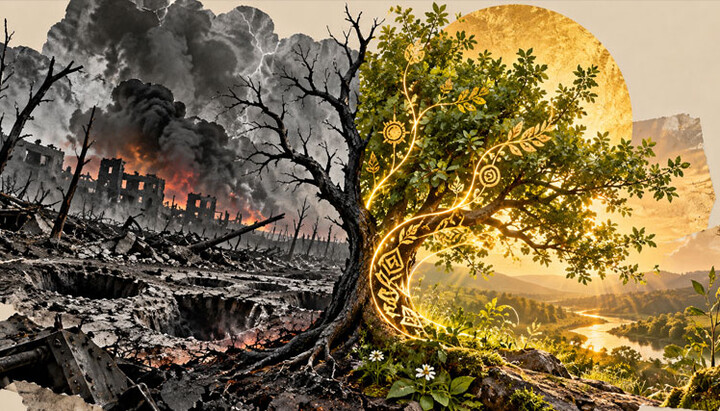
The picture of this "damage" is horrifying in its scale. Scorched earth where nothing will grow for the next thirty years. Centuries-old forests turned into charred splinters laced with lead.
Agricultural fields pitted with craters and sown with millions of deadly mines. Rivers poisoned with fuel oil, heavy metals, and rocket fuel. The death of entire ecosystems, the disappearance of rare species of birds and animals that never understood why people turned their native home into a blazing hell. War destroys not merely infrastructure. It methodically annihilates what the philosopher Martin Heidegger called the "house of being" – the very fabric of organic life that keeps man from falling into nothingness.
The terrible drama of collateral damage
And here we encounter a striking phenomenon. While ecologists and human rights defenders try to introduce the term "ecocide" into international law and equate it with war crimes, academic and parish theology most often maintains a strange silence. We argue about canonical boundaries, the rules of fasting, digitalization, the limits of what is permissible in art. But as soon as the conversation turns to the destruction of forests or the poisoning of rivers as a result of hostilities, the topic is pushed to the margins. It is declared "secondary," "secular," a "fashionable environmental agenda," or a distraction from the main thing – the salvation of the immortal soul.
Why has Christian thought so easily surrendered the theme of protecting nature to secular humanism? Is not the destruction of the created world during wars a direct crime against the Creator? If the world was created by God and called by Him in the Book of Genesis "very good," then turning this world into a poisonous desert for the sake of the satanic logic of military expediency is not merely an environmental catastrophe. It is an act of the gravest God-fighting, a desecration of the Divine design, about which a believer has no right to remain silent.
To understand the depth of this tragedy, we must step beyond the bounds of conventional ecology, which regards nature merely as a "biosphere" needed by man for physical survival. We need to return to philosophical and theological experience and reveal the mystical depth of creation.
And here we will be helped by the teaching of the seventh-century Byzantine theologian – St. Maximus the Confessor.
At the foundation of St. Maximus's cosmology lies the teaching of the Logoi — the Divine intentions, the meaningful matrices that determine the essence and purpose of every thing. In every particle of creation — from a gigantic galaxy to the humblest blade of grass or a drop of dew — its own Logos is inscribed. These are not abstract philosophical ideas, but a living Divine expression of will.
The world is not a meaningless set of atoms randomly bound together by the mechanical laws of physics. Nor is it merely a "natural resource" waiting to be exploited and spent. The created cosmos is a spiritualized symphony of meaning. All these endless Logoi have as their source and first cause the Divine Logos — the Second Person of the Holy Trinity, the Word, through Whom "all things came into being."
The Living Symphony of the Divine Logoi
When we look at the created world through the teaching of Maximus the Confessor, every thing begins to be understood as a living voice of the Primordial Logos, a Divine resonance. Nature becomes God's foremost revelation of Himself. Long before the Bible was written, God wrote the "Book of Creation."
Every species of animal, every tree, every river is a letter or a phrase in this Sacred Book. And when human cruelty wipes an entire region off the face of the earth, it literally tears out and burns pages from the Divine revelation of creation.
What, then, is man's place in this architecture? According to St. Maximus, man was created as a Microcosm ("a little world") and a Priest of Creation. He occupies a unique borderline position. In him all levels of being are united: the matter of the body, plant and animal life, and a spiritual nature striving toward God. Man is placed as a connecting link, as a mediator between the created world and the Uncreated Creator. His vocation is not to rule with a club in hand over a broken world, but to gather the Logoi of creation, to perceive their humble beauty, and to offer them back to God in an act of thanksgiving and love.
Man was called to be a high priest, through whom the whole cosmos is sanctified and united with its Creator. Water, bread, stone, wood — all were meant to become the material for this single offering of thanksgiving. But in the fire of military action, the distortion of the human calling reaches its tragic peak.
Sin in the Christian tradition is not merely the violation of a legal rule, but an ontological catastrophe, a distortion of the natural movement of things. Instead of leading the world up to God, the sinner closes creation in on himself and his passions — power, pride, fear, and the destruction of his fellow men.
When man destroys nature for the sake of military expediency — setting forests on fire, flooding coastlines with fuel oil, blowing up dams and turning blooming valleys into rotting seas — he commits a violent, bloody "rupture of the Logoi." A river created by God as a source of life becomes, in wartime, a water barrier for drowning troops or a toxic weapon for washing away settlements. Land meant to nourish with bread is turned into a mined staging ground that breeds death.
The Bloody Rupture of Cosmic Meanings
War transforms a human being from a priest of creation into a harsh tyrant and executioner. The destruction of nature during war is not an abstract "collateral damage." It is the direct, systematic desecration of the Temple of God. War is a form of satanism. By destroying the ecosystem for tactical advantage, man attacks the Creator's Design, openly declaring to God that His world has no value in the face of human malice and political will.
One can look at this world in different ways. Most people live in consumerist utilitarianism.
For them, nature is merely inanimate "material" for survival, industry, and waging wars. A forest is cubic meters of timber, a river is a hydrodynamic frontier, animals are incidental casualties or resources.
But the Church proclaims theological personalism and cosmism, expressed in the words of the Apostle Paul: "the whole creation groaneth and travaileth in pain together until now." In this perspective, the created world is not a mute slave of human whims, but a suffering participant in human history, subjected to corruption against its will and awaiting healing from man.
The Profound Necessity of Ecological Repentance
And here a question arises for our conscience: can one consider oneself a believer if one is indifferent to the destruction of the created world? Does a Christian have the right to reduce his faith solely to "saving his own soul," ignoring the fate of the cosmos created by God? How did it happen that we have learned to weep bitterly over our petty personal sins, yet not a single tear falls when, in the fire of yet another military conflict, thousands of hectares of ancient forest burn and dead fish float up in poisoned rivers? When animals and birds perish in terrible agony from human cruelty?
Reducing faith to a "ticket to paradise" while remaining completely indifferent to a burning world is a profound substitution. It is spiritual egoism, forgetting that God so loved the whole world, and not only individual human souls torn out of their native environment. Awareness of this problem calls us to repentance, that is, to a change of mind.
Traditionally, repentance concerned two vectors: "man – God" and "man – man." But today it is vitally necessary to open a third vector – man's repentance before creation. Harming nature and destroying it senselessly, both in war and in peaceful life, must be recognized as a grave sin that requires a rethinking and a change in our attitude.
The Practical Continuation of Eucharistic Service
We believe not in the final annihilation of being in a nuclear or ecological hell, but in the renewal of the world. Christ came to redeem not only humanity, but to renew all of Creation. We are promised "new heavens and a new earth" – a cosmos transfigured and healed from the wounds of war. And every step we take today to protect and restore nature is a practical drawing near to this hope.
Caring for the restoration of land desecrated by destruction is not an abstract secular hobby, but the very real continuation of liturgical service to the world.
Ecocide in war must be clearly called by its true name – the sin of God-fighting. When we plant a tree on the site of a burnt-out ruin, when we cleanse a river of poison, when we protect a forest from being turned into a firing range, we restore to man his true calling. We once again become not destroyers but keepers of this world, able to defend, in the name of God, all that He has created.