
Почему святитель Иоанн Милостивый называл бедных господами?
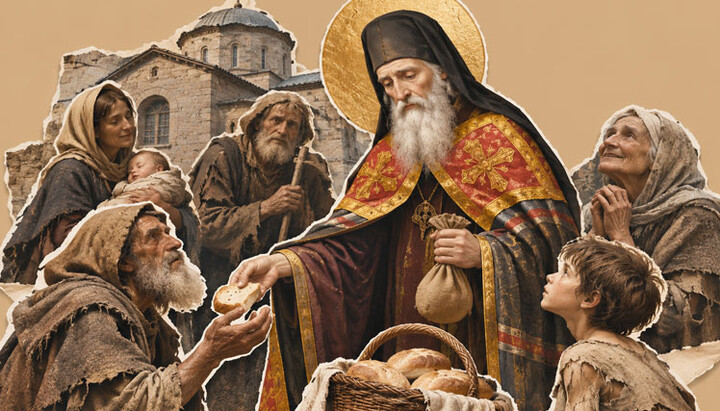
Он стал Патриархом большого портового города, где живут тысячи нуждающихся, а на горизонте уже маячила война.
When John, a recent layman from Cyprus, became Patriarch of Alexandria at the insistence of Emperor Heraclius, the usual church bookkeeping burst at the seams. He was a widower who had buried his wife and children, and he found himself at the head of a vast city where thousands of people crowded the streets without a crust of bread or a roof over their heads. Instead of counting what was left of the savings and preserving the reserves for a rainy day, the new Patriarch summoned the treasurers and ordered them to go around the whole city and write down all of his masters.
The treasurers looked at the primate in bewilderment. What masters could there be, when all around there were only ragged men and cripples? St. John the Merciful explained to them: those whom the city considered beggars and the wretched were his masters and helpers. The list came to more than seven and a half thousand people. They were given money every day, on a regular basis, through a personal treasurer.
This example overturns the logic of power and wealth. The Gospel says: "Inasmuch as ye have done it unto one of the least of these My brethren, ye have done it unto Me" (Mt. 25:40). For St. John, every petitioner on the list of the needy gave him a reason to give away, without looking back, what lay in the patriarchal treasury.
The anecdotal story of the coverlet
But the money in the treasury is not endless. When John assumed the authority of first hierarch, about eight thousand litrae of gold were found there. Even when the cash was dwindling, the saint did not shut himself off from the people. Once the treasury was almost empty, and the Patriarch had to borrow about a thousand litrae of gold from Christians in order to continue helping the poor.
Among the stories from the life of St. John, the episode with the expensive coverlet is especially memorable. One wealthy townsman sent it to the Patriarch. The saint did not keep the costly item for long – he gave it away to be sold, in order to raise money for the poor. The proceeds could buy a good many household items, for example coarse blankets.
But the wealthy donor prudently bought the coverlet back and brought it to the Patriarch again. The saint sold it again. The townsman again bought it back and returned it. This was repeated several times, until the Patriarch said with a smile that they would see which of them would tire first: one of buying the coverlet, and the other of selling it.
Along with this incident, another story from the Patriarch's life comes to mind. A certain beggar passed himself off as a captive and received help twice – six nomismata each time. When the man came a third time, the saint did not expose him for his cunning and ordered that he be given twice as much. The Patriarch did not rule out that perhaps Christ Himself was testing him in this way.
The test of glory
Alexandria lived by the sea and by bread. The city was home to about two to three hundred thousand people, and Egyptian grain passed through in transit to Constantinople in enormous quantities. Despite the temptation of quick enrichment, the Patriarch demanded that merchants not cheat people by false weights and that they keep uniform measures and scales.
When the Persians were ravaging Syria and Palestine, trouble came to their neighbors as well. St. John sent the Patriarch of Jerusalem, Modestus, a thousand nomismata and a thousand sacks of grain, adding legumes, wine and oil to the shipment to ransom captives and support the devastated lands.
At the same time, he asked that his name not be mentioned as a benefactor on the buildings that were erected – he had no need of a commemorative plaque.
Once Saint John shared an unusual dream with those close to him: Mercy appeared to him in the image of a maiden with an olive wreath and called herself the first of the daughters of the King. And indeed the Patriarch became a man of mercy. He built an entire system of social assistance while the familiar world order was collapsing around him.
Two fast ships of the Christian Church sailed to Sicily for grain so that the city would not be left without bread. And when the Persians took Alexandria in June of 619, Saint John departed for his native Cyprus. He returned to Amathus, where he was born, and there he completed his earthly journey.
The Patriarch's Meager Inheritance
The saint never saved money for old age and left no mountains of treasure to heirs. In his will he humbly wrote that he had taken care to render unto God what is God's. By the end of his life, only a third of a solidus remained in the patriarchal treasury — a negligibly small savings.
As he lay dying, Saint John thanked the Lord for having been counted worthy to offer Him what by right belonged only to God Himself.
His entire life in Alexandria was built on the understanding that gold and grain are given not to lie hidden away while seven and a half thousand people around him wait for help.
When Persian detachments already stood at the gates of the city, the holy Patriarch asked himself only one question: how many more people would manage to receive bread for their daily sustenance?