

The agony of a wounded creation
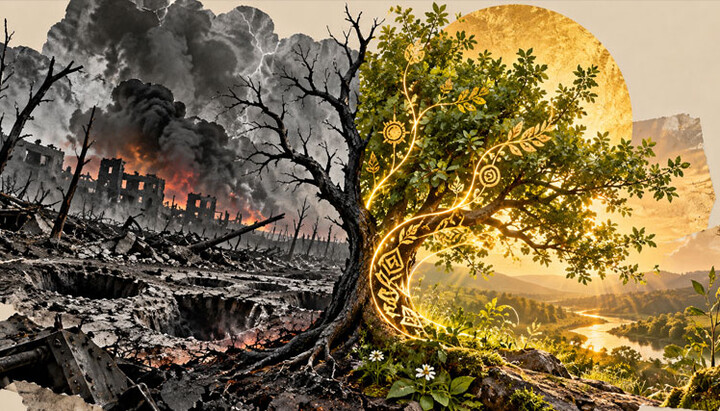
The destruction of nature during war desecrates God's divine design. The teachings of St. Maximus the Confessor reveal why the devastation of creation is a grave sin.
November 6 marks the International Day for Preventing the Exploitation of the Environment in War and Armed Conflict. Established by the UN General Assembly in 2001, the observance was originally conceived as a sober assessment of environmental risks. But today, as the planet is shaken by wars both regional and global, the date sounds like a desperate alarm bell – one to which we have become utterly deaf.
When we think about war, our attention naturally turns to human suffering. We count the dead, mourn devastated cities, and shudder at the plight of refugees. This is the natural response of living compassion. Yet behind the flashes of explosions and the thunder of artillery, a terrible tragedy unfolds – one that analysts call "collateral damage."

The scale of this "damage" is horrifying. Land burned so completely that nothing will grow there for the next thirty years. Ancient forests reduced to charred splinters riddled with lead.
Farmland scarred by craters and sown with millions of deadly mines. Rivers poisoned by fuel oil, heavy metals, and rocket propellants. Entire ecosystems destroyed, rare species of birds and animals wiped out without ever understanding why human beings had turned their homes into a blazing hell. War destroys far more than infrastructure. It systematically annihilates what the philosopher Martin Heidegger called the "house of Being" – the very fabric of organic life that keeps humanity from falling into nothingness.
The terrible tragedy of collateral damage
And here we encounter a striking phenomenon. While environmentalists and human rights advocates seek to introduce the term "ecocide" into international law and place it alongside war crimes, academic and parish theology often remain strangely silent. We debate canonical boundaries, fasting rules, digitalization, and the limits of what is permissible in art. But as soon as the destruction of forests or the poisoning of rivers through military action comes up, the subject is pushed to the margins. It is dismissed as "secondary," "secular," a "fashionable environmental agenda," or a distraction from what supposedly matters most – the salvation of the immortal soul.
Why has Christian thought so readily surrendered the defense of nature to secular humanism? Is the destruction of the created world during war not a direct offense against its Creator? If God created the world and pronounced it "very good" in the Book of Genesis, then turning that world into a poisonous wasteland in obedience to the satanic logic of military expediency is more than an environmental catastrophe. It is a profound act of rebellion against God, a desecration of His divine design about which no believer has the right to remain silent.
To grasp the full depth of this tragedy, we must move beyond conventional environmentalism, which views nature primarily as a "biosphere" necessary for human physical survival. We must return to the philosophical and theological tradition and uncover the mystical depths of creation.
And here the teachings of the seventh-century Byzantine theologian St. Maximus the Confessor can guide us.
At the heart of St. Maximus's cosmology lies the doctrine of the logoi – the divine intentions and principles that determine the essence and purpose of every created thing. Every particle of the universe, from a vast galaxy to the humblest blade of grass or drop of dew, possesses its own logos. These are not abstract philosophical ideas but living expressions of the divine will.
The world is not a meaningless collection of atoms accidentally bound together by the mechanical laws of physics. Nor is it merely a "natural resource" waiting to be exploited and consumed. The created cosmos is a spiritually meaningful symphony. All these countless logoi have their source and ultimate cause in the Divine Logos – the Second Person of the Holy Trinity, the Word through whom "all things were made."
A living symphony of the Divine Logoi
When we view creation through the teachings of Maximus the Confessor, every created thing becomes a living voice of the primordial Logos, a note in the divine harmony. Nature becomes God's great revelation of Himself. Long before the Bible was written, God wrote the "Book of Creation."
Every species of animal, every tree, every river is a letter or a sentence in this sacred book. And when human cruelty wipes an entire region from the face of the earth, it literally tears pages from the divine revelation of creation and consigns them to the flames.
What, then, is humanity's place in this design? According to St. Maximus, man was created as a microcosm – a "little world" – and as the priest of creation. He occupies a unique position at the meeting point of different realms of existence. Within him are united all levels of being: the matter of the body, plant and animal life, and a spiritual nature directed toward God. Humanity was appointed as the connecting link, the mediator between the created world and the uncreated Creator. Our calling is not to rule over a broken world with a club in our hands, but to gather the logoi of creation, recognize their humble beauty, and offer them back to God in an act of gratitude and love.
Humanity was meant to become the high priest through whom the entire cosmos would be sanctified and united with its Creator. Water, bread, stone, wood – everything was to become part of this single offering of thanksgiving. But in the fires of war, the perversion of humanity's calling reaches its tragic climax.
In the Christian tradition, sin is not merely the violation of a legal rule. It is an ontological catastrophe, a distortion of the natural movement of created things. Instead of raising the world toward God, the sinner makes creation serve himself and his passions – power, pride, fear, and the destruction of his fellow human beings.
When people destroy nature for military expediency – setting forests ablaze, flooding coastlines with fuel oil, blowing up dams and turning flowering valleys into rotting seas – they commit a violent, bloody "rupture of the logoi." A river created by God as a source of life becomes, in wartime, a barrier used to flood enemy troops or a toxic weapon that washes away entire villages. Land meant to produce bread becomes a mine-infested battlefield that yields only death.
The bloody rupture of cosmic meanings
War transforms humanity from the priest of creation into its ruthless tyrant and executioner. The destruction of nature during war is not some abstract form of "collateral damage." It is the direct, systematic desecration of God's temple. War is a form of Satanism. By destroying an ecosystem for tactical advantage, human beings assault the Creator's design, openly declaring to God that His world is worthless in the face of human malice and political ambition.
There are different ways of looking at the world. Most people live according to a consumerist, utilitarian outlook.
For them, nature is merely inanimate "material" to be used for survival, industry, and warfare. A forest is so many cubic meters of timber; a river is a hydrodynamic barrier; animals are incidental casualties or instruments to be used.
But the Church proclaims a theological personalism and cosmic vision expressed in the words of the Apostle Paul: "The whole creation groans and labors with birth pangs together until now." From this perspective, the created world is not a voiceless slave to human whims but a suffering participant in human history, subjected to corruption against its will and awaiting healing through humanity.
The urgent need for ecological repentance
And here a question confronts our conscience: Can we truly call ourselves believers if we remain indifferent to the destruction of creation? Does a Christian have the right to reduce faith to the "salvation of one's own soul" while ignoring the fate of the cosmos God created? How is it that we have learned to weep bitterly over our minor personal sins, yet cannot shed a single tear when thousands of acres of ancient forest burn in another armed conflict and dead fish float to the surface of poisoned rivers? When animals and birds die in terrible agony because of human cruelty?
Reducing faith to a "ticket to heaven" while remaining utterly indifferent to a world in flames is a profound distortion. It is spiritual selfishness that has forgotten that God loved the whole world, not merely individual human souls torn from the creation in which they live. Recognizing this problem demands repentance – a transformation of the mind.
Traditionally, repentance has been understood in terms of two relationships: "humanity and God" and "humanity and fellow human beings." But today it is vitally necessary to recognize a third dimension – humanity's repentance toward creation. Harming nature and destroying it needlessly, whether in war or in peacetime, must be recognized as a grave sin that demands a fundamental reassessment and transformation of our attitudes.
A practical extension of Eucharistic ministry
We believe not in the ultimate annihilation of existence in a nuclear or ecological hell, but in the renewal of the world. Christ came not only to redeem humanity but also to renew all creation. We have been promised "a new heaven and a new earth" – a transformed cosmos, healed of the wounds of war. And every step we take today to protect and restore nature brings us closer to realizing that hope.
Caring for the restoration of land desecrated by destruction is not some abstract secular hobby. It is a genuine continuation of our liturgical ministry to the world.
Ecocide in wartime must be called by its proper name – the sin of rebellion against God. When we plant a tree where only ashes remain, when we cleanse a poisoned river, when we protect a forest from being turned into a military training ground, we restore humanity to its true calling. Once again, we become not destroyers but guardians of this world, capable of defending, in God's name, everything He has created.