Supreme Court overturns rulings upholding UOC "renaming" as lawful
The Supreme Court ruled that the Ministry of Culture should have involved UOC representatives in its 2019 religious assessment and that lower courts should not have substituted evidence from 2023 for evidence relating to the original "review."
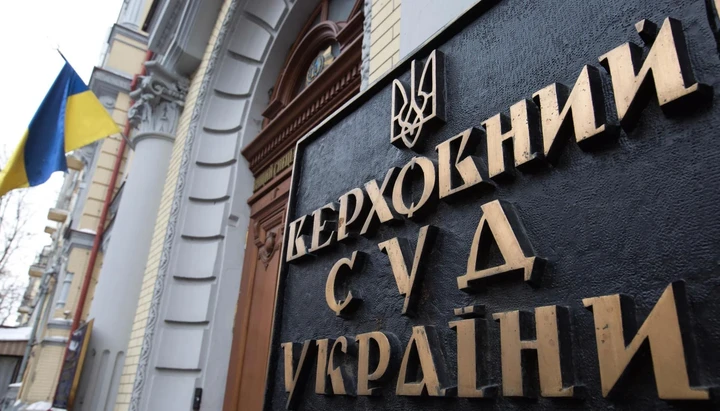
On November 17, 2026, the Administrative Cassation Court within Ukraine’s Supreme Court partially granted appeals filed by the Kyiv Metropolia of the Ukrainian Orthodox Church (UOC), the Pochaiv Lavra, the Florivsky Convent, the Odesa Eparchy, and the Odesa Theological Seminary. The court overturned rulings issued in 2023 that had upheld the legality of a 2019 religious assessment conducted by the Ministry of Culture. That assessment served as the basis for requiring the UOC to change its name, according to the Supreme Court’s ruling in case No. 640/4748/19.

The panel of judges overturned the May 15, 2023, ruling of the Kyiv District Administrative Court and the November 2, 2023, ruling of the Sixth Administrative Court of Appeal. The case was sent back to the trial court for reconsideration. This time, it must be heard under the general rather than simplified procedure.
The Kyiv Metropolia of the UOC and the Pochaiv Lavra had challenged Ministry of Culture Order No. 37, dated January 25, 2019. They also contested the publication, on January 26, 2019, of a list of religious organizations required to amend their charters and names. The list appeared on the ministry’s website and in the government newspaper Uriadovyi Kurier.
The plaintiffs argued that the assessment had been conducted without representatives of the religious organizations, even though Article 30 of the Law on Freedom of Conscience and Religious Organizations required their participation. They also maintained that the assessment examined a “religious network,” a concept not provided for by law, rather than the organizations’ registered charters.
The trial and appellate courts rejected those arguments. The appellate court held that Law No. 2662-VIII, as a more recent and specific law, did not require Church representatives to participate. It also concluded that, in the absence of an approved methodology, the Ministry of Culture was free to determine how the assessment would be conducted.
The Supreme Court disagreed. The panel ruled that Law No. 2662-VIII must be applied in conjunction with Article 30 of the Law on Freedom of Conscience. The fact that the newer law did not repeat the requirement to involve representatives of religious organizations and specialists “does not constitute grounds for its non-application.” According to the court, the absence of detailed regulations governing the assessment procedure did not give the Ministry of Culture “unlimited discretion.” The lower courts should have determined whether the ministry had ensured the participation of Church representatives and whether they had been given an opportunity to submit their governing documents and explanations before the assessment was completed.
The Supreme Court also criticized the lower courts for relying on materials that were not directly related to the 2019 assessment. These included an assessment of the UOC Charter approved by the State Service of Ukraine for Ethnopolitics and Freedom of Conscience (DESS) in January 2023 and a publication concerning remarks by Archpriest Oleksandr Bakhov.
The Supreme Court emphasized that these materials “do not, in themselves, establish that the defendant complied with the legally prescribed procedure for conducting the assessment in 2019.” Moreover, the parties had not been given an opportunity to comment on those materials. The Supreme Court cited the European Court of Human Rights ruling in Haidashеvskyi v. Ukraine, in which the Strasbourg court linked concerns about judicial impartiality to a court’s independent collection of decisive evidence.
The panel also noted that, under Ukraine’s Code of Administrative Procedure, the burden of proving the lawfulness of its actions rests with the defendant – in this case, the Ministry of Culture. Therefore, the lower courts’ reliance on the plaintiffs’ failure to “disprove” the UOC’s affiliation with the Russian Orthodox Church (ROC) could not substitute for an examination of the ministry’s evidence.
The Supreme Court further found that the decision to hear the case through simplified written proceedings, without summoning the parties, was unjustified. In the court’s view, the importance of the dispute to the plaintiffs, the contested facts, the large number of participants, and the considerable public interest required a hearing under the general procedure. The Pochaiv Lavra’s lawsuit had originally been considered under that procedure. The court stressed that this procedural violation “cannot be regarded as merely formal,” because it affected how thoroughly the facts of the case were established.
According to the Supreme Court, the Constitutional Court’s 2022 ruling upholding the constitutionality of Law No. 2662-VIII confirms the state’s authority to conduct religious assessments. However, it does not settle whether the Ministry of Culture acted lawfully in carrying out this particular assessment.
At the same time, the Supreme Court upheld the appellate court’s decisions refusing to open appellate proceedings on complaints filed by the Odesa Eparchy and the Odesa Theological Seminary. The court explained that their arguments had already been considered in appeals brought by other parties to the case.
The Supreme Court’s ruling took effect immediately upon issuance. It is final and cannot be appealed.
As a reminder, on December 20, 2018, the Verkhovna Rada adopted Law No. 2662-VIII, requiring religious organizations whose governing centers are located in an “aggressor state” to indicate that affiliation in their full official names. On January 26, 2019, the Ministry of Culture published the results of its assessment and a list of organizations subject to the law, including the UOC.
In April 2019, the Kyiv District Administrative Court issued an injunction prohibiting registration actions involving UOC organizations while the lawsuit was pending. The injunction was upheld by both the appellate court and the Supreme Court. In December 2022, the Constitutional Court ruled that the “renaming” law was constitutional. In May 2023, the Kyiv District Administrative Court dismissed the UOC’s lawsuit and lifted the injunction. The appellate court upheld that decision in November of the same year.