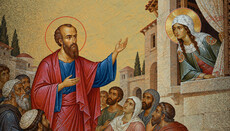

The master whose last icon was finished by an angel
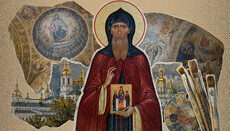
As a boy, he witnessed an icon miraculously appear in the altar. As an old man, he would witness his own icon completed in an equally miraculous way.
The day before the feast of St. Alypius of the Caves, the Church celebrated the Translation of the Image of the Savior Not-Made-By-Hands – the cloth upon which the face of Christ imprinted itself. According to tradition, this image healed a Syrian ruler of leprosy; he had sent an artist to Christ, who was unable to paint Him. Remarkably, if this tradition is to be believed, the first icon in the history of the Church was painted not by an iconographer, but by God Himself.
The treasury of a child's memory
A similar story would repeat itself a thousand years later in the life of a Kyiv monk. In 1083, Greek masters came to the Kyiv Caves Monastery to paint the newly built Dormition Cathedral. Among those who ground their pigments and held their ladders was a young boy named Alypius. It was then that he first witnessed what self-painted icons were.
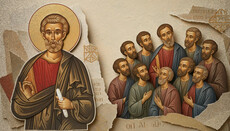
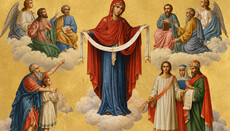
The work proceeded as usual, until one day an icon of the Most Holy Theotokos miraculously appeared on the wall of the altar. The light emanating from it was brighter than the sun. A dove flew from the lips of the Most Pure One, circled the church, and disappeared into the mouth of the Savior depicted in the upper part of the vault. News of the miracle reached the Kyiv prince, who came to see it with his own eyes. The boy stood among the masters, gazing with reverence at the wall painted by the hand of the heavenly powers.
He would never forget this. Many years later, that same invisible hand would complete his own final icon.
Miraculous paint in the hands of an unmercenary saint
St. Alypius learned the craft of iconography from the Greeks and received monastic tonsure from the Abbot of the Caves, Nikon. Commissions for his icons came steadily — he painted cathedrals and fulfilled private orders from boyars and ordinary parishioners. Yet he handled his payment in a manner that seemed strange to those around him: he divided it into three parts. One part he set aside for paints and boards, the second he distributed to the poor at the monastery gates, and the third he kept for himself — only as much as a monk needed for sustenance. If icons in any church aged and began to flake, he would take them to his cell and restore them free of charge.
Once, a man covered in festering sores was brought to the monastery. Ordinary treatment had not helped him. Alypius heard the sick man's confession, gave him Holy Communion, and instead of medicine, anointed his wounds with the same paint he used to depict the images of the saints. He then instructed him to wash his face with the water priests use to rinse their hands after the Liturgy. The man was healed. Years later, his grandson, in gratitude, made a generous donation to the monastery treasury.
The paint in Alypius's hands healed not because it was magical. It healed because it was in the hands of one who sought no earthly reward – a man who had long since ceased to possess anything of his own.
Icons as witnesses in court
A devout Kyivan built a church and wished to adorn it with seven icons. Too shy to approach Alypius directly with the request, he sent the boards and silver to the master through two monk-intermediaries.
The monks, without much deliberation, kept the silver for themselves. They said not a word to Alypius about the commission.
Months passed. The patron, having waited in vain for the icons, complained to the abbot. The abbot summoned Alypius and was met with genuine bewilderment: the master had never heard of this commission. The monks, standing right there, slandered the saint before the abbot: they claimed he had taken the silver but refused to paint the icons.
The boards were then brought into the monastery courtyard — boards which, according to the deceivers, had stood untouched all that time. But instead of bare wooden panels, the brethren saw fully painted icons, no less beautiful than Alipius’s earlier works.
Witnesses later recalled that they bowed before the boards with awe, as though standing before a holy relic. The accusation collapsed before everyone’s eyes, and the slanderous monks were driven from the monastery in disgrace.
One of those icons, later known as the Vladimir–Rostov Icon, was placed in a wooden church in Kyiv’s Podil. When almost the entire Podil burned to the ground, the fire consumed the church as well. Yet the icon was found unharmed in the ashes, without a single crack or scorch mark. It was moved to another wooden church. Before long, that church burned down too. Once again, the icon survived unscathed. Word of this reached Prince Vladimir Monomakh himself.
The master was not the last one to hold the brush
Near the end of his life, St. Alypius accepted one more commission — an icon of the Dormition of the Most Holy Theotokos, which was to be completed by the feast day. A few days later he fell gravely ill and took to his bed. From that point on, he no longer had the strength to hold a brush.
The patron came for the icon at the agreed time and found an empty board and a dying master beside it. Instead of sympathy, he apparently left in anger.
That same night, in the cell where Alypius lay, an unknown young man appeared and set to work. The dying man thought at first that the patron, not believing in his infirmity, had sent another iconographer. Meanwhile, the young man ground pigments on a stone, applied gilding, and drew lines, and within three hours completed an image of such beauty that it became clear: the one standing before Alypius was far from an apprentice. By evening, the young man vanished mysteriously, along with the icon.
The next morning, the patron entered the church – whether to settle accounts or to repent – and froze. In the appointed place stood the icon of the Dormition: radiant and complete. He rushed to the abbot with questions.
The abbot and the patron came to the dying man's bedside. "Father, who painted this icon?" asked the abbot. Alypius replied that an angel had painted it, and added: that same angel was standing beside him now, waiting to receive his soul. With these words, he quietly departed to the Lord.
The gift that does not belong to you
The boy who had once stood in wonder before the altar wall became an old man on his deathbed. He had drawn the central lesson of his life: the brush held by the master never fully belonged to him – it was God Himself who painted through it.
Today, when vocation is increasingly measured by the size of one's fee and talent by the number of commissions, this story puts us to shame. Alypius did not refuse payment for his work, yet he did not allow it to become a measure of his talent. Two thirds of his earnings left his hands immediately.
In this there is an unexpected consolation for us as well. When war takes away one's life's work, one's craft, one's workshop, it seems as though the talent itself disappears along with them. The story of St. Alypius says otherwise: what God once placed in a person's soul cannot be measured by a fee, by stolen silver, or even by a burned-down church.
People may interfere with the work, deceive, steal, burn to the ground the walls of the building where the fruits of that work were kept. But the gift itself does not disappear for it never fully belongs to man.