"Ecumenism is a temptation of the last days"
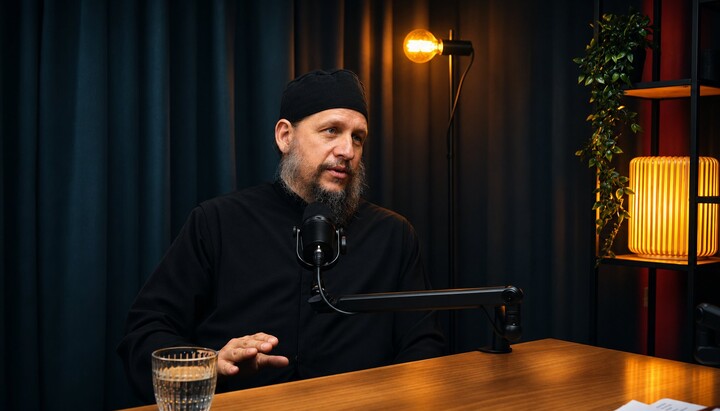
What Fr. Peter Heers planned to say in his canceled lecture on Elder Ephraim, where the Ukrainian church crisis has its roots, and who has the authority to make decisions for the entire Church – in an interview with UOJ-Greece.
The Greek editorial office of the Union of Orthodox Journalists publishes an interview with Father Peter Heers, a well-known American theologian and writer.
Fr. Peter was born in the United States to an Anglican priest and converted to Orthodoxy at the age of 20. He is the spiritual son of one of the closest disciples of Elder Ephraim of Arizona, the founder of Orthodox Ethos, and the author of books on ecumenism and the boundaries of the Church. He currently serves as a cleric of the Romanian Orthodox Church’s Metropolia of the Americas.
In this interview, Fr. Peter explains why he considers ecumenism “a temptation of the last days” and discusses the crisis of conciliarity that he sees as the root of the Ukrainian church question. The conversation also explores Elder Ephraim’s legacy, Church decisions during the pandemic, raising children, and his message to young people.
From Arizona – close to Elder Ephraim
Thank you for accepting our invitation so readily. You’ve traveled a very long way. Where have you come from?
From America – Arizona, to be precise. We’ve been living there for almost nine years. Before that, I spent nearly 20 years in Greece, from 1998 to 2017. We left in 2017. I taught at Holy Trinity Orthodox Seminary in Jordanville for two years, and then we moved to Arizona. In 2018, we opened a school, the Three Holy Hierarchs Academy, and we’ve been there ever since.
So you live near Elder Ephraim?
Very close. A ten-minute drive.
Glory to God! What is it like to be so close to him?
It’s a tremendous blessing to be near his grave, the places where he walked, and the monastery he built. I first met the elder in 1994, and in 1995 I visited the monastery when there were still only tents and a generator. There was no electricity or running water. The elder was starting from nothing in the middle of the desert.
In 1998, I went to Greece intending to become a monk on Mount Athos, but I always maintained my connection with the elder. I often visited him with my family, and whenever I faced an important decision, I would seek his guidance. So America feels like home to me because of the elder.
Was he your spiritual father?
He was my spiritual father’s spiritual father. But we had direct contact from the very beginning, and whenever I faced a major decision in life, I would travel to Arizona to discuss it with the elder and receive his blessing.
From Anglicanism to Orthodoxy
I know you were born in the United States, into the family of an Anglican priest...
Yes. My father was a priest for 28 years, and in 1992 he and his entire parish became Orthodox. A year later, I became Orthodox as well. I was studying at the University of Wisconsin at the time, and I was 20 years old.
Tell us about your family’s conversion to Orthodoxy – first in general terms, and then about your own experience.
My parents always tried to remain faithful to the tradition they knew and opposed all the innovations in the Anglican Church, especially the ordination of women. After ten years of struggling against these changes, they realized there was no light there and that they needed to look elsewhere.
Then God sent a convert priest who met my father and opened the door to Orthodoxy for him in 1991 – 35 years ago.
Everything happened quickly. Within six months, my father had studied the question, and the entire parish was ready. God had prepared the ground.
I remember my mother calling me at university and saying, “We’re becoming Orthodox.” I asked, “What do you mean? What is Orthodoxy?” I knew almost nothing about it. She replied, “It’s another world.”
Then I went to a local Greek Orthodox parish. I remember attending Vespers in a beautiful, simple little church – almost a chapel by Greek standards. Inside were only the priest, the chanter, and one elderly woman.
But to me, it was as though I had entered paradise. It really was another world, just as my mother had said. I remember the feeling when I closed the door behind me after Vespers: “What was that? It was as though I’d been somewhere else entirely.”
It was nothing like the Roman Catholics. By then, I had already left the Anglican Church and was considering becoming a Latin-rite Catholic because they at least seemed somewhat more faithful to tradition.
My heart accepted Orthodoxy immediately, but my mind needed to follow. I had to read. And God arranged for me to come across Fr. Seraphim Rose’s book Orthodoxy and the Religion of the Future. That’s quite a radical first book for a convert. But one thing struck me: if this man understands the devil and demonic activity so well, then he must also know Christ. He must be enlightened by Christ.
It was so unlike anything I had read before that God immediately set me on the path of traditional Orthodoxy – toward monasticism and everything that followed. I left everything behind and began visiting monasteries throughout America.
Education, Mount Athos, baptism, and the priesthood
Before we return to your conversion, tell us a little about your education. What did you study?
I first studied history in America. When I came here, I earned a degree in theology and then completed my master’s and doctoral work in dogmatics under Professor Dimitrios Tselengidis. My subject was the ecclesiology of the Second Vatican Council. The work has been published in both Greek and English.
From the very first moment you enter the Church, ecclesiology confronts you as a convert, whether you want it to or not. You don't merely think about these questions – you live them. How are you received into the Church? Through Baptism or Chrismation? On what grounds? What does it mean?
I have lived with these questions since becoming Orthodox. I wrote my dissertation on the subject, and since then we have written and published many books about it. Because everything revolves around this question: the identity of Christ, the Church, and salvation.
Could we say that the Holy Spirit called you – rang a bell, so to speak? Did you feel it when you returned home and said, “It’s another world”?
Yes. You immediately recognize the difference. The soul understands because the Holy Spirit speaks silently within it. It’s not a matter of analysis or criticism. The heart finds peace. You want to remain there and never leave. There is warmth – the warmth of the Holy Spirit – and you don’t want to move away from it.
Yes. You immediately recognize the difference. The soul understands because the Holy Spirit speaks silently within it. It’s not a matter of analysis or criticism. The heart finds peace. You want to remain there and never leave. There is warmth – the warmth of the Holy Spirit – and you don’t want to move away from it.
Was there someone who helped you hold on to what you had come to believe was the truth during those first steps?
Yes, several people. I was searching, moving from place to place, and two or three people helped me tremendously. One was an elderly hieromonk, Fr. Sergius Black, with whom I spent a year. He had studied under Fr. Georges Florovsky and Archbishop Basil (Krivoshein), and he knew the great figure of the Russian Church, Elder Sophrony. He passed on many wonderful things to me.
Then there was the thousand-page biography of Fr. Seraphim Rose. It changed everything. After reading it, everything became perfectly clear: I wanted to become a monk. In 1996, I traveled to Mount Athos and was baptized there – we’ll come back to that.
Bishop Basil also helped me greatly. We remain close to this day, and I still call him. Then there was another person on Mount Athos, and Elder Ephraim himself, whom my father met in 1994, two years after my parents became Orthodox. So there were quite a few people.
You had accepted the truth, but you continued searching – and rightly so. Was your time on Mount Athos decisive? You wanted to stay there, become a monk, and receive Baptism?
Yes, I wanted to become a monk. I’m not a monk – I never became one, although I wanted to. But that was not my will; it was God’s will. There’s quite a story behind it.
Tell us what happened.
In 1996, I first visited Mount Athos. I went to all 20 monasteries, visited the cells, climbed to the summit, and spent almost two months there. Eventually, I was baptized. In America, I had been received through Chrismation, but the Athonite fathers do not consider that the proper way of receiving converts. Elder Parthenios baptized me at St. Paul’s Monastery. He is a holy man, truly holy, and it was a tremendous honor and blessing for us.
I then returned to America and began publishing a magazine called Divine Ascent. I stayed there for a year, but my heart was on Mount Athos. In 1998, I returned and found my elder, one of Elder Ephraim’s five closest disciples. He played a decisive role in my life. Without him, I don’t know where I would be today.
A spiritual father is the most important person in one’s life – the alpha and omega. I remained in Greece with his blessing. I wanted to become a monk, but he told me, “It would be better for you to become a priest.” Leaving Mount Athos was difficult. I didn’t want to go, but I accepted it as God’s will.
A week later, I met my future wife. We spoke two or three times and decided to get married. I wanted her to become a priest’s wife, while she had been considering monasticism. That also showed you the truth of what the elder had said: if you obey, God will arrange everything.
Yes, everything is blessed, and I believe that too.
That’s exactly what happened. But obedience is difficult. It is a constant struggle. It requires humility, fighting against your own will and your own thoughts. I stayed, enrolled in the theology department, and continued visiting Mount Athos three or four times a year. That was where I learned Orthodoxy. Mount Athos was my school of spiritual life, and that was how I came to study theology.
I wrote my dissertation not because earning a doctorate was my goal, but because I wanted to offer the Church something important. That is why I chose the subject and spent years studying the reception of heretics into the Church. As I said, this is a defining question. It provides the foundation for understanding the boundaries of the Church, her identity, and much more. Glory to God.
The benefits of Orthodoxy: discernment of spirits
What did Peter find in Orthodoxy that had been missing from his former faith?
Life and truth. If you have never lived outside the Church, among the heterodox, you cannot understand this. It is a matter of experience.
Heterodoxy is religion, not revelation. There is no Holy Spirit there, no grace in the sacraments, and no understanding of the discernment of spirits. That is what distinguishes Orthodoxy from everything else: the discernment of spirits.
Behind movements and ideologies are spirits, demons. These are not merely ideas; they also involve the activity of spirits. So when we speak of discerning spirits, we mean not only recognizing demonic activity or presence itself, but also all its consequences – all the movements arising from the fallen world and directed against the salvation of the world and mankind.
Orthodoxy recognizes them. If you struggle spiritually and purify your mind, you begin to see and understand: this comes from God, and that comes from the devil. There are criteria for discerning these things. Outside the Church, those criteria do not exist.
Beyond the answer someone might find in a university textbook, I’d like to ask you as a priest and as a person, for the benefit of those watching us. After all, our audience includes not only Orthodox Christians but also people of other confessions and religions who want to learn, just as you once did. Could you name one or two differences in faith that you personally encountered? You said Orthodoxy is life.
There are many. Everyone knows there are differences in dogma. We can discuss those, but they are not the most important thing. Of course, Western innovations – the Filioque, papal supremacy, and so on – took them far from the faith of the Apostles.
But even before they fell into those errors, they had abandoned the ascetic, hesychastic life.
Historically, I cannot prove that conclusively, but it follows from spiritual laws. From spiritual life, we know that dogma and ethos – the spiritual way of life – are inseparable. When you fall away from the ethos, from the way of life, you also fall away from dogma. It is almost a law.
So before they abandoned the conciliar system and embraced papal supremacy, before accepting the Filioque – a heretical teaching concerning the Holy Trinity and the Holy Spirit – they had already fallen away in their way of life, their ethos, their experience.
And we, too, can make that mistake if we are not strict in our spiritual lives.
Or if we are too strict, I would add. Both extremes.
Yes, both extremes exist today, and I would say they converge in how they operate. They resemble each other because both are worldly. Both are characterized by worldly thinking and rationalism. They may criticize and hate one another, but they actually belong together.
The royal path has nothing to do with either extreme. It is important to understand that unity cannot be achieved simply by “correcting” papal primacy. Anyone who says that is spiritually deluded.
Over the past thousand years, many other things have happened that divide us. Anyone who has traveled the path from Anglicanism or Roman Catholicism to Orthodoxy knows this.
For example, they regard Francis of Assisi as a saint. But if you read his life, it becomes clear that it is not the life of a saint of the Orthodox Church. There are many things there that any elder here would identify as spiritual delusion or misunderstanding.
Let me give just one example out of hundreds: he prayed to Christ to grant him His stigmata. That request alone is already spiritual delusion. You and I may bear the “marks of the Lord” and suffer, even physically, as Christ did, but we must not ask for such things. Yet he asked and received them. And he was not alone. Some 200 other “saints” of the papal church reportedly had bleeding stigmata, right down to Padre Pio, who lived just a few decades ago.
These are signs of spiritual delusion, not holiness. So what kind of unity can there be if we merely “correct” one or two dogmas? It is the worldliness that truly separates us. To sum up, someone coming to Orthodoxy from another confession will understand it through the examples the faith provides – through imitating the saints and living an Orthodox way of life.
Protestantism and “two boats”
Does Protestantism influence Orthodoxy? I mean, many people consider the Protestant way of life easier. Some who are listening to us are somewhere in between. They say, “I can be somewhat Orthodox, even mostly Orthodox, but still do some of the things Protestants do – there’s more freedom there.” Does this affect the thinking of someone who wants to become Orthodox?
A Christian is “not of this world.” He lives in the world but is not of the world. Protestantism is of the world. In other words, such a person wants to live a worldly life. That is impossible. He has two masters. His heart is divided – given both to the world and to God. It cannot work. It cannot last. As the Lord says, he will hate the one and love the other.
You cannot stand in two boats at once. Absolutely not. Most likely, such a person doesn’t really know Orthodoxy yet.
He is halfway there, still searching.
Yes.
The holy fathers and pastoral ministry
In your opinion, do Orthodox Christians in Greece and the United States know the theology of the Holy Fathers and the Ecumenical Councils? Do we – and I include myself first – know which path to follow, at what pace, and for how long? And please tell us more about America.
If we labor spiritually and strive to obey our spiritual father, if we have a good disposition and struggle to examine ourselves and gain self-knowledge, then we will be able to assimilate the teachings of the Holy Fathers, the Ecumenical Councils, and the whole of Tradition. Without that, the door is closed. The books are closed. We will neither understand nor experience these things.
The first things are cutting off our own will, obedience, and humility. Then, little by little, we begin to taste the Holy Spirit, and only then do we understand what the Holy Fathers wrote and what they intended.
Is this a matter of of personal searching, or does it also concern pastoral ministry – yours and that of other priests?
Of course, the spiritual father, the priest, must guide people. He is a mystagogue. He must lead people into the mysteries of Christ, into the life of the Church. That is his task.
Who brings people into the Church – Christ, the priest, or both together?
Is there any separation between the Church and Christ in pastoral ministry?
No.
Of course, the Church is Christ. That is beyond dispute. But that is not what I mean. I mean bringing someone into the Church, helping them become part of its life and participate in the sacraments of the Orthodox Church. Surely that involves both, including the priest’s pastoral ministry?
Yes, but the priest’s task is not to drag someone into the Church at any cost by lowering the standards and making everything easier. Because in doing so, he is more likely to push that person out than bring him in. There must be no pressure, but neither should there be any cutting and tailoring of Tradition or making life in Christ easier. That is spiritual delusion. The priest must speak the truth, as Christ does. He represents Christ and must convey Christ’s words to people.
There is this idea that we are the ones who will bring people into the Church. I can barely bring myself in, and I’m supposed to bring others No. I must bring them to Christ. Christ does the work. Christ brings people in, Christ arranges everything, Christ seeks out each person and brings him. My responsibility is to faithfully preserve the deposit of faith. Then the door remains open. If I fail to preserve that deposit, Tradition, and dogma, I am the one closing the door to people.
You put it well – we must not cut and reshape Tradition to fit each individual. That would mean “a faith tailored to me or to you.” That is a mistake, and I agree with you. But changing or diminishing Tradition is one thing; bringing someone closer step by step is another. There is room for economia here.
Of course there is economia. We would make many accommodations, but never at the expense of the goal, the faith, or the truth. Otherwise, a person may see one thing at the beginning of the journey and something entirely different at the end, and say, “But that’s not what you told me.”
There is also a particular spiritual delusion among clergy: believing you possess authority you do not actually have and trying to do things that are not yours to do. For example, thinking that I must attract people through human methods. No. I must get out of the way so that people encounter Christ, not my inventions.
The One Church and Ecumenism
Is the One, Holy, Catholic and Apostolic Church identical to the Orthodox Church?
Absolutely. There is only one. Christ is one: “One Lord, one faith, one baptism.” There is no other.
There are not two Churches, and there never will be.
Identical in the fullest sense – completely the same?
That is our identity. It is not as though there is another “you” somewhere, as though you were divided in two. You are one and the same.
The Church and Christ are inseparable – “yesterday, today, and forever.” Anyone who speaks of a divided Church is spiritually deluded. Anyone who claims that the Church has been divided or can be divided does not know what he is saying. He does not know Christ.
Let me be clear: this is a matter of faith. We say, “I believe in the Church,” and we confess this three times a day – at the Liturgy, at Compline. Every day, a Christian says, “I believe in one God... in one Holy... Church.” We do not merely say that the Church “exists.” We believe in the Church because she is the divine-human Body.
Can Christ be divided, broken into pieces? No.
And yet, through our behavior, we seem to do precisely that.
That is something different. We leave the Church when we follow our passions. But here we are discussing our Creed and what we understand the Church to be.
One in essence and undivided. Now I would like you to explain the word “ecumenism” and identify what you see as its greatest danger to Orthodoxy. Let me repeat the question because it has two parts: I want your personal understanding, not simply a literal definition, and I want to know what you consider the greatest threat ecumenism poses to Orthodoxy.
It is not I who say this. The saints say that ecumenism is a temptation of the last days.
Don’t simply repeat what the saints say. I want to hear your opinion.
My opinion is worth nothing, and I am not going to tell you “how I understand it.” What matters is what the saints say. But let me explain. There is the ecumenical movement. I wrote a book about it, also available in Greek, called The Missionary Origins of Modern Ecumenism. It is a short book.
The movement emerged among Protestants in missionary circles around 1880. Protestants needed to unite among themselves. Its goal was never to return to the One, Holy, Catholic, and Apostolic Church. It was always about practical objectives – making missionary work more successful. That was the situation then, and it has not changed to this day. Essentially, these were worldly calculations, ideas, and aspirations among Protestants.
And we entered that movement, accepted its framework, and have not changed anything since. We think we have accomplished something, but in practice I see no improvement.
Then, in 1965, the Roman Catholics entered the movement, and the ecclesiology of the Second Vatican Council shaped everything that followed. Many Orthodox Christians have been influenced by the theology of Vatican II, which essentially represents a new understanding of the Church.
So ecumenism is both a movement and a particular understanding of the Church.
In terms of its understanding of what the Church is, ecumenism is a heresy. It speaks of a divided Church, a Church that contains heresy within itself, a Church made up of different parts. These ideas extend even to the sacraments. Some claim that sacraments exist outside the Church. But there can be no sacraments outside the Church. All the sacraments and the very mystery of the Church are one. They cannot be separated.
All these theories about God belong entirely to our age. They are not patristic thought. They do not come from the Fathers. People take fragments from the Fathers to construct an attractive theory, all for the sake of this world and some notion of success. These theories, this prevailing conception of the Church, constitute the greatest temptation of the last days. Because they attack the divine-human Person of Christ.
And that is precisely the temptation Christians will face in the last days: they will lose their faith at the ecclesiological level. They will no longer believe that the Church exists in the world. Instead, they will believe that she has broken into pieces, as many already do. And if there is no Church, there is no salvation. That would mean Christ is not “the same yesterday, today, and forever,” and that we must “build” a new Church.
That is the goal.
Do you believe this is ultimately where things are heading?
I think that, in the coming days, people in the churches will increasingly embrace theories associated with so-called perennialism.
This is an idea we have heard for years from Pope Francis and others – that religions save, that all religions are paths leading to Christ and salvation. Its roots go back 100 to 150 years, to figures such as Frithjof Schuon, René Guénon, and others who believed that religions are outwardly divided but inwardly united, and that all religions are different revelations of the same God.
That is where ecumenism is heading.

This is where ecumenism will lead, and it will be the «religion of the future» of which Father Seraphim Rose spoke – the religion of the Antichrist.
So it turns out that only they see the outward division and inward unity, while we do not?
That is just what they say: if you are sufficiently «enlightened,» you see this inner unity. These intellectuals hold to such ideas relying, in essence, on the power of the mind alone. Schuon and those like him possessed remarkable powers of reason. They notice similarities: Buddhism teaches this, Christ teaches that, in some respects they coincide – and they conclude that everything leads to one goal.
So one must be an intellectual, hold a degree, study – does that mean God reveals Himself only to those with diplomas?
You have taken the answer right off my tongue. It is exactly the opposite. The Church extols fishermen, not intellectuals.
Heresy, heretic, heresiarch
Father, what is heresy? Allow me a minute to explain. We laypeople, with very simplified logic, write about theological subjects every day, knowing nothing about God. We give lessons, become teachers, and do not accept objections: «I am right.» On the same subject another writes something different – and is also «right.» But we all come together in one perplexity – those of us willing to read two minutes more than the next person: what is heresy, who is a heretic, and above all – who is a heresiarch?
Heresy is when one takes a part of the whole and passes it off as the whole, or interprets it differently from the way the holy fathers received it. It is when something new is introduced, or what we received from the fathers is distorted, and this is made a point of schism, so that people become divided along this line. This is no longer the catholic, conciliar and apostolic teaching, but only a part of it.
A part?
Yes. And ultimately it does not matter what exactly is at issue – the Person of Christ, the Holy Trinity, or the Church. If a teaching departs from the deposit of faith we have received, it is heresy. And the deposit of faith is necessarily the fruit of experience: we did not «invent» it, we did not decide that it would be good to speak about God in this way. Heretics, however, arrive at a new theological view through reasoning and begin to impose it. So it was, for example, with the filioque: it was born not of the conciliar Church, but of a small group, and only gradually was it accepted by everyone in the West.
What heretics have in common, as St. John Climacus says, is pride. Pride together with rationalism.
Forgive me, I will interrupt again: pride and egoism include a «discovery.» That is, they take a piece, interpret it as they wish, usually distort it, and say: «Here is what I have found.»
Yes. Usually worldly calculations stand behind this – iconoclasm, for example, and today, I think, ecumenism.
By the way, today we are celebrating the Seventh Ecumenical Council.
Yes, today is the commemoration of the Ecumenical Council at which the icons were restored. And let us recall that a few years before the Seventh Ecumenical Council there was a heretical council, where about 350 bishops [at the Council of Hieria in 754 – 338 bishops] approved what the emperor wanted – iconoclasm. This means that secular power and politics often stand behind heresy. And today the same thing is happening: quite often, because of politicians and worldly calculations, we introduce new theories about the Church and the like.
The cancelled talk about Elder Ephraim
If we begin such a discussion, Father… And I know that you have another talk after the broadcast.
I have no talk.
What do you mean, you have none?
There was a talk. Today, on Sunday, at the Church of St. Demetrios, as part of the Demetrian celebrations. But some people, for their own reasons, unfortunately do not want to hear about Elder Ephraim.
Forgive me, but I am obliged to ask: I am here in the role of a journalist, and you yourself do similar work. The interview was planned – and here it has taken place. The talk was planned – and there is no talk. You are not so much answering as putting me in an awkward position. What happened?
The talk was cancelled on the instruction of the Patriarchate, the reason for which I do not know.
How do you know this?
The organizers informed us: unfortunately, at the last moment – three hours before the talk – we cannot hold it, because the Patriarchate does not want it to take place.
Glory to God for all things. Apparently something has changed, but what exactly, I do not know.
"Glory to God for all things" – beautifully and rightly said. Was the program changed? Do I understand correctly that they did not tell you the reason?
They did not. They simply said that the talk was not possible. But whoever made this decision could at least, out of respect, have taken into account that a person had flown in from the other side of the world, and that people were going to come to listen about Elder Ephraim.
What did you want to tell us about today?
About Elder Ephraim and especially about his work, accomplished within the Patriarchate, in the Archdiocese of America. The greatness of the Church, the person of the Elder, and the fruits of his labors would have been evident. Such was the topic. Who does not want to hear this and why – that is a question to which I have no answer. I do not know.
I will move on. How were you notified – by telephone, by message?
One telephone call.
Tell us something more.
I know only that the talk has been cancelled: "Thank you very much for coming from the other side of the world, but it will not take place." I do not know. They will not tell us. It would be good if they said why they do not want to hear about the Elder. I do not think that is the reason – apparently something else is to blame. But there are no explanations. God knows.
So what were we talking about? Essentially, about heresy.
About what heresy is, who a heretic is, and who a heresiarch is. We stopped at heretics.
Heretics are often driven by worldly calculations and by power – by the desire to hold on to power. They lack the experience of the saints. They do not crucify themselves as the saints do, nor do they abide constantly on the cross in the sense of serving first of all the Church rather than the world. Such is the image of heretics: first they fall away from the path, from the ethos, and then they introduce innovations into dogma. This is usually how it goes. It happens that people first depart from dogma and then fall in their life as well, but usually it is the other way around. And in both cases there is pride, egoism, and self-interest. One must beware of this.
You have given a definition of a heretic. And what of a heresiarch? What does this mean ecclesiologically – according to the writings of the holy fathers, according to your studies, and for you personally?
The well-known heresiarchs are Arius, the pope… truly, these are the gravest and worst cases in history. And again, usually it is for their own reasons: for the sake of renown, power, glory, a name. They persist in some false teaching and draw people after them. That is, they are people of the devil, not of the Crucified One – not of that utmost humility toward which we must at least strive.
Inter-Christian dialogues and joint prayers
Today, many inter-Orthodox and inter-Christian dialogues are being conducted. Do you see in them any positive or at least significant result?
I think that even the ecumenists who are promoting these dialogues today have already understood that they are achieving nothing. There is something worth saying here – I would speak of it in today’s talk as well.
If 5–10 years ago we had five catechumens in our parishes in America, today we have 50. Sometimes 100–150: right next to me there is a parish with 150 catechumens.
Why is this happening? Precisely because today, as never before in the history of America, Orthodoxy is presented correctly on the internet, in parishes, and in society – without discounts and diplomacy, as is fitting, in a confessing spirit. Seeking people come to find the truth – and they find it. They need nothing else: they want the truth, because the truth sets them free from everything else and gives them peace.
This has nothing whatsoever to do with ecumenism.
What more is needed to understand that for the Church ecumenism is a great nothing? At best it is a waste of time, at worst – a path to the Antichrist. Ecumenism has no future. It is needed, perhaps, only by someone who at some point wants to leave the Church and become a papist. Otherwise, people flee from heterodoxy and become Orthodox.
The solution is mission. I have said this many times and written it in books: the antidote to ecumenism is mission. These two things cannot coexist and cooperate. True Orthodoxy cannot go hand in hand with ecumenism – they are opposites.
And one more question. What is your personal opinion about joint prayers with the heterodox?
Again, my opinion means nothing – what matters is what the fathers say. We even published a book by Father Anastasios Gotsopoulos on the sacred canons: what the holy fathers and the canons say about joint prayer. But do not listen to Father Anastasios or to me – listen to Saint Paisios.
His life tells us: two papists came in order to read the "Our Father" together. He said: "I cannot pray with you together. We do not have one faith." The condition for prayer is faith, a common faith. And out of true love – not false, worldly love, but genuine love – Saint Paisios said that we cannot pray together. Precisely so that they would feel it, so that they would have the "good disquiet" of which Saint Paisios speaks.
This is what we must give people – a good disquiet. But ecumenism gives the opposite: a false peace, as though we were already one. This is the worst thing; it is not love. We do not love others when we create the impression that we are already one. This is of this world, it is diabolical, not from God.
But can we pray for the heterodox?
Certainly, constantly, with prostrations and, if we can, with tears. Of course, we should pray for them – but not with them.
And for sinners – for those whom we consider sinners.
All the examples of the saints and of Christ show us precisely this.
The Orthodox ethos
Your website is called Orthodox Ethos. You chose the Greek word "ethos" [character, way of life].
Yes, this is very important. The hardest thing…
Go on, and then I will ask.
I chose this word because we speak about Orthodoxy and about "Orthodox practice," but the main thing is to acquire the ethos. This is the difficulty for the Western person, for the convert, for the American. To acquire the ethos, we need examples, we need to imitate. When you see a saint – how he sits, how he speaks, how he stands… That is how I saw Elder Ephraim 32 years ago. I did not know Greek then, but I saw him – and that was enough. Within seconds I understood what a saint is and what the goal of my life is.
Simply by seeing him?
Yes. By the way he looked at me, the way he spoke, the way he sat, the way he walked, he showed that the Holy Spirit possessed him, that his whole body, every movement, was filled with the Spirit. It was a lesson for life, and no words were needed. This is what the Orthodox ethos is – it is holiness. It means acquiring a particular way of life. Christ is not only the Truth, but also a way of life. This must be emphasized: if we have such a life, we will not err in dogma either. This is what we need to acquire.
But this is difficult, because we have no examples. It does not work. If you remain in rationalism, in the idea of Orthodoxy, only in its confession, you have no experience of Orthodoxy. You do not move forward or change, you do not gain self-knowledge, you do not see yourself and cannot advance spiritually. Even if you know the canons and all of history perfectly well, it makes no difference.
Rationalism and faith
It seems to me that rationalism does not help in anything at all. Wishing to help our viewers, let us say: a faith like our Orthodox faith cannot be lived with unbridled rationalism. One must think with experience and with the soul as well – what the mind grasps, one must also feel at least a little. Just as you did when you saw Elder Ephraim: you did not say "he is a saint because I saw him," but "he is a saint because I felt it."
Yes, you do not stop at rationalism. Such is faith: we live by faith. And faith is not only what will happen in the future. Faith is trust, a direct relationship with God. We live by trust in Christ. And this is above reason. Moreover, the whole Gospel preaches what transcends nature: from the Incarnation to the last mystery of the Church, we have the surpassing of the order of nature. Holy Communion does not fit within the limits of logic or nature, of the fundamental nature of things. It is above all this.
Our whole life should be in this state – living by faith. This is not simply believing in something: «God is good and will provide for us in the future.» Right now, directly, I have a relationship with Him, and I live, I walk within this relationship: God – His providence, His will. I seek His will above all else.
In the life of Elder Ephraim, I am struck that he, like Saint Joseph the Hesychast, wanted to fulfill the will of God in everything and did not take a single step without being sure that it was the will of God. They could wait a very long time before making a decision if there was no sign or something that said: this is the will of God. This is how we should live too, as far as we can. Reason will not help us here – we will make a mistake.
In this chair where you are sitting, a few days ago sat Mr. Konstantinos Fountas – a physicist working at CERN. The conversation turned to Holy Communion and the coronavirus. He objected to those who were urging: «Receive Communion, you will not catch anything.» We discussed this for about five minutes – with some tension, a healthy scientific tension on his part, while I am not a scientist. And we got to holy water. I said to him: «If you do not agree about Communion, let us take holy water, at least.» And I proposed an experiment: we take two bottles of water from a kiosk. One is blessed by Father Peter, the other is not, and we put them somewhere for two years. After two years, anything at all will have grown in one, while the other will remain clean. He laughed – but he did not say «no.»
He has no experience – you see.
Here is where rationalism lies – you said a very true, wise word. I am not giving a lecture, but I experienced this on the Holy Mountain with the late Father Nisim, who lived opposite Koutloumousiou: we spoke a great deal about rationalism. It is a catastrophe for those who do not know. I am the first: since I do not know, I will go by the logical path. No, it does not work that way.
It is just as you say. The man had no experience, and that is why he arrives at this. But God shows that through prayer everything changes. The life of the Church shows this.
I remember that 30 years ago in Chicago there was a miracle: an icon of the Mother of God was streaming myrrh – the flow came even from the eyes, very impressively. We all went there. Bishop Basil was there, of whom I spoke – he is very important in my life. A journalist asked: «How do you explain this miracle?» And the bishop answered: «But we have miracles every week, every day in the Church. Holy Communion is a miracle. It does not surprise us. This is the life of the Church.»
If you do not live in the Church, you cannot transcend logic and avoid rationalism. You live within these frameworks, and they limit you. You do not live life – you live, in essence, as if in a cage; you are not a free person. But in the Church free people are born, because they live above reason.
And to finish with Mr. Fountas: at the end he even apologized in jest: "Forgive me for not saying what you wanted to hear." And I answered: "You said what you were supposed to say. We do not need people who agree with everything." A wonderful scholar, a great humorist, a witty man – he gave us a very good interview and made a very good impression.
Love and Criticism
The Orthodox ethos. Let us agree that love is part of the ethos – perhaps it is its very foundation.
Of course, but it is the love of Christ, not simply human love. We live – Christ lives in us, and in Christ we love. This is not human love. It is the grace of God living in us, and believers are bound together by it – in it we are one.
"And though I have not love, I am nothing," – the Apostle Paul, Epistle to the Corinthians.
I recall what a certain Athonite recently told me – I liked it very much. He had met with Elder Ephraim many times, and each time afterward he wept and wondered: what is it that is in the elder, in a holy man, in every saint? And he understood: it is the love of Christ living in him. And later he came across an old talk of the elder, in which he recalled how, upon arriving in America, he prayed: "My Christ, I will not be able to labor here for You unless You give me Your love, so that I may give it to people." This is not about the love of the world – emotional, human, often selfish. That love has nothing in common with the sacrificial, crucified love of Christ, which changes everything.
I recall what a certain Athonite recently told me – I liked it very much. He had met with Elder Ephraim many times, and each time afterward he wept and wondered: what is it that is in the elder, in a holy man, in every saint? And he understood: it is the love of Christ living in him. And later he came across an old talk of the elder, in which he recalled how, upon arriving in America, he prayed: "My Christ, I will not be able to labor here for You unless You give me Your love, so that I may give it to people." This is not about the love of the world – emotional, human, often selfish. That love has nothing in common with the sacrificial, crucified love of Christ, which changes everything.
From our conversation I understand that you pray for those whom you rebuke. Do you do this before rebuking them, or afterward?
One must pray constantly – both before and after. Unfortunately, we are only human. Often we speak rationally correctly, but without love – and therefore it does not bring such a result. We try to do everything with love, so that there may be a result.
Saint Paisios also speaks wonderfully about this. One can strike a person with the truth instead of setting him free – this happens when we speak without love. The struggle of a believer is to do everything with love. Truth and love must never be separated. This is difficult, because today there are so many challenges: one constantly has to speak about problems and sensitive topics, and discernment is needed – when to speak and when to keep silent.
Dialogue with Opponents
Do you think that a meeting with someone who has long disagreed with you or whom you criticize could be beneficial?
I would very much like that. I would very much like to talk and meet with those who criticize me or disagree with me.
So, dialogue must be conducted even if it does not bring the desired result?
Look, not every dialogue. There is dialogue for the sake of dialogue. Elder Athanasios Mitylinaios says – I even gave a talk based on his words – that there is a dialogue from God and a dialogue from the devil. One must discern. Not every dialogue is good, and we do not conduct dialogue for the sake of dialogue. For example, the dialogue of Eve with the serpent was crafty. It is with this that coexistence with evil begins.
Well observed. There was no common problem there – there was deception. But here we have a common problem.
If there is a disposition to learn… People came to Christ with different attitudes. Some came as disciples – to clarify something, to understand more deeply: “Lord, explain it to us.” That is how the disciples came. And this is blessed, because they went to Christ with humility and wanted to learn. I am not speaking about myself, but about Christ: everyone goes to Christ through someone, but what he seeks is Christ. What matters is the disposition with which he goes. If the disposition is good, dialogue bears fruit, as we see in the example of the apostles. The Pharisees and others also came and held dialogue with Christ. But the result was deplorable, because there was no humility and no readiness to submit.
This is precisely the problem of ecumenism. When the dialogue between the papists and the Orthodox began in 1965, it was defined, if I am not mistaken, by the Greek formula “επί ίσοις όροις” – “on equal terms,” that is, the parties stand on one level. This is a mistake. There cannot be a dialogue on equal terms with heresy – as if Orthodoxy and heresy stood on the same level! Such a dialogue will not bear fruit. But if the non-Orthodox come to Christ – and the Church is Christ – come to the Church with the desire to understand, to learn, and to submit to her, this is blessed, and every good will follow. But the ecumenical dialogue is not built on this basis.
I will stay a little longer on dialogue, but not the ecumenical kind. Suppose you and I disagree and argue on social media: you write one thing, I write another, you answer me, I answer you. And the people who read us are already wounded by this dispute. And at some point we agree to meet in person and end the “war” on social media. Which of us will go to the other as a disciple?
A true disciple of Christ is always a disciple. Yes, he may say what Christ says, what the holy fathers say, but he regards himself as a disciple. Therefore it is not hard for him to go together with another to Christ as a disciple.
Good, let me ask differently. Who will be the first to write or call the other with the words “Let’s talk”? The question is a concrete one, and it is a question of egoism.
Perhaps it is a question of egoism, and perhaps it is a question of discernment. It is not always the same thing. There can also be an imprudent continuation of dialogue. Do you remember the example of Patriarch Jeremias with the Protestant Lutherans?
Tell us about that example.
Their dialogue went on for years – then, in the sixteenth century [the correspondence of Patriarch Jeremias II with the Tübingen theologians, 1573–1581] – and at some point the patriarch said: “Enough. This dialogue makes no sense.” The patriarch ended it. That is, it is not always necessary to conduct “dialogue for the sake of dialogue,” to talk and talk. Sometimes it is better to break off, so that the other may think it over himself, struggle, and suffer. God, of course, never ceases to speak with man, but it is not always beneficial for us to speak with everyone about everything.
What is hard for you personally? Think of a person – if you wish, do not give a name, a position, or a rank – with whom it would be worth speaking, but you do not want to. That is, you understand that the conversation could be beneficial, but you do not dare, because you differ too greatly.
I will not name a name.
You may say whatever you like; I am not pressuring you. Any name and any rank.
I would very much like to speak with those Church hierarchs who believe that those of us who from time to time criticize certain decisions and documents hate, let us say, the institution of the Patriarchate. That is how it is.
Is the Patriarch an Orthodox bishop?
What does “Orthodox” mean? Right-thinking, “rightly dividing the word of truth” – or Orthodox by title? He certainly occupies the see.
The question is clear: is he an Orthodox bishop?
If this means that he “rightly divides” – in my view, no, not one hundred percent. He makes errors in ecclesiology.
Let us move to the second question. We pray also for those who err.
Of course, we pray.
So you would speak with him, and it would be beneficial?
God willing. I am nobody, a simple priest from Thessaloniki – the Patriarch has no time to speak with me.
Do not put the question that way. Suppose he wants to speak with you.
Of course, we would be glad to talk.
Is he Orthodox? By position – certainly: he is the Patriarch of Constantinople. But does he “rightly divide the word of truth” – no. So it is not for me to decide. This is a conciliar question, a question for the Local Churches. The entire conciliar system must correct any bishop, wherever he may be, if he does not “rightly divide.” This is the business of the Church.
I will change the question. Father Peter is walking through Texas and meets the Patriarch, or any person with whom he has, let us say, purely human disagreements. After all, they are not from God.
Yes, I think so.
Would you start a conversation with him? Would he start a conversation with you?
Of course.
That is all. Next question. So, you pray for those whom you subject to theological criticism – precisely theological.
Yes, this is not a personal matter.
That is why I speak of theological criticism – and the other side must also have the right to respond. Since the Union of Orthodox Journalists told me that I would be interviewing you, I have been reading your materials, and I pay most attention to how you write and speak. For me, this is the alpha and omega. You point to a problem, but you also propose a solution – you do not dwell on it merely in order to cry out about it. For me, this is the most important thing. Without a proposal, only the problem would remain. But you propose solutions, relying on the holy fathers and the councils.
That is how it should be. What is the point of speaking about problems if we do not seek solutions, if we do not point toward healing? The Church is a hospital; we heal. We desire healing – that is the main thing.
In the program we hosted, we often received 70, 80, even 100 questions in a single evening. We went on air for three hours, on Tuesdays and Thursdays. Now I host less often, I have no time, but earlier it was twice a week. People have so many questions, they thirst to learn the truth. The Church must give people answers. A thousand questions, but the main question is one: how can I be saved?
True. That is the main thing – at least for me as a journalist and as a person, setting the profession aside. There is no point if a spiritual father tells me only: «You made a mistake,» «You will do this.» If he does not give me a solution, I have an enormous problem. But he gives the solution when I tell him everything. Sometimes we must find the solution ourselves, but even then he shows us the way in this manner.
Yes, he shows us the road.
The Ukrainian question: the root is in ecclesiology
Now we face a problem that is called the Ukrainian one.
Look, our problem, I would say, is always one, and here too it is Christ. In the sense that we choose: to follow Christ or to follow the world. This is where all divisions and all problems begin. The task is to recognize, to understand, to attain self-knowledge – when we fall away from the path of Christ – and to repent.
So someone must repent for what happened in Ukraine. Who has enough humility?
They say some already understand that they have made a mistake. Now courage and faith are needed to say «forgive me.»
Returning to the meeting. Who will be the first to call, to send a message?
The one in whom there is more of Christ. He is in the other as well, but to a lesser degree. The point is that here, renouncing one’s own will and admitting a mistake entail enormous consequences. It is not just a personal choice, and the consequences will not be only personal. The one who made the mistake must crucify himself. But if he crucifies himself, he will be exalted, and in this will be his salvation. God grant that he resolve to do so – for the sake of his own salvation and for the good of the Church, for the sake of that very church institution in whose name, as they claim, everything was done.
Do you think that the hierarchs – and those higher up, all the way to the patriarchs – have a spiritual father?
The hierarchs? Yes, they do.
Surely they have someone. I know you did not expect this question, but I want to ask it.
How can I know whether they have a real spiritual father? If not – woe to them, may God help them. The spiritual father is the most important thing in the Church, especially for a priest or a hierarch. If you do not have a spiritual father, you are blind. Do you know what the Fathers say? He who is his own spiritual father has a fool for a spiritual father.
Lord, have mercy. How, in your opinion, can a person come to himself and admit a mistake – I am speaking of the hierarchs – if we assume that someone, as you said, without specifying, is to blame in the Ukrainian question?
I will put it this way: perhaps both sides are to blame, but at different levels and in different parts. And I am speaking first of all about ecclesiology. Here is the problem, behind our whole problem is ecclesiology.
Please explain.
This is the same theme – both in ecumenism and in ecclesiology as applied to the Ukrainian question: the identity of the Church, the way in which the Church acts. Here there is a great crisis. We have fallen away from the Orthodox way of acting. For example – I will not name names or situations – both now in the Ukrainian question and in others: when a bishop says, «I bear no responsibility, I do not want responsibility, let the Patriarch answer and make such-and-such a decision» – and this is so important – and does not want the conciliar system to function – forgive me, but this bishop has a problem. He does not have an Orthodox way of thinking.

What does it mean, «let the Patriarch decide for the whole Church»? That is called papism, not Orthodox ecclesiology. We have this in the Church: in many Local Churches neo-papism has appeared, and now the hierarchs themselves want it.
For me this is a mystery. Do you want this so as not to bear responsibility? Or do they have some kind of problems, I do not know, or is their understanding of the Church deeply distorted? It cannot be that decisions which concern the whole Orthodox world, the whole Church, are made by one person, even if he is a Patriarch. This is not Orthodox.
In the Acts of the Apostles it does not say, “Peter said so.” It says: «For it seemed good to the Holy Spirit, and to us» – to the Holy Spirit and to us, not to me. Here, I think, is the root of the evil – both in the Ukrainian question and in ecumenism, and in all the topics where we have divisions at this level: we do not follow Orthodoxy itself, we do not follow the holy fathers. This is where the whole problem begins.
Why did the pope fall, and all the rest? Because they did not follow the holy fathers and departed from them. They did not consider it important to follow the fathers precisely and strictly – and soon they went far away. And we have gone far away, and we do not repent and do not return to the beginnings. Of course, there are many factors here, including political ones. But the basis of the problem in the Ukrainian question is this.
So, you are at home in Texas. The telephone rings: «Get on a plane and fly, for example, to France». At one table, on one side, is the Ukrainian side (I do not like dividing the Church into sides, but there is no other way to put it), and on the other, the Ecumenical Patriarch. And they say to you: «Take a pen and paper and write us five decisions, no more». Would you turn the page over and say: «Listen, I propose this, this and this»? Would you become a mediator in order to find a solution to this enormous problem?
Of course. Everyone must yield, but on the basis of ecclesiology, Orthodox ecclesiology. That is not up for discussion.
Would you do it?
The solution is simple.
How so? Theoretically – renouncing one’s own will, and everything else recedes?
Yes. We must be ready to sacrifice the secondary, the worldly, our interests. If this does not happen, we are not Christians. If I insist on the secondary and tertiary and put it above Christ and unity in Christ, the problem, of course, will continue. So it is not hard to resolve it. The problem is in humbling oneself.
That is, sacrificing your egoism and the worldly, which you spoke of.
Yes. But also following the holy fathers. It is not only humble words – «I am a bad person, bless me». Then we must correct the systemic problems that arise when we depart from patristic thought and patristic ecclesiology.
So there is currently a deviation in these matters.
Yes, there is.
Perhaps that is why this situation has come about.
Everyone knows it.
I am not the last to know, – I do not know. I am asking you.
Everyone knows, but no one speaks. That is the problem today: everyone goes around in circles, and no one will say, "Here it is."
Why does this happen? Is it because we think about ourselves?
Look, in one case it may be discernment, in another it is cowardice. It is not always one or the other. In one case it is worldly: "lest I lose something." In another it is truly a discerning position. One must look at each context, each case separately. The zealots do not have this kind of discernment: for them everyone is a coward and everyone is worldly. But that is not always so. For example, Elder Ephraim had astonishing discernment.
On Elder Ephraim
Say a few words about Elder Ephraim. Since today, as you said, you will not say this where you should have, say it here – about Saint Ephraim.
About the Elder – forgive me for calling him a saint, but that is how I perceive him. Through the Elder, God saved the Church in America. Fifty or sixty years ago, Father John Romanides wrote that if an Athonite did not come and begin building monasteries, the Church in America would perish, because secularization and Protestantization there had reached extremes. And the Elder came – with enormous love and patience – thousands of souls in confession, in repentance. An incredible labor. There has been nothing like it in the history of the Church: 17 monasteries [in America], eight in Greece, thousands of souls, hundreds of nuns and monks.
But it is not so much a matter of numbers as of the quality of Christ's love for every person who found himself before him. You felt it. You would go in to him for confession – and you felt that in that moment you were the most important person in the world to the Elder. Such was his love. And he changed thousands of souls – simply by their coming into contact with such love.
He had enormous discernment. This is the fruit of experience, but also of his love: discernment – when to speak, when to insist, when to keep silent. He never responded to the criticism to which he was subjected. Never. It is astonishing. He was terribly criticized, lied about, people said incredible things, and some even tried to kill him.
Kill him?
Yes, twice – you will see in his Life. He went through a great deal.
What do you mean – they tried to kill him?
Yes, they tried to kill him twice. You will see in the Life, which comes out the day after tomorrow. I have not read all of it, only excerpts – he is a great saint. We still have not understood him. Saint Porphyrios said: "Elder Ephraim conceals this" [his holiness].
And now it will be revealed – in due time – and will help even more people. And to this day he acts after his death: he appears, speaks, instructs, helps, prays. He is a great saint of the Church.
Glory to God. On your website's logo there is a saint or an elder in a cave, if I remember correctly. Who is this?
It is not a specific person. He personifies the Orthodox ethos: prayer, contrition, the heart's love for the world.
Father Petru, who evidently came up with this logo or took a large part in creating it, do you follow what it shows people? That is, focus and seclusion. Do you live in accordance with the example you show to people?
You are a very good interviewer. [Laughter.] Ask my wife – she would probably say “no.” [Laughter.] Rather not. I often make mistakes. That will be revealed at the end. We will not see it – we hope that we will be interceded for both from below and from above.
But here is the thing: I try, whatever happens, to speak the truth – what the holy fathers say. Even if I myself do not have such experience, woe to me if I begin to speak differently and contradict the saints and elders. In essence I am a catechumen: I am still learning what Orthodoxy is, and I will be learning until the end. I try to grasp it through experience. The life of the saints, the life of Elder Ephraim, is so far from the Orthodoxy that most people live by today. I cannot explain exactly why and in what way, but I feel it and see it at certain moments, in examples. I understand that the mystery of holiness which the Elder lived has nothing in common with most of what we say about Orthodoxy. Everything we do and say remains at the level of human reason and arguments. But the Elder was far beyond those limits – he was already living eternal life here. So what can I say? Do I live by what I teach? No. I only point: go there, over there.
Anger and attachment to things
Let us step a little into the homes of our viewers. We all get angry every day, from morning till evening. Even now I seem calm, but I am still annoyed: I wrote down some questions, but I am saying something else. I will not speak about the pastoral care of priests – tell people what to follow, if we have an example. How should a person behave who has anxieties? The question is subjective, but I will accept a general answer. Every day we are irritated for no reason: I am angry at you, you are angry at someone else. We lack something, we want something all the time – because another person has it and we do not. What is this state?
First, if we are attached to the material, we will arrive at anger. This means we need to put things in order and understand what has value and what does not. At least at the level of understanding. If we can step back a little and look at ourselves somewhat more objectively, see our wretchedness and ask God, “Enlighten my mind so that I may see my wretchedness” – keep that before us, and not what the other person is doing, always keep our own wretchedness before our eyes – then we will be able to cut off anger somewhat, because we will not be attached to what is not worth it.
And on the other hand – to understand what we are losing. We do not understand what we are losing. We cannot come to hate sin, because we like it, it gives a temporary, false consolation, but we do not understand what we lose with it. We need to pray: “My God, show me what I will lose with this sin, with this way of life.” And when you compare – I will lose this for the sake of that – you begin to say: it is not worth it. Anger is not worth it. It is nothing before eternity and the life of Christ.
That is, to step back and look at life differently: to move out of the very small into the great, to rise a thousand meters up and look the way God looks. To have a broader view, to see our own limits and understand: how petty this is, it is not worth it. But we are stuck there every day and think that by force, by pressure, by pushing we will achieve something.
Children and Music
Children and music is a huge topic for me as well. I made 44 broadcasts on one channel's radio; recognized figures came on, and I always raised the subject of music. Here in Greece we went through a very long period – four or five years – when trap music reigned. It was an enormous problem. Psychiatrists, priests, academics, and ordinary mortals like me were invited, and a great deal was said about it. The question is this: that music influences children and us is a given. What should we parents do to guide our children toward the right music? I, for example, was born in 1974: heavy metal, rock, the Greek music of that time. It did me no harm – fortunately. Or did it?
Do you think something shows? [Laughter.]
You tell me.
No, there is no great harm in that sense. But when we give our soul, our life, our heart to that which is not Christ, which is not eternal and has no eternal significance, we lose something. There are degrees here, a whole spectrum. For you, perhaps, it is a trifle – you lost a little. I, too, grew up outside the Church, and in my time I liked such music very much. I cannot say that it harmed me greatly or that I went astray: I did come to Orthodoxy after all. But the time spent and everything I "acquired" then – that is a loss.
Good. It seems to me that we do not always do something in order to gain something. In my time, music was a way to relax over a cup of coffee, nothing more – I grew up in a village. But today we have a different problem, which, to be sure, is gradually fading – this very trap music (a variety of rap). I do not know whether you know what they sing about in it.
It is noise-filth, not music.
What should we parents pay attention to in music, in clothing – I will broaden the question a little – in order to protect our children?
All of this is so heavy for the soul that it burdens it greatly. Therefore I would say: they must be taken out of this environment for at least 24 hours – for a day, two, three, four – and immersed in light, peace, and silence. So that the child himself understands: this irritates me, to this I am stuck, this is an attachment of my soul – and neither the words nor the music itself inspire me. There is no communion with God and neighbor there; it is something dead. But here I have calm and peace. Only in this way, through experience, should liberation come.
It cannot be done with words – "careful, careful" – because children are easily carried away. They want to be with other children, to have friends and so on. But if they feel from experience what it means to be outside of this – as with the internet: if a child is constantly online, and then spends a day, two, a week in nature, he will understand from experience what it means to live a real life, in contact with nature and people, and not with a machine. It is similar.
So the illness… Experience is the main thing, you say; they must be taken out of there. Yes, but there are parents with the same "experience." What should they do? I see them every day, because I am very busy with children – it concerns me greatly. People of about 30 who listened to the wrong music and watched the wrong films – in the cinema, on YouTube – and the children are growing up with wrong examples. Here pastoral care comes into play, but a person must himself want to come to the Church; you cannot drag him in, as you said at the beginning. That is the problem: after all, today's child is tomorrow's parent. What kind of society will we build?
I do not think that a direct war against this will bring results – they simply will not tell us about it [i.e., they will hide it]. Christ must shine – the light that will enter the darkness and draw them out. That is, the life of parents or friends must be brighter, more beautiful, more attractive, so that children themselves leave all this behind. There is no other solution. No one ever leaves sin or darkness by force.
But he does not even know. He is in darkness, as in Plato's cave.
Yes, yes, the cave. He does not understand. He cannot stand up and leave in order to see the light. He sees only the shadows behind him. So shouting “Leave, stop, this is not good” will not help. But if he has an experience, if he himself comes to understand, to discern, to compare, – then he will be able to leave.
Marriage and Same-Sex Unions
“And the two shall become one flesh,” we say about marriage. And now – about the laws that have been adopted [in Greece; the 2024 law on same-sex marriage]. You know them very well. What can happen in the mind of a person who accepts that marriage is not marriage? For me, at least, this is not marriage; it is something entirely different, it is just that I cannot say so from the place where I am now. What will happen in a person's mind if he accepts, even a little, that this is the fruit of freedom and that Christ loves everyone – the marriage of two people of the same sex? I am speaking about same-sex marriages. What will happen in my mind if I say: all right, it is nothing terrible, God loves them – and perhaps I make a statement: “These people are also children of God, it is nothing terrible”? The consequences may be even worse: still worse laws will be adopted, and people will retreat into apathy: “All right, never mind.” Is that even worse?
Yes, yes.
My question is: what can happen if we accept this condition without objection?
And what happened after Sodom? How did it all end?
Do you think we will come to that?
Of course. The holy elders have already said that the consequence of carnal sin – both within marriage and outside it – as well as of abortions and fornication, will be a third world war, which is approaching. And it may happen very soon. When we are so indifferent to the truth and, on top of that, console ourselves with a false, essentially satanic, state of mind, – what is God to do? You have chosen. Spiritual laws are at work: without repentance everything will go where it must go – pedagogically. You will receive the result of your choice.
You are no longer living – you are already spiritually dead, a walking corpse, if you have such a union and such carnal desire. Understand: this is not life. So what is God to do when the world is unrepentant and indifferent to its own salvation? In essence, this is a lack of love – on the part of society, of leadership, of brothers – toward these people, but also toward the whole of society. You do not love society, God, or your neighbor if you sit by indifferently and say: “Let everyone do as he wishes.” It is like when another is running toward a precipice and you say: “Bye, have a good trip.” Do you have love? No. This is precisely what you are doing when you see such a thing and do nothing, say nothing, and even say that it is good: let everyone do as he wishes. But the reckoning will fall not on one person alone – it will fall on the whole of society. So it will be. And after that – may God help us.
You said “also within marriage.” Are there grave sins in marriage too? I am listening to you attentively.
So the saints say – not I. What am I to say? The saints, Saint Porphyrios, speak of this very strongly. The purpose of marriage is love, but also children. If we step outside these bounds, then even in marriage we are outside the will of God, when we perform acts that do not bear these fruits. That is, love is expressed within the boundaries that God has set, and in favor of life – at least in the spouses' openness to life. When they go beyond these boundaries and everything becomes selfish, only for the sake of fleshly desire, here both the purpose of marriage and the blessing come to an end. And then, just as outside of marriage there is lawlessness and what is unnatural, so too within marriage.
There is a notion that everything that happens in marriage is blessed. This is a mistake. Marriage has its own identity and meaning. It is not the case that «we do whatever we like, and we have God's blessing». This is delusion. The holy elders say that such unnatural relations lead to something even worse – it is even worse than for those who are outside of marriage. Because you have received the blessing of marriage, you are within God's blessing – and you do not keep it, you do not respect it, in essence you defile the blessing.
Yes, true. I understand: it is like receiving a blessing and then trampling it. That is worse than not receiving a blessing at all.
Is it not so? It is like receiving Communion and then going off… You are in marriage – it is holy, it is a sacrament, you must respect what you have received. It is a blessing. In marriage there are three persons, not two – you are united in Christ. If you do what is not blessed, you go not only against the other person, but against Christ, Who blesses you. I think that is why it is heavier, and why the saints speak about these sins.
Yes. Everything you have said I perceive more as counsel than as criticism – and people accept this better.
Of course. I try… We all begin with desires, and desires must be cut off. There is no person who does not have them. One must learn to restrain desires, learn the path of ascetic struggle and chastity.
That is the problem: in modern society people do not ask to be taught, and we do not ask to learn. And perhaps – not as a reproach – the pastoral care of priests is not what it should be: a little more intense, not pressing, but more tangible, a more living presence.
Yes. People sometimes need a word – a clear and even stern one, but with love. Not sternness without discernment, but with love.
True. People need this.
The Spiritual Father and the Hierarch
Do you hear confessions? Are you a spiritual father?
Yes, though unworthy. Young people come, adults, children – people come. Where we live, there are not many of us, but they come. I do not have thousands, as in Greece – I have hundreds.
And who guides you – in practice?
My spiritual father.
Your bishop is far away in America, because of distances and so on. And here, in Greece, or at some conferences, do you meet with him?
Yes. But even in Greece, do not think that most bishops are pastors in this sense. They are administrators. It is a problem – to see in a bishop an administration, and not…
What do we lose from this?
A great deal. There is even a notion that he must be an administrator, and not a pastor and not a spiritual father.
But the rank says «arch-», it says «metropolitan», and not «administrative employee of the metropolis».
Archbishop. Archbishop – that is the best word. The first among priests.
So what are we losing?
We find ourselves in a family where there is no father. What do we lose there? A great deal. All the problems, say, of Black people in America – everything points to the absence of a father.
An Orthodox priest in America
What is it like to be an Orthodox priest in America? More specifically: how do people treat you?
I would say that over the past five years there has been a great change – both among the Orthodox and among people outside the Church. A very positive one. People see us in the subway – even people who are completely far from the Church – and wonder: "Who are you?" They want to find out: there is something in you.
What do you mean by "completely far"?
They don't know who you are: a Muslim? a Jew? They don't know, but they are interested. And then: "You are Orthodox? Ah, Orthodox, tell me, tell me!" Especially after Covid, the world has changed. Many people understood that our problems are spiritual, of a spiritual nature, and not political, that they are not solved by politics. They have lost all hope in politics and now look at a priest differently: perhaps he has something to say to us.
This has changed, and it is good for the Church, very good. There are opportunities for mission. And within the Church itself, people took everything for granted.
Covid frightened people a little – in a good sense. And they turned to the Church.
Yes, yes. And even longtime Orthodox believers, who had taken the Church for granted. In America, at least, many said: "Oh, the church is closed, I can't go to church," – and they rushed there, and they appreciated it. Not all, but many. And that is good. God permits temptations because good will come out of them. We often do not understand this – we see only the bad. But much good came out of Covid.
And all this delusion – a great delusion was in the Church: closing the churches, giving Communion with many spoons, pressuring people to get vaccinated – all of this is delusion, a terrible delusion of the Orthodox. I have been saying this since then and to this day, and I don't care, let whoever wants to condemn me do so. It is delusion, it is not Orthodox. And you need not listen to me – listen to Saint Paisios. Elder Ephraim of Kapsala [a disciple of St. Paisios] said shortly after the start of Covid that Saint Paisios would not have put on a mask, would not have taken the vaccine, would not have kept his distance – none of what we were told to do would Saint Paisios have done. So we acted wrongly by pressuring people to do all of this. We did not follow the saints.
In this chair several months ago sat the Deputy Minister of Health, Mr. Marios Themistocleous, and we had a tense ten minutes when we talked about the coronavirus. He, the current deputy minister, said that the vaccines helped – this is science, medicine, he is a doctor – and saved lives. And your humble servant told him that my spiritual father had said: "If you do it – blessed, if you don't – blessed, but for now do not do it, because there is no exact evidence that the vaccines are right." He did not argue with this.
He also said that the Church was perhaps an ally – some hierarchs said “get vaccinated” – but, on the other hand, that was not a bad thing: the Church made it clear – not so much “do not do it,” but “listen also to the Church, to those who tell you: calm down.” That is, the situation was blown out of proportion. My question to him was this: I did not believe it, and our whole family did not get vaccinated – first of all because of the way they tried to pressure us.
Very true.
He did not dispute this, and we changed the subject. A man of confession, wonderful, like all our guests. I will send you this interview – it is very good. So, about the method: they issue you a fine or tell you: “Do not go out,” “Fill out a paper, do something, send a message in order to go out.” That is, if I go out without the paper – I will get infected, but if I pay 100 euros – I am fine. Do you understand?
It is amazing. From the very beginning I said, and to this day I cannot understand, some spiritual people of the Church, bishops and others, who ran to get vaccinated and to close the churches. I have only one question, and I cannot understand this: was the methodology that was used insidious, demonic, or was it not? I immediately made a program called “The Demonic Method of the Coronavirus.” In everything that was introduced, right up to the vaccine, the method was not God’s but the devil’s: pressure, threats, lies – all of this. Immediately, without knowing anything about medicine or law, anything at all – and there is no need to know anything. Even the simplest woman, if she has a spiritual life, would have said: this is not from God. How could bishops and priests not understand this – even to this day? This troubles me very much, because it is the ABC of the Church. One does not need to know everything – a person cannot know everything – but one can have an experienced, practical sense: this way, this ethos – is not from God. This we can all know.
Yes, the method itself proves it. And on the other hand, many churches and metropolises served in secret and gave people Communion – I say this publicly. We all received Communion. No one got infected, nothing happened. The coronavirus existed, it has existed for so many years and will go on existing – it is a virus. Why it was given such scale – we will not examine now, God willing, another time. But the method really did point a finger that this was wrong.
I am soon making a program about repentance. Because public mistakes and public sins require public repentance.
Correct.
Things will not go well for us in the future – with the next problem, the next crisis – if we do not repent of what we did. I do not say this out of pride, I am nobody, but it is like spiritual laws. If we have not repented, have not said “bless” [have not asked forgiveness] for such great mistakes in the past, in the future we will do even worse. Therefore we must repent – such are the spiritual laws. And when we repent, these consequences are abolished, and we are on the right path. This is no small matter: the whole Church needs conversation, sincerity, self-knowledge and repentance. Otherwise it will not go well for us.
The Prophetic Voice of the Church
Let us not blame the Church for everything. I, a layman without holy orders, would suggest that you begin by holding one, two, three, four conferences, or even a council, on how to speak with politicians. Everything passes through politicians; you know this very well. No decision is made or revoked until a politician says "yes" or "no." I have ties with many of them. And I do not know whether they are ready to receive catechesis, and if they do receive something, whether it is not out of fear or for the sake of gain. This is worth studying. The topic is enormous, and it should be first on the list: for it is not we, ordinary people, who decide, but politics. What are you doing for politicians, how will you catechize them?
Look, we must set an example, whatever happens. One cannot expect from the world the mind of Christ, the way of thinking of Christ. Do not expect it.
So that the politician may see the example of a priest?
Of course, the example of the Church in these matters. The Church has a prophetic position in the world, a prophetic voice. She has not only pastoral care but also a prophetic ministry. And the prophetic position is freedom. It frees people so that they may walk the narrow path of salvation. If we leave all this aside supposedly for pastoral reasons – and often these are mere pretexts, because we are cowards – although sometimes they really are pastoral reasons…
It is very honest of you to speak of cowardice.
Note that in the Apocalypse, the first in the list of sins that lead a man into the fire of Gehenna is cowardice. To be a coward is no small matter. It means that you have no faith, no trust in God. So let us not hide and say that it is for the sake of love or discernment. Often this is not so – we are covering up our weaknesses. But the Church must speak to the world precisely with a prophetic voice. This is very much lacking today. That is why we go on and do not know where.
Father, if you tell a politician or a layman: "Speak prophetically" or "Prove that the ancient prophecies have come true," they will call you an alarmist and an eschatologist.
No, no. Note: "prophetic" here does not mean "about the future." It means truth in the present. The prophets spoke in their own age and proclaimed the truth of God, and not only about the future.
So instead of the word "prophetic" there is, for example…
Well, let us say bold – with boldness before the world.
Good.
Truth in everything.
Yes, yes. Boldness. To give the truth.
If the Church does not speak the truth, who will? Is it not so?
We are all looking for something to lean on, and, having a spiritual father, we lean on him.
Politicians for the most part will not follow the truth of Christ. Do not expect it. Leave them. But we, the Churches, will speak the truth. If we do not speak the truth, we shall give an answer, and the consequences will be grave – both for ourselves, and for the flock, and for the world.
Unity in the truth
In conclusion, I would say: a united Church will give a much stronger and more lasting truth in the eyes of a layman who does not see divided groups.
Unity in the truth. Not the Orthodox Church… Do not put it that way.
Yes. But even among ourselves there is often…
Yes, we must have Orthodox unity, but in the truth – among the Orthodox.
Yes. Someone must take a step back and ask forgiveness, as you said at the beginning.
Yes. But, of course, forgiveness – I repeat – on the basis of patristic consensus and Tradition. That is where we will show obedience. Otherwise we will never attain unity. Unity lies in the fact that all of us follow the holy fathers and heed them – not only the holy fathers of the fourth or fifth century, but also those of today, the recent saints. This is how one becomes a «follower of the holy fathers»: by following Saint Paisios, Porphyrios, Iakovos, and others of recent years. That is why I cited the example of Saint Paisios in connection with the coronavirus.
This is not difficult, friends. It is a matter of resolve, faithfulness, and humility. That is where our problem lies. The problem is spiritual.
If one asks for forgiveness without these guarantees, it will be forgiveness for the sake of advantage – and one will go back again.
Yes, for many people it will be a lie. Little will change.
When Elder Ephraim Will Be Glorified
In conclusion: when, in your opinion, will Saint Ephraim be canonized? In everyone's mind he is a saint – we do not need official recognition.
He is a saint. This is a good and important question. God knows when. But according to the Tradition of the Church, I must say, we are in no hurry. If you look at the entire history of the Church, it can be 20, or 30, or 50, or 100 years. Saint Nikodemos [the Hagiorite] was glorified more than a century later, although he worked miracles every day. I do not know whether this is a guarantee and a sign. What I want to say is that recognition by the Patriarchate is the last thing, coming after recognition by the people and by God. And this we already have: the recognition of his sanctity by the people of God and the multitude of miracles from God.
So one could hurry and say «sooner», but there is no need. There is no need – because, I fear, I will say something a little heavy: there are interests in having the canonization go through quickly.
Are there interests in having it happen quickly as well?
Yes. And I do not want these interests to overshadow the genuine sanctity of the Elder.
Interests in a quick canonization? Why? After all, canonizations often go quickly.
Because when I, a bishop, recognize a saint, I gain authority from it.
I see.
I have an interest in recognizing him, because people will love me – after all, they love the saint. Do you understand? So that this does not become mixed with the pure image of the saint. But God permits it and arranges it so that, in spite of the interests, everything is blessed. He is already a saint. You know, for 1,400 years there was not even any official canonization.
Since when has it existed?
About 300 years ago – I do not know exactly when it began. But for certain, for a thousand years all these saints – Saint Nicholas, all of them – did not have official canonization by councils. How did it happen? A service was written, icons were painted, and the people venerated the saint. This means the Elder is already a saint. From the moment the people accept him and God bears witness through miracles, he is a saint. And let official recognition come when it comes.
In a good hour.
In a good hour.
A Word to Young People
Give us your blessing. I could ask you to say something to all people – about calmness, about anger. But, if you agree, I would like you to give a wish, a piece of advice to young people – to our youth, to the tomorrow of every country, not only of Greece, for Orthodoxy is universal.
To delve into the meaning of life and to love the truth above all else. If they do this, God will sooner or later direct their steps along the footsteps of the saints, and they will be set free from this age. Let them hate what holds them in bondage at this time. They must know that the nihilism of our age is their enemy. This is what we are living through – nihilism: the apostasy, all of this, this whole way of life – very much of it belongs to the nihilism of our age.
The first step is to realize that I am in this atmosphere and want to be free from it. I want to be liberated, not to be confined by my age, to be outside of it and to become a true human being, free from all these shackles. And they will be freed only in Christ. Let them love Christ, let them pray to Christ, that love for His Face and for the truth may increase, and to live only for the truth.
And to the young men who want to become priests, I say: “If you want to become a priest, very good, but be prepared to endure persecution, be prepared for problems. But out of love for Christ and for the truth, do what God wants, wherever He may lead. Do not enter the priesthood as a job, for the sake of a position – only for the sake of Christ, only for the sake of the truth of Christ.” Such young men will become very strong. They will become martyrs – by blood or simply by their witness – and will help very many people.
Today is a wonderful time to be a priest, but great courage is needed, and it is difficult. You will encounter many things – and this is very good for sanctification: you have many hardships, and through them, little by little, step by step, you will become a saint, following the holy fathers. But you must decide: nothing above the truth. For no reason will I serve anything else. If you do this, you will help very many people. [Laughs.] I wish the same for you.
God grant it.