Exhibition of XIX century New Year decorations is opened in the capital of Ukraine (PHOTO, VIDEO)
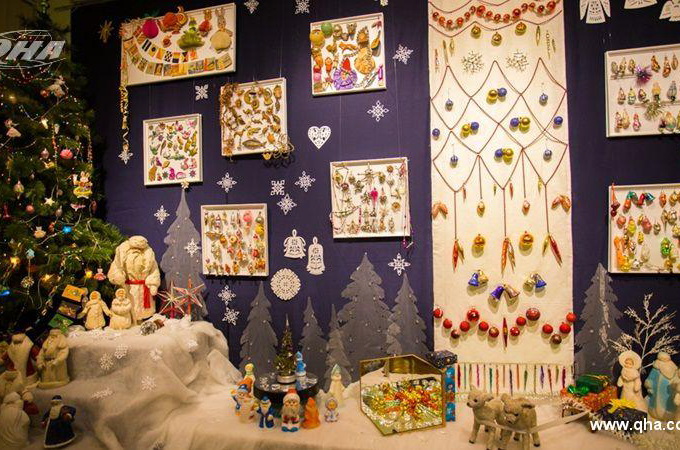
Nearly 600 Christmas tree decorations were exhibited at the event. This year the museum staff decoded to accentuate the history of the Christmas decoration, reflected in the name of the exhibition – “New Year Kaleidoscope”.
The present display is just a part of the décor collection, kept in the museum. All in all there are more than 3 thousand items available in the archives.
The oldest decoration on display is over 150 years, the youngest is over 30. Among the show-pieces there are rare Christmas decorations of the 19th century, “Dresden” ornament, Bohemian decoration, as well as self-made figures made of cardboard, paper, textile, for instance, pre-revolutionary lithographic masks of the clown and clowness, and a paper ballerina.
Besides, one can spot there articles being familiar since our childhood – balls, pines, father frosts, snow maidens, as well as “crystals” popular back in the USSR. A traditional New Year ball has always been popular with everybody. Artists used to convey all the developments in the society on such decorative balls.
“The history of “crystals” is quite interesting. There was a shortage of raw materials to produce holiday decorations, namely silvering, therefore, only one side of the ball was coated with silver out of economical considerations. The idea was thought not to be good enough, yet they came up with an unusual decoration that looks nice against colored lights. “Crystals” quickly gained popularity,” tells Julia Vygovskaya, a Methodist of the State Decoration Museum.
According to her, the Soviet power permitted citizens to set a New Year tree only in 1936, but decorations were not on sale then. Therefore, the tree was decorated first either with pre-revolutionary decorations or self-made ones. However, the production of decorations was soon launched, and at the beginning of the 40-s Kiev region citizens were completely supplied with holiday decorations, made at Kharkov and Odessa factories.
The transition from handicraft to mass-produced industry occurred in the 50-s of the XХ century. In the Soviet time nine factories used to make decorations in Ukraine.
Leading museum artist Ellen Orro speaks of the importance of preserving family archive decorations, passed from one generation to another.
“It forms a certain link between generations. Old items bear a particular semantic – historic or spiritual – load. It’s important that parents decorate Christmas trees together with their children. Here you can find a lot of decorations and ornaments made at master classes with children; the same things children can make again at home with their parents, which can be further on passed from one generation to another,” says Orro.
The museum personnel state the exhibition is targeted not only at kids. They also invite adults to attend the event, who can recall the time when they used to believe in Santa Claus and New Year miracles.
Read also
DESS finds Balta Eparchy of UOC affiliated with ROC
Yelensky-headed state service said it found signs of affiliation of the Balta Eparchy Administration of the UOC with the ROC.
Upper Lavra court hearing postponed
The next court hearing in the Upper Lavra case has been scheduled for November 3.
UOC priest blesses ambulances at Kamianske medical center
A UOC priest in Kamianske blessed ambulances for a medical facility and wished its doctors God's help in their work.
Dumenko to German ambassador: Law targeting UOC also applies to other groups
Epifaniy Dumenko sought to defend Ukraine’s law restricting religious organizations during a meeting with the German ambassador.
Activists bused to court hearings in UOC cases, media say
A minibus has been spotted transporting protesters to and from courthouses where UOC cases are being heard.
Firefighters save historic UOC church from fire in Zakarpattia
A fire broke out at a UOC church in the Tiachiv district, damaging the altar and church furnishings.