Copy of Leonardo da Vinci’s "Last Supper" found in Vologda Cathedral
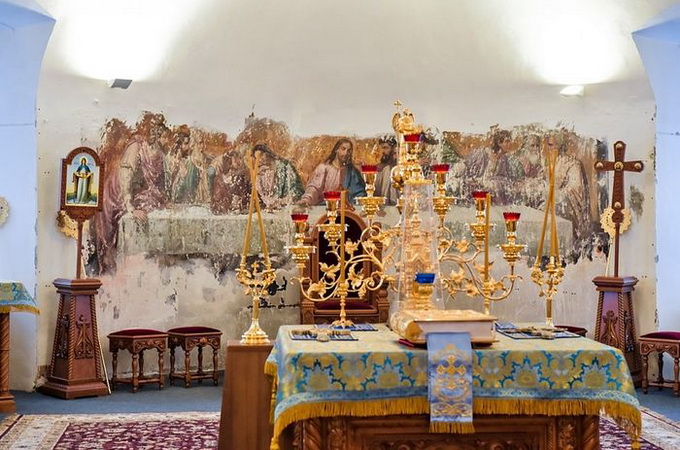
Certain variances from the original do catch the eye, for instance the different color of Judas robe.
The building served for many decades since the Soviet era as a regional art gallery, the mural being hidden behind wooden panels upon which paintings hung, being discovered only once the building was returned to the Vologda Diocese and restorations began. Experts are evaluating it as a true find.
“The artist managed to not simply mechanically repeat Leonardo’s composition, but to introduce his own color treatment. Indeed, this composition has its own attractiveness, color properties, and mastery of composition, which replicates the original. It’s not so easy to replicate—it requires a high level of mastery,” noted the chief researcher of the Pushkin Museum Viktoria Markova.
The practice of copying works, especially of the Renaissance, developed in Russia in the eighteenth century, when Russian artists were traveling to Italy and seeing these masterpieces firsthand. Presumably the mural was painted when the cathedral was restored in the nineteenth century and painted by Yaroslavl artist Alexander Kolchin.
Only one other Da Vinci copy is known in Russian churches—that in the altar apse in St. Petersburg’s Kazan Cathedral, dated to the early nineteenth century. “It is connected with the programme of the St. Petersburg Academy of Arts, which since the XVIII century has been teaching artists to turn to classical compositions," said Professor of Lomonosov Moscow State University Vladimir Sedov.
A comprehensive study of the mural is underway in the Resurrection Cathedral.
Read also
Khust Eparchy honors memory of St. Job of Uholka
A Liturgy is served in Mala Uholka, a birthplace of St. Job of Uholka, on the saint's feast day.
UOC parish in Cologne donates ultrasound machine to Kharkiv region hospital
In Cologne, UOC believers raised funds for an ultrasound machine for the Kehychivka district hospital in the Kharkiv region.
Shevchuk tells Pope Leo of Ukraine's preparations for "another harsh winter"
The head of the UGCC expressed "special gratitude" to the Pope for his phone calls with Putin and Zelensky.
Berlin hierarch comments on Phanar document published by UOJ-USA
Metropolitan Mark called the information about the 2018 "Unification Council" alarming if confirmed, and expressed hope that Patriarch Bartholomew will reconsider his position.
UOC marks Synaxis of All Saints of Volyn Land at Lutsk cathedral
Metropolitan Serhiy of Ternopil and Kremenets led the Liturgy on the feast day of the Lutsk cathedral of All Saints of the Volyn Land.
SBU detains OCU cleric who organized draft evader's escape for money
In Transcarpathia, law enforcement officers detained a clergyman of the OCU who arranged for a draft evader to be smuggled into Slovakia for $15,000.