Architectural “monsters” to be built near Kiev-Pechersk Lavra, – mass media
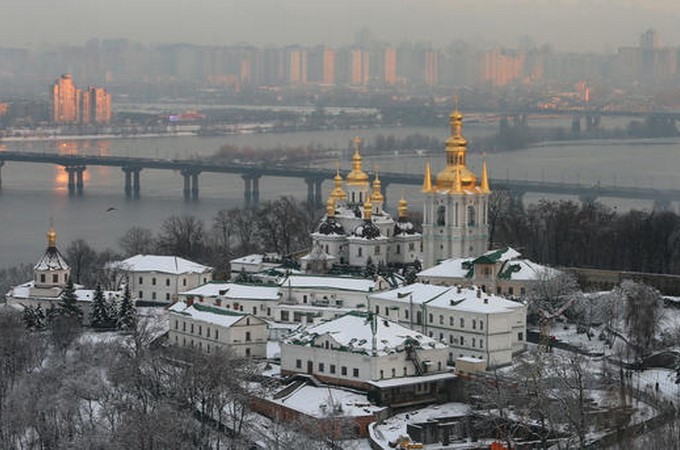
Citizens and experts are sure that by this act the authorities will unleash property developers who will continue raising their “monsters”, but this time next to the old sanctity.
According to archeologist Timur Bobrovsky, objects “Saint Sophia Cathedral” and adjacent monastery’s buildings, Kiev-Pechersk Lavra”, entered in the List of UNESCO World Heritage in 1990, while in 2008 two schemes were added to define borderlines of the buffer zone. In 2009 UNESCO recommended to extend this buffer zone, the recommendation having been followed two years later.
Last year the Ministry of Culture approved a buffer zone project only for the Kiev-Pechersk Lavra, having returned to the previous borders, established in 2008. So, the buffer zone borders of the 2011 year remain legitimate, but for some reason other borders are introduced,” explains Mr Bobrovsky. He adds that if, for instance, a property developer, referring to the order of the Ministry of Culture of 2016, builds a sky scraper next to the “monster” in Grushevskogo Street and is sued for this action, his lawyer will easily prove that the problem of two buffer zones is a concern of the Ministry of Culture, not his client’s.
The Ministry of Culture of Ukraine assured “Segodnia” today there is no issue of changing the buffer zone. “A protective (buffer) zone of the architectural ensemble of Kiev-Pechersk Lavra was approved in the foreseen manner. Herewith it fully corresponds to the buffer zone of Kiev-Pechersk Lavra, designed in 2009 and published on the UNESCO site.”
According to Marina Solovyova, head of the public company “Andreyev -Landscape Initiative”, talks around the curtailment of the buffer zone have been carried on for a long time now. “The point is the territory, where a former shoe factory is located (this square of 6 ha next to the Kiev-Pechersk Lavra is a part of the buffer zone). It was planned a long time ago to begin construction works on this site,” says Ms Solovyova.
Vice-President of Kiev National Union of Architects Organization Georgiy Dukhovichny also confirms that the buffer zone reduction issue has been spoken of many times. Regarding the premises of the shoe factory, they’ve intended to build it up for a long time. “This territory is the last outpost. Diagonally it’s within a stone throw from the Lavra,” clarifies Mr Dukhovichny.
Read also
Reports to SBU of weapons in UOC churches were always false, Novynskyi says
The protodeacon said that under Maliuk, inspections began to be accompanied by public accusations against the Church without evidence.
Culture Ministry pledges to speed up seizure of Kyiv-Pechersk Lavra from UOC
Culture Minister Tetiana Berezhna has pledged to personally attend a court hearing in the Kyiv-Pechersk Lavra case.
Kamianske Eparchy honors Dnipro Icon of the Mother of God for first time
A festive service was held at a cathedral in Kamianske, where the Dnipro Icon of the Mother of God was brought out for veneration by the faithful for the first time.
Kyiv conscription officers abduct UOC priest
TRC officers reportedly abducted Maksym Kostiuchenko, a cleric of a UOC church in the Ukrainian capital.
Court grants DESS lawsuit to dissolve UOC’s Rovenky Eparchy
The appeals court partially granted the DESS lawsuit seeking to dissolve the Rovenky Eparchy but rejected the request to seize its property, citing a gap in Ukrainian legislation.
Met. Meletiy consecrates house of worship for UOC community in Dankivtsi
Members of the persecuted UOC Intercession parish in Dankivtsi have converted a house into a place for communal prayer and worship services.