Military сareer, script and miracle: 10 facts about Sts Cyril and Methodius
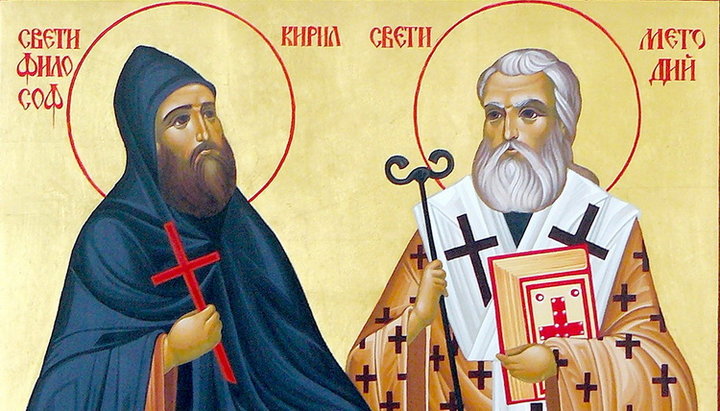
Saints Cyril and Methodius – Enlighteners of the Slavs
On this day, we commemorate an event that radically transformed the history and culture of the Slavs and granted them access to the divinely inspired treasure of humanity – the Holy Scriptures – through the invention of the Slavic alphabet by the two saintly brothers.
Although Kievan Rus' was already a relatively advanced state culturally and economically before the mission of Cyril and Methodius, historians and linguists still debate whether the Slavs had any form of writing prior to their work. It was thanks to these Equal-to-the-Apostles that Greek liturgical books were translated into Church Slavonic – a language based on the brothers’ native Slavic dialect spoken in Thessalonica (modern-day northern Greece, once considered part of southern Bulgaria).
Thanks to their efforts, Slavic peoples of various independent nations now share a common culture, history, and religion – something that likely would not have occurred if the development of the Slavic script had taken a different path.
Below are ten lesser-known facts about the Holy Brothers Cyril and Methodius:
- Before taking monastic vows, Saint Methodius had a military career lasting over 10 years. At age 20, he became governor of one of the Sclaviniae (Slavic regions), and by age 30, he unexpectedly chose to enter a monastery.
- Before becoming a monk, Saint Cyril worked as a librarian.
- After graduating with honors from the elite school at the Byzantine imperial court, Cyril was appointed librarian and scholar.
- Cyril and Methodius visited the territory of modern Ukraine. During their mission to the Khazars, they stayed in Chersonesus Taurica (present-day Crimea). While there, Cyril studied Hebrew and the Hebrew alphabet in preparation for debates with the Khazar khagan, whom he had been invited to convert.
- They are the patron saints of Moravia – a historical region in the Czech Republic. It was in Moravia that their Slavic script was first used, and Church Slavonic became the liturgical language. The Czech Republic celebrates their feast on July 5 – the only holiday that is both a religious and state holiday in the country. Christmas and Easter are not official state holidays in the Czech Republic.
- Cyril and Methodius did not invent the Cyrillic alphabet. It was actually created by their disciple, Saint Clement of Ohrid. Saint Cyril is believed to have created the earlier Glagolitic script. These two alphabets are the oldest known Slavic scripts, with Glagolitic predating Cyrillic.
- Throughout their missionary work, the brothers faced opposition from Church authorities over using the Slavic language in worship. Notably, Pope John VIII issued a ban on Slavic-language liturgy. Only Pope Adrian II supported them and approved the translation of liturgical books.
- One miracle attributed to them during their lifetime was the discovery of the relics of Saint Clement, Pope of Rome, in 861. In 868, the brothers brought his relics to Pope Adrian II. Today, the saint’s skull is kept in the Far Caves of the Kyiv-Pechersk Lavra, where it is said to emit myrrh.
- Saint Cyril died and was buried in Rome. Saint Methodius continued their mission and was buried in Great Moravia’s capital, Velehrad.
- Ironically, the largest number of spelling errors on a monument in the post-Soviet space is found on a statue of Saints Cyril and Methodius in Moscow. The Old Church Slavonic inscription on the pedestal reads: “To the Holy Equal-to-the-Apostles First Teachers of the Slavs, Methodius and Cyril. Grateful Russia.” Linguists have identified five spelling mistakes – including two in the word “Russia.”
Their work gave Slavic nations access to a shared Christian tradition in their native tongue, uniting them culturally and spiritually. This legacy continues to shape the identity and religious life of Slavic Orthodox and Byzantine Catholic communities across Europe and beyond.
Read also
How a wedding stopped a war
The young princess of Slutsk was married off to keep two powerful noble families from drowning the city in blood. Soon afterward, a Uniate metropolitan complained that Orthodoxy had been reborn in Slutsk.
Man before the forces of nature
A solitary figure on the shore seems insignificant before the immense power of the sea, yet it is he who stands before the Creator.
The mysteries of Golgotha in the light of archaeology
The veil of centuries obscures what really happened in the fourth century. Archaeology and ancient texts shed light on the true history of one of Christianity’s greatest sacred sites.
Zaporozhian Cossacks defend the persecuted faith
The story of how Cossacks drew their sabers to defend abused priests – while sometimes causing violent disturbances inside churches themselves.
A forgery at the foundation of Mohyla Academy
For centuries, historians have repeated an appealing story about a wealthy benefactor’s generous gift. Archival documents, however, paint a very different picture of what happened.
Theology of worn-out shoes
A painting of a pair of old shoes in a Dutch museum preserves the memory of an ordinary working person and a life of hard labor.