
Thomas’ dirty finger in the open wound of Christ
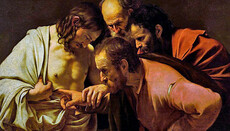
In Caravaggio’s painting, Christ Himself guides Thomas’ hand into His wound. He does not recoil from unbelief, but allows the apostle to touch the place of pain.
The first thing one notices on this canvas is one hand resting upon another. Christ’s left palm lies on Thomas’ wrist and seems deliberately to guide his finger into the gaping wound in His opened side. With His right hand, Christ Himself draws back the edge of His garment, making the wound more accessible. In other words, it is not Thomas who seizes upon Christ’s body – it is Christ Himself who admits His disciple to it. It is He who insists that the apostle’s unbelief should finally disappear.
Caravaggio painted this work around 1601–1602 for the collection of the Roman patron Vincenzo Giustiniani. And he did something almost no one before him had dared to do.
There are no halos here – only living people
In this painting, one will find none of the things with which sacred scenes are usually adorned. No golden crowns, no streams of heavenly light, no angels in the corners. The four heads of the figures are pressed close together in the darkness, and were it not for the wounds on the body of one of them, they could be mistaken for a group of tired elderly laborers.
Behind Thomas stand two other apostles, generally understood to be Peter and John; they crane their necks and peer into what is happening with no less tension than Thomas himself. Their faces are coarse and weather-beaten. One man’s forehead is cut by wrinkles so deep that they look like furrows in dry earth. Caravaggio painted the apostles from ordinary Roman commoners, and this is visible in every fold of their skin.
The faces of the figures are snatched out of near-total blackness. Light falls from somewhere on the left in a narrow strip, catching shoulders, foreheads, the outstretched hand – while everything else sinks into darkness. This technique is known as tenebrism.
The darkness on Caravaggio’s canvas behaves like a living thing: it presses in on the figures from every side, weighs upon them, and leaves them only a narrow island of visibility.
The light falls more strongly on Christ Himself than on the others – His figure seems to glow from within, and the shadow in which Thomas is held gradually recedes precisely where the apostle touches that light. In such darkness, it is easy to recognize the state of a man whose ground has been knocked out from under him and who has nothing left to hold on to.
The dirt beneath Thomas’ fingernail
The most outrageous detail for Caravaggio’s contemporaries is Thomas’ fingernail. It is dirty. The apostle thrusts into the wound of the risen God the very finger with which, a minute earlier, he might have been mending something or digging in the earth. The light catches even the edge of skin lifted by that finger. Before Caravaggio, artists had approached this subject more cautiously: Thomas would usually merely stretch his hand toward the wound, while the actual touch remained, as it were, offstage. Here the finger enters inside, and the viewer ceases to be an observer and becomes almost a physical participant in the scene.
1.jpeg)
Thomas’ dirty finger in the wound of Christ
Here lies the most important reason to keep looking at this canvas. God did not demand that Thomas first put himself in order. He did not say: wash yourself first, believe properly, and only then come near. He allowed precisely that hand to approach His wound – a hand with dirt, with doubt, with all of man’s unwashed brokenness.
We imagine that we must come to God already corrected. Caravaggio shows the opposite: man is received as he is in ordinary life, and Thomas’ dirty finger reaches straight into the heart of the Savior.
It is also worth noting what might not have appeared on the canvas at all. The Gospel does not state directly whether Thomas touched the wound; it says only that he cried out: “My Lord and my God!” Caravaggio added this touch himself. He decided that we needed to see the very moment when doubt, by touch, reaches truth.
Doubt is not betrayal, but the search for God
In church circles, doubt is often treated almost as treason against faith. “Just believe,” people say to someone whose life is breaking in two. But Thomas is not a cynic who enjoys denial. He refuses to believe on someone else’s word not because he wants to renounce Christ, but because he will not be able to go on living and preaching if Christ’s Resurrection turns out to be only a beautiful fiction. He does not need faith in general. He needs the living Christ; otherwise, everything else loses its meaning. This is a thirst for the real, sharpened to the utmost in a man shattered by grief.
And the answer he receives overturns our usual image of God.
We picture an invulnerable Lord speaking from on high. But here God opens His scars to His disciple and calmly allows him to touch the most painful place. The salvation of one terrified man proves more important to Him than His own inviolability.
Blessed Augustine spoke well of this painting – long before the canvas itself was ever made. Reflecting on why the apostle was so slow to believe, he said: “Darkness was still over the abyss – in the depth of the human heart, there was darkness.” And he placed on Christ’s lips simple words addressed to Thomas: “Come, touch, put in your finger, and do not be unbelieving, but believing.” It sounds like the invitation of a hospitable host. The very gesture Caravaggio would later paint in color: the hand of God guiding the hand of man.
When life falls apart, faith rarely remains neat and orderly. It comes limping toward God with torn sleeves, dirty hands, and painful questions. Where were You? Why did You not stop this? Caravaggio’s Christ does not demand explanations, repentance for doubting, or perfect belief. He simply opens His wound. And suddenly the greatest miracle is not that Thomas touches Christ, but that Christ allows Himself to be touched.