Volyn Eparchy rep: Scenarios for seizure of UOC temples is practised on us
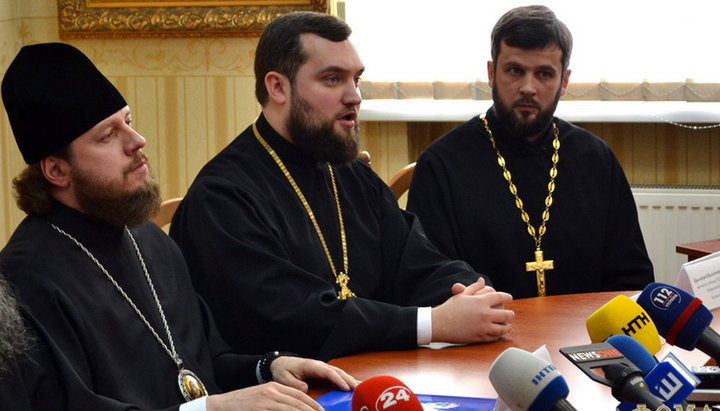
Press conference "UOC in March: Reaction of International Organizations, Lawsuits, Religious Conflicts in Regions – Figures and Facts"
Today Volyn region ranks first in practising scenarios for the seizure of UOC temples. This was said by the head of the press service of the Volyn Eparchy Archpriest Oleg Tochinsky during the press conference "UOC in March: Reaction of International Organizations, Lawsuits, Religious Conflicts in Regions – Figures and Facts".
“We, citizens of Ukraine, who have Ukrainian passports, who have rights similar to the rights of all other citizens of our state, feel our insecurity today,” emphasizes the priest.
He explains, “Unfortunately, in our region, the concept of freedom of religion is one-sided and is used positively only for those who today are needed to the current government and participate in all this lawlessness.”
“Moreover, representatives of the regional administration, local self-government bodies and law enforcement agencies prefer either not to respond to our appeals, or to respond but in a very interesting way,” said Father Oleg.
According to the cleric, if a UOC religious community held a meeting and confirmed loyalty to the canonical UOC, the regional administration nevertheless denies it the right to exist, sending a letter claiming that the meeting had passed in violation of the law.
“At the same time, meetings that were held by outsiders for the parishes, people far from the Church, in some local clubs or schools, are found legal by the regional authorities,” the representative of the Volyn eparchy continued.
The consequence of all this is the removal of the UOC religious community from the registration and the seizure of the temple.
The priest says that raiders, seizing churches, resort to illegal actions. “To get into the temple, they use chainsaws, grinders, crowbars, etc. They bring people who know how to break locks on the doors of our temples. And in most cases, all this happens in the presence of the police officers. We know incidents when the police even stood in a cordon, protecting those who pick locks, cut temple doors off their hinges as in the Zhidychin case,” says Fr. Oleg.
As Father Oleg noted, at the requests to react to the offences, the priests receive a response from the police: “Write a statement.” But the police do not always accept statements.
As the UOJ reported, on March 26, 2019, a press conference "UOC in March: Reaction of International Organizations, Lawsuits, Religious Conflicts in Regions – Figures and Facts" was held at the Holy Dormition Kiev-Pechersk Lavra, during which the head of the UOC Representative Office to European International Organizations, Bishop Victor of Baryshevka (Kotsaba) spoke how the authorities neglected the norms of international law. During a media briefing, an interactive map of the seizure of temples developed by the Legal Department of the canonical Church was presented.
Read also
Reports to SBU of weapons in UOC churches were always false, Novynskyi says
The protodeacon said that under Maliuk, inspections began to be accompanied by public accusations against the Church without evidence.
Culture Ministry pledges to speed up seizure of Kyiv-Pechersk Lavra from UOC
Culture Minister Tetiana Berezhna has pledged to personally attend a court hearing in the Kyiv-Pechersk Lavra case.
Kamianske Eparchy honors Dnipro Icon of the Mother of God for first time
A festive service was held at a cathedral in Kamianske, where the Dnipro Icon of the Mother of God was brought out for veneration by the faithful for the first time.
Kyiv conscription officers abduct UOC priest
TRC officers reportedly abducted Maksym Kostiuchenko, a cleric of a UOC church in the Ukrainian capital.
Court grants DESS lawsuit to dissolve UOC’s Rovenky Eparchy
The appeals court partially granted the DESS lawsuit seeking to dissolve the Rovenky Eparchy but rejected the request to seize its property, citing a gap in Ukrainian legislation.
Met. Meletiy consecrates house of worship for UOC community in Dankivtsi
Members of the persecuted UOC Intercession parish in Dankivtsi have converted a house into a place for communal prayer and worship services.