Filaret does not sign “synodal” decision on observance of OCU statute
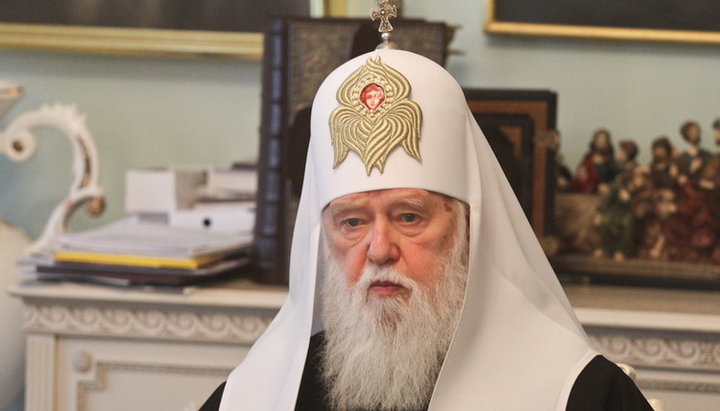
“Honorary Patriarch” of the OCU Filaret Denisenko. Photo: League. Dossier
On May 24, 2019, the “Holy Synod” of the OCU decided to entirely follow the statute its church structure, but “honorary patriarch” Filaret Denisenko did not put his signature under this decision, said Epiphany Dumenko, the head of the Orthodox Church of Ukraine, at a briefing on the outcome of the Synod meeting.
“What was promulgated by His Holiness Patriarch Filaret was testified by him at the meeting of the Holy Synod. ...> We had deliberations, we convinced him, but everyone saw that His Holiness Patriarch Filaret, unfortunately, agreed to disagree,” the TSN TV channel reported Epiphany’s words.
The head of the OCU also refuted Filaret’s earlier statements about the dependence of his church structure on Phanar. Asked by journalists about making the Holy Myron, he replied that such a paragraph only emphasizes the spiritual connection of the new religious organization with Phanar and is also available in other 5 Tomoses issued by Constantinople.
Epiphany did not deny that the statute also contains a paragraph on the resolution of all internal conflicts of the OCU by Constantinople and stressed that it cannot be rejected.
“If we discard this provision, we will deny ourselves. ...> We must then reject the decisions that were made in Constantinople on October 11 (2018 – Ed.),” the head of the new church structure said.
According to him, Filaret will not be punished for his rhetoric, whereas rumors of attempts at the last meeting of the “Synod” to put the “honorary patriarch” on the retired list are not true.
“I defended his position. I defended that he should continue to lead the eparchies as part of the Kiev Eparchy, i.e, as part of the city of Kiev. Thus, we have done and we will do everything to ensure that His Holiness Patriarch Filaret, who has put a lot of effort into the development of our Local Ukrainian Orthodox Church, feels not only spiritually comfortable but also financially comfortable,” said Epiphany.
Recall that the “honorary patriarch” even before the meeting of the “Synod” stated that he did not intend to fulfill the conditions of the Tomos. He noted that paragraphs on myrrh, the expropriation of parishes abroad by Phanar and the solution by Constantinople of internal conflicts of the OCU deprive the new church structure of the right of the autocephalous church. According to Filaret, he does not reject the Tomos but will not fulfill the conditions laid out in the letter. “None of the autocephalous Churches that has ever received the Tomos on autocephaly from the Patriarchate of Constantinople has such provisions,” concluded the “honorary patriarch” of the newly created religious organization.
Read also
Pilgrim group from Kyiv Theological Seminary visits Mount Athos
KTS students are making a pilgrimage to the holy sites of Romania, Greece, Mount Athos and Italy.
UOC cathedral celebrates its patronal feast in Ternopil
The service in the cathedral of the Holy Martyrs Faith, Hope, Love and their mother Sophia was led by Metropolitan Serhii of Ternopil, concelebrated by four hierarchs.
MinCulture marks centenary of Soviet-era reserve at Lavra's Refectory Church
Representatives of the Ministry of Culture presented awards to the Reserve's employees on the occasion of the anniversary at the Refectory Church of the Lavra.
Conference to mark 1700th anniversary of Christianity adoption held in Georgia
In Georgia, representatives of the Church and the state noted the defining role of Christianity in the country's cultural development.
MP urges to ease pressure on UOC for sake of peace
Oleksii Honcharenko proposed compromises on language, historical memory, and Church issues as part of efforts to achieve peace, saying those who wish to attend the “Russian Church” should be allowed to do so.
Court takes 17th-century church in Staryi Pochaiv from UOC community
A commercial court overturned a 2018 registrar’s decision and stripped the UOC’s Ternopil Eparchy of ownership of the 17th-century church.